Bodhi 心 is a recovering vagabond in training to become a Zen Buddhist monk, a long-time student of psychology and an avid improver of the human condition from the inside out, alive in the marketplace, recovering from codependency and substance abuse, formerly a mental-health peer-support worker and currently a full-time healee using meditation, dharma and neuroscience and counselling to recover nervous-system balance after 40+ years of trauma.
Also reading • writing • psychospiritual • health • adventure • alternative living • (motor)cycle maintenance • esoterica • miscellany • literature
https://linktr.ee/bodhikokoro
yuggera and turrbal country
In my living experience of recovery from complex trauma, I being … lol, a relevant typo there … I begin to feel enlivened and enthusiastic again about the things and activities I have been passionate about all my life, but which I learnt to hide from a world/culture that considers them foolish or idealistic, such as reading, studying, applying and writing about the New Psychology, meaning books like Transcend and the Tao De Ching.
This work has always been my purpose, and I have known this on some level since I was a child. The culture I was raised in did not value this at all, so I harboured these passions in secret except from a few trusted friends. Otherwise it was repressed, hidden from the world, and the psychological force required to maintain this secrecy and to project a false-image was profoundly injurious, but also created a kind of counter-pressure, such that when my authenticity comes punching through again I experience it as almost overwhelming. (The Incubus song “New Skin” comes to mind.)
(Curiously, the first stanza, not the one about fallacious cognitions that has always been a kind of mantra for me.)
And I experience shame when I “indulge” this passion to wake-and-write, when I spend hours at a time writing page after page of longhand that over the years has become boxes and boxes of journals and scraps of notes that are now gathered around me like … not like … as a cache of half-written books.
The experience of wanting to bound out of bed and resume this life’s work is characterised by a burgeoning of authenticity that makes me happy. It may be a relative happiness compared to the genuine happiness of sukkha, but I’ll take it, because the energy of this motivates me to do the training of letting that relative happiness go so I can continue moving toward the deep contentment I know is my and everyone’s birthright.
I’ve been getting about 5 hours of sleep a night because I often wake up bursting with enthusiasm to be awake answering my calling, and weirdly I feel a mild shame around this as well, that I am not getting the amount of sleep that the “establishment” dictates is what an adult needs. (Jonah Takalua comes to mind.)
That shame says, If I am not getting the sleep an adult needs, then I must be an immature adolescent, like reading by torchlight under the quilt until stupid o’clock in the morning is some kind of heinous sin.
I understand that shame is an egoic attachment to one’s sense of inferiority, and I am grateful to be letting go of this as well.
I don’t actually read until stupid o’clock in the morning anymore, because I have sleep-hygiene skills I have taught myself on the journey of re-parenting, but I do often wake up before my alarm feeling energised and ready to seize the day (Dead Poets Society comes to mind), which is a feeling that has been far-too-infrequent in my adult life because our culture is not conducive to this kind of bounding-puppy enthusiasm.
Well, I plan to … not plan to … I am changing the culture of my own life, one morning leap out of bed at a time.
With my room in a flu(mmo)x of books, towers of dishevelled documents, magazines, unhung decorations and an underwear drawer down to its last pair of trunks … I would have said previously that things are in disarray, but now I see that things are in a formative state ~ and that things, all things always, are in a formative state, as in always forming and reforming, never settling into one state or another, and as I type this I feel the relief that comes with beginning to know this at a deeper and deeper experiential level.1
I am still settling in at home, and I feel I have the time to be patient because there is a relatively secure future here. (I say “relative” because who knows what might happen.) Also I trust myself and the universe and I feel the universe trusts me because it senses that I am sensing that I am it.
I am of the universe in the same way a wave is of the ocean, not separate.
I deepen into becoming an instrument of this divine oceanic reality, and I am equipped to accommodate anything that happens, whether I like what happens or not.
I realised recently that I am not the boss of reality and I have been saying this jokingly to friends, but I mean it. [5.55]
Reality is the boss, and there is very little I can do to influence the untold number of events that unfold on its watch. But I watch what I can, and what I can influence is how I respond to events. By training myself to respond constructively to everything I observe, I form new mental, emotional and behavioural habits that are more and more wholesome every day.
In habits I trust.
I am piecing together some ideas that interest me very much about the (w)holistic importance of being responsible for my (and only my) mental, emotional and behavioural habits.
These ideas are grounded in the #dharma, sustained by near-constant mindfulness and #meditation in all action, and increasingly backed by #neuroscience, which makes me feel all boisterous and joyful because these ideas (when and only when applied) lead inexorably to the experience of something called sukkha (in Buddhism, and probably many other things in the world’s many spiritual traditions), which means “genuine happiness”.
Not fleeting happiness, not pleasure conflated with happiness.
Genuine, abiding contentment with all that is, without the overlay of judgement saying, “This is good, now I am happy,” or “This is bad, now I am unhappy.”
These (w)holistic ideas about personal responsibility have profound implications for collective wellbeing and long-term sustainability (a healthy world arises out of healthy minds) but their application does start with the individual. If the individual is lucky (as I am) to meet with what we all deserve, they will have the support of a community that understands these implications at least on some level,
and this collective support is what turns individual awareness and responsibility into a bonafide superpower. #sangha
These ideas have some very cool names … Indra’s Net (thanks Marc) … the morphogenetic field or morphic resonance (thanks Rupert Not Murdoch) … the holographic universe (thanks Einstein, Michael Talbot, et. al.), the #dharma … and are exemplified by the saying, “A rising tide lifts all boats” (thanks Pierce ~ may we discover together that JFK did indeed lift this from the Bible, and that maybe the Flood is actually a metaphor about a time in Biblical history when a flood of awakening wiped out swathes of ignorance in the psyche of humankind, because we know … or at least, strongly suspect … these episodes of collective awakening come in waves through history and can never really be talked about directly, so: metaphor to the rescue).
I don’t have the time or the desire to elaborate further on these ideas at the moment, because I have a group meditation to attend in 9 … 8 minutes. For now it will be enough to share the Serenity Prayer.
May I ask you to leave your notes below ~ as always, my intention for sharing these thoughts is to stimulate dialogue. If public dialogue is not your jam, get in touch directly here. If commenting on WordPress is a laborious chore because you don’t already have an account, please share this post with your comments on the socials, because it’s a dialogue we sorely need to help us transition from the doldrums of modern civilisation into whatever form is next.
I say “flu(mmo)x” because the confusion comes from within me (who is flux), not from within the state of my room, which is also in flux, but not necessarily confusing. ↩︎
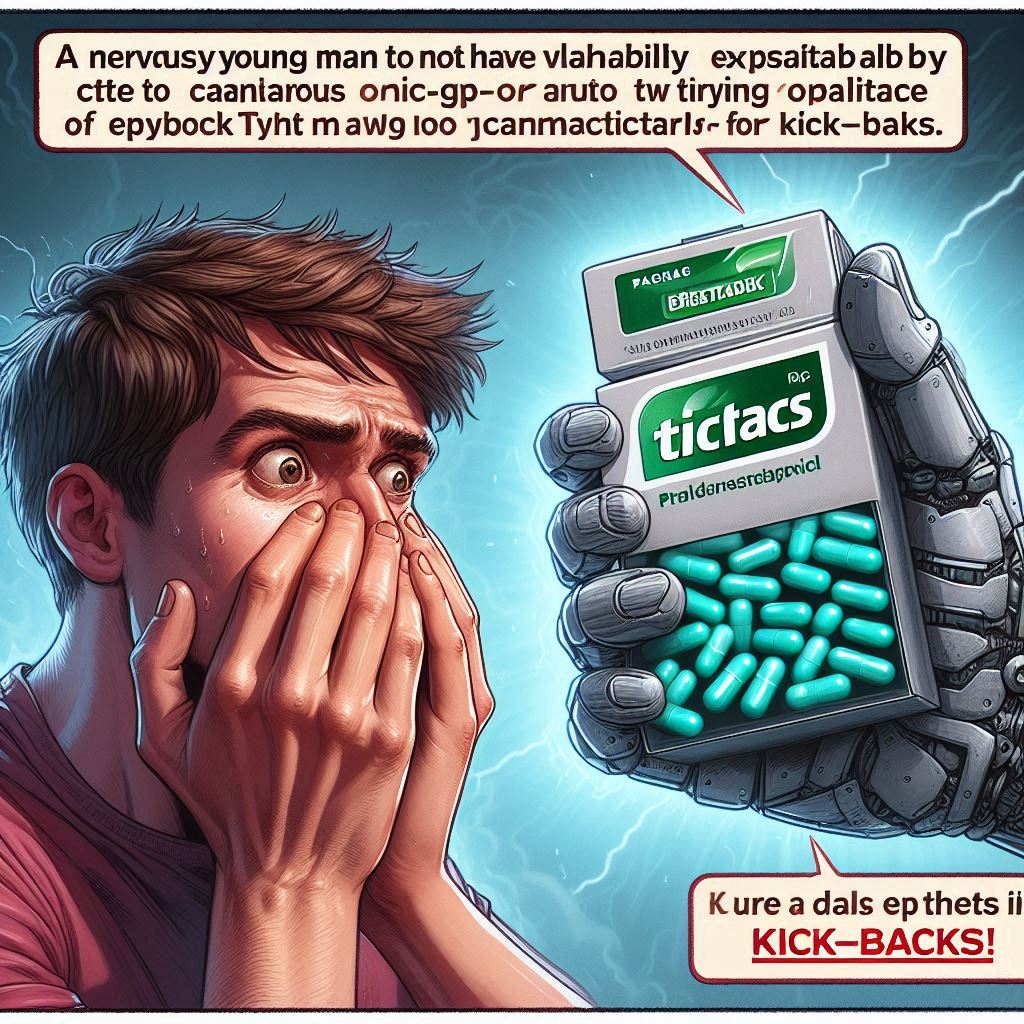
I am submitting a complaint to the Office of the Health Ombudsman today, after a shonky GP tried to swindle me into what I am calling “tic-tacs for kick-backs”, meaning anti-depressants I don’t want or need.
I have been meaning to do this for a while, but have had so much other shit going on lately (mostly good shit), but after a second sleepless night filled with pre-occupations about said shit, I decided while making coffee that this is what I would spend my pre-meditation time doing, because:
maybe it will leaven the burden of carrying this complaint-intention around and begin to lift the resentment I feel every time I remember that this situation happened
as a bystander and citizen, I feel a duty to report this knuckle-head so that other vulnerable people might not become his prey in future
after doing this I might be able to start working on letting-go of some of the shit language I use to think about and describe this fellow, who I understand is just trying to find happiness, albeit in the “wrong objects”, namely, financial wealth ~ and then sometime later I might be able to start opening myself to more-generous assumptions through the diligent application of forgiveness
I was going to link here to my Google Review of this GP, but for now I think it’s prudent to not point so blatantly at his privacy (does he get the benefit of privacy if he is running a public private practice?), lest I pull an avalanche of defamation bullshit onto my own head.
I am so legally naive that I don’t even know the differences between things like defamation and slander. My intention here is not to unnecessarily injure this GPs reputation, but to make people aware that they might want to exercise caution if approaching this GP. I formerly identified as something of a citizen journalist, and this activity and post is I guess a hangover from those days.
I am not going to post here my cautionary-tale Google Review, but I am going to post my (de-identified) complaint to the ombudsman, because I’m curious to know what others think of the reasoning I’m doing here.
I am 99% convinced that this bloke has a whole-arse method that he rolls out whenever he sees a vulnerable person walk into his clinic, and yet I am clinging desperately to the idea of holding my convictions tentatively because:
I like what Bertrand Russell said about not being opinionated
The essence of the liberal outlook lies not in what opinions are held, but in how they are held: instead of being held dogmatically, they are held tentatively, and with a consciousness that new evidence may at any moment lead to their abandonment.
I am new to the Logan/Springwood area, and needing a new regular GP, I went to Dr Doo-not-much for sleep support, expecting a melatonin prescription perhaps.
He tried to prescribe me anti-depressants, without answering my questions about what the prescription actually was (I had to ask a nearby pharmacist to explain what he had prescribed me).
I also asked to start a Mental Health Care Plan (which I maintain with all my GPs as a preventative measure) and he tried to tell me that a MHCP was pointless because I would just get “talk therapy” and what I really needed was a diagnosis.
This is untrue ~ my last MHCP therapist is a Somatic Experiencing practitioner, but Dr Doo-not-much wouldn’t listen to my experience of finding my own Medicare registered therapists.
He referred me to a nearby psychiatrist, and explained to me that he has a “deal” with them to get cheap diagnoses.
The biggest red flag though: on my second and final appointment, Dr Doo-not-much knocked a whole stack of inbox trays off his desk and proceeded to blame everything except his own elbow for the stack falling.
This guy is super dodgy, and really shouldn’t be practising. If he cannot accept accountability for knocking something off his desk, how can I trust him to be responsible for the known side-effects of the powerful pharmaceuticals he tried to swindle me into taking!?
He told me to take those anti-depressants (without telling me that’s what they were) for a couple of weeks until my sleep stabilised!
If I hadn’t had the wherewithal to enquire with the pharmacist or the confidence to self-advocate, I would have been sucked into this guy’s ruse to get me hooked on anti-depressants for kickbacks, and would have had to taper.
I have been managing depression symptoms for 20+ years with lifestyle changes and have never needed pharmaceutical medication.
I know my health history, and I know my needs.
This guy was so frenetic and conceited that he wouldn’t listen to me when I tried to tell him I know my own history of recovery from mental illness.
He has also not released my results from tests performed for a foot injury after nearly 3 weeks of waiting after another GP requested them.
I am genuinely concerned that this guy is harming patients by prescribing them anti-depressants without proper education: if he prescribed them to me within 2 visits, without conducting so much as a mental-health questionnaire, then who else is he prescribing them to!
On the complaint form the Office of the Health Ombudsman ask “What do you want to happen?”, so I said:
I would like Dr Doo-not-much to be investigated to see what he means by having a “deal” with a local psychiatrist, because if this man is funneling people through a dodgy psychiatrist to get them diagnosed and prescribed unnecessary pharmaceuticals for profit, then this is serious malpractice and he could be causing a lot of short- and long-term harm for his own financial gain.
And I am attaching a second PDF with the formal complaint form, documenting reflections that occurred to me after completing that form:
I went to Dr Doo-not-much for both sleep support and to start investigating why my foot injury was still giving me trouble after getting stitches for a laceration resulting from stepping on a sharp rock.
When I told him the symptoms (pain and swelling, some months after the stitches were removed) he tried to prescribe me anti-biotics before even beginning to print the referral for blood tests that I had asked for, to see if there was an infection.
I informed Dr Doo-not-much that I was reluctant to take anti-biotics unless absolutely necessary. When he asked me why, I informed him that I didn’t want to mess with my gut bacteria unnecessarily.
Dr Doo-not-much brushed this off, and told me that anti-biotics were a good preventative measure against infection.
A preventative measure against infection forming inside a wound that had already healed on the outside?
This just didn’t make sense to me, and after completing the accompanying PDF I began to suspect that this might be part of Dr Doo-not-much’s nefarious method: prescribe anti-biotics to ruin a patient’s gut bacteria, making them susceptible to depression, and attempting to render them dependent on powerful mind-altering pharmaceuticals by simultaneously prescribing them anti-depressants.
I am trying (not very hard) to avoid emotive language here, but the truth is I felt and still feel that my trust was profoundly violated by this doctor, and I am genuinely concerned that he is rolling out this method on the daily to people who are less able to self-advocate than I am.
I have been similarly coerced in psychiatric wards and it’s just really not cricket ~ this kind of practice is profoundly unethical and harmful, and I hope that this complaint will be investigated thoroughly by an objective party who is not so thoroughly embroiled emotionally in whatever is going down at this GP clinic.
I am genuinely open to suggestions that I am just being paranoid here, but I am equally open to hearing whether others observing this post would draw the same conclusions from the behaviours I observed.
I know that “tic-tacs for kick-backs” is a thing, but I always held the belief that something like this would never happen to me.
Let me know in the comments below, or contact me directly through this website or the socials.
Much appreciated if you got this far through the post!
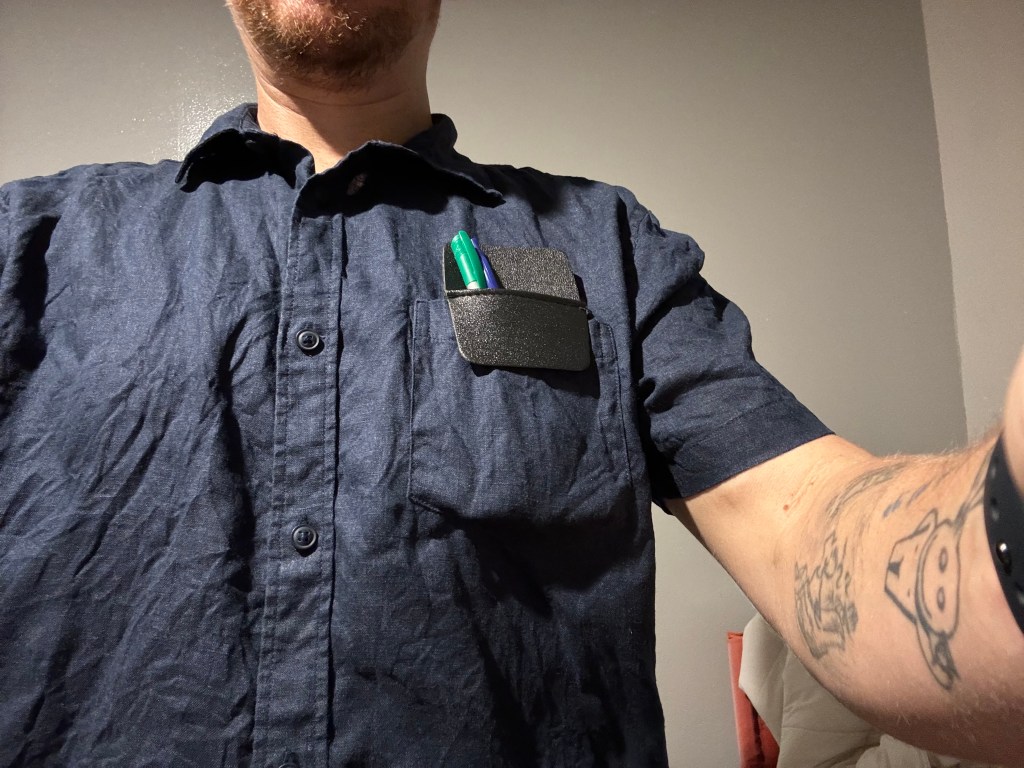
My pocket protector arrived in the mail today, much earlier than expected. I am happy about this for a slew of half-coherent reasons.
It’s Father’s Day, which I know only because my son reminded me, despite the fact I have been working hard on reparenting myself lately ~ so this is a nice and unexpected Father’s Day gift for myself. #
I am a middle-aged man now, and have been a father for sometime, which gives me “permission” to be as daggy as I like. #
It reminds me of a time when a dear and long-term but currently distant friend playfully teased me about the pocket protector I had fashioned out of cardboard, maybe 15 years ago when I was still in my 20s.
One of my pens had burst in the salvaged army-reserve jacket I wore at the time, and this friend, known to me alone as Knobelisque the Great, commended me for being the bogan-cum-mega-nerd I was back then, with my hobo-chic jacket and my cardboard pocket protector.
That was a time when I was earnestly and successfully applying myself to an unexpected publishing career, and some 5 or so years after my first real girlfriend told me, “Because you are a writer, you need to carry a notepad around ~ all writers do that.”
So I started doing that, and I have started doing that again, as well as now embracing the inner mega-nerd that has always just wanted to confidently wear a pocket protector.
Both of these friends are distant now, but I know they would be proud of me for saying, “Fuck it I’m wearing a pocket protector!” #
It fits perfectly in the new linen shirt I bought for myself recently, alongside the above-mentioned spiral notebook, which I am extra-celebrating since I re-read in Zen and the Art of Motorcycle Maintenance, that Robert Pirsig also carried a notepad in his shirt pocket.
I have never really identified as having heroes, but if I did I would say Pirsig is one of them, and I am not ashamed to say that I endeavour to emulate the attitudes he articulated in that singular novel.
Also, he depicts himself as 40 in that story, and I am also currently 40. Every other time I’ve read that book I was, obviously, younger than 40, and each of those times I assumed that Pirsig was maybe 60 and that Phaedrus was maybe 40.
This has been a tendency of mine ~ to always assume that wise folk are more adult than I am.
Reading that Pirsig was 40 at the time of that motorcycle journey with his son has reminded me that wisdom is not a factor of biological age, and on that note I am going to link here to an essay I wrote about the problems associated with typecasting young writers as insufficiently experienced to write about improving the human condition.
I was around 25 when I wrote and published this essay, and may or may not have been wearing a pocket protector, I don’t know.
I do know, thanks to recent personal research, that the reason I can’t remember these details has something to do with trauma-induced dissociative amnesia, which I have previously referred to by saying that “there is a blackhole where the recollection of my history should be”. #
I bought this linen shirt, and a pair of linen trousers, because I have recently moved to a Zen monastery in Brisbane, and am in training to become a monastic. This pocket protector complements that whole-arse lifestyle move in a way that I find incredibly punny:
in some traditions of Buddhism, primarily Tibetan, I believe, there is the practice of seeking refuge from fear in what are called “Dharma Protectors”. My practice being primarily informed by Zen, and with my otherwise-secular background, I don’t really go in for relying on entities that may or may not exist outside myself in some dimension of reality that requires special training or mantras or mandalas to access.
Each to their own.
And with Australian larrikinism deeply embedded in my bones and blood, I consider it funny that I would rather seek protection from a … what smells like faux-leather pocket protector … than from, as Carl Jung apparently said, “Imagining figures of light.”
That said, I do very much believe in and value the power of the imagination to heal both psychological and physical injury, but my current understanding is that the power of imagination stops there, at the personal and therapeutic level.
Imagination may also facilitate transcendence of the personal and support the stabilisation of transpersonal awareness, I don’t know.
What I do know is that my pocket protector will save my shirt from getting soiled by ink. #
bit of an update for anyone who’s curious because they know things have been a bit misshapen for me recently
I held something very heavy for a visitor at work the other day, and it was only later when I was writing the case note at home (we had gone overtime on that shift before I realised I had completely spaced on writing the note at work) that I realised how heavy it had been, but also I realised that maybe it hadn’t seemed heavy at the time because, I realised, I must have a natural ability to hold this space for others without much in the way of formal training.
I’ve said ‘realised’ a lot because that night after work was rich with insight.
I realised I am naturally good at this work, and that was pleasing to say the least ~ to know that I have a natural talent for helping people and for supporting them in distress just lights up my heart. Which leads to and supports the next thing 👇🏻
I had been reflecting that night after work, on a new opportunity I am exploring to live, volunteer and potentially ordain as a Zen monk at a Buddhist meditation centre in Springwood in the next few months years, and remembering that I have this vision to become a Buddhist Psychotherapist, coach, dharma teacher and author of new psychology. This has been a vision for a few years now, but I lose sight of it now and then, when life is especially stressful and demanding that my attention go more toward spot fires and admin than to long-term plans of the future and potential.
Which brings me to the other point of reflection that night – one I haven’t shared on the socials yet – which is that Nikki and I are separating. I haven’t been able to sense hope or even have sight of a future in the last two months because I have been couch-surfing and house-sitting through the separation. I have also not been able to maintain the practices and routines that keep my present in shape for the future I desire and deserve, one of genuine happiness in service to humanity and the planet. That’s why I say in the precise that things have been a bit misshapen lately. However, house-sitting for a month at my mum’s place, I have had the time and space to reflect and get back in touch with what feels like my sacred purpose here on this beautiful planet.
The curious mixture of emotions resulting from these reflections was a cocktail of high elation and deep sadness ( … interesting that these should be so dichotomised … 🤔 ) which reminded me that sometimes I have trouble regulating joy. The tinge of regret among the sadness and the hurt of recalling the moment when the separation was initiated … these were nuances that made this rich experience all the more stimulating.
I was going to draft this post then, but needed to be up for something in the morning and am proud of myself for being able to regulate enough to rest because I am understanding more and more these days that the realisation of the above-mentioned vision depends, of course, on my own wellbeing and self-care.
I say ‘of course’ because of course it’s obvious once you’ve realised this, but it’s only recently that I’ve begun to understand this, which seems weird now that I know it 🤔 😂 I wanted to post about that here soon, but the gist of it is the recent insight for me that my recovery of wellness from dependence on substances and other addictions depends on building a wholesome and self-compassionate lifestyle that naturally erodes that dependence and becomes the foundation for genuine wellbeing.
I always thought I needed to drop my addictions at once and then I would be able to build a wholesome lifestyle, but my whole approach around this has shifted. I now see that a lifestyle characterised by wholesome roundedness includes and naturally leads to the sort of healthy coping skills we need to manage stress without dependence on substances and behaviours that trigger substances in the brain.
This approach inspires a lot of hope in me, because it feels like the right way to go about this – compared to my former approach of dropping all my dependencies at once to ‘go clean’, hoping that I will magically develop the coping and stress-management skills I need to be okay with life’s demands without the support of drugs and maladaptive behaviours, like the ol’ coffee to wake up and weed to get sleep routine or the need to be drunk at a party to socialise. Which hasn’t actually been a problem for me since my early 30s.
None of my dependencies have been a real problem for a while, actually. I’ve been saying and feeling like I’ve been in genuine recovery for a few years now, including the periods of setback that even now I can see (while I’m in them) are just a part of the journey. This confidence comes from having gradually improved my lifestyle to support not just sobriety but a thriving growth and an ever-deepening connection to my spiritual (or true) self.
That improvement has been greatly supported by Nikki over the years, and part of the sadness I feel about our separation is that we won’t be supporting each other as closely in that as before. I am also happy and grateful though, that we are still supporting each other during this time of transition, because it means the love was real even if we are no longer compatible for the romantic and intimate closeness we had for the last seven years or so.
Like I said, the emotions around this are mixed because that sadness co-exists with joy from knowing I am getting myself into a position where I can deepen my connection with and understanding of these Buddhist practices and ideas and become better able to support others in the journey from distress and suffering to ease and genuine happiness, thereby helping to bring about a more-harmonious and sustainable world for all. Note the subtitle of this blog: a health world arises out of healthy minds. I deeply believe this and can even say I know it on an intuitive level, and not just because Buddha said “mind is the forerunner of all states”.
Of course there is a unity between body and mind, and I have been feeling enthusiastic lately about learning primal and animal movement as part of my holistic health regime, but that’s for another post and another time.
I have spoken to my current Zen teacher Arno about this plan to ordain, and he supports it. If the plan comes through, I will be taking ordination with a different teacher – the abbot at Bodhi Chan Meditation Centre where Pathway Zen sit for our sesshins twice a year, in Springwood. The Sanbo Zen lineage I have been sitting with does not have a monastic tradition or pathway, believing the valid point that awakening must be pursued in the “marketplace” as a “householder”, compared to a monastic, who has taken “the path of homelessness”.
I value this idea alongside such ideas from Zen that “a day without work is a day without food”, inspiring the work-practice of samu. I am under no illusion that ordaining in the West will necessarily mean I don’t work at all and depend entirely on the lay community for my sustenance and accommodation. I do not expect this kind of support, though it may be the case that such lay–monastic community relationships exist even in humble Brisvedas. I expect that I will continue working part-time in the mental-health space, and of course I will always have general life affairs to manage.
I am not going away to the Himalayas to sit in a cave facing the wall for nine years. I will very much still be living in the “marketplace”, the only difference being that I will have taken some vows, be observing a set of monastic precepts, and training as a monk among those “worldly” obligations.
All that said, there is a possibility I will not be able or expected to work (in some traditions the monks are not even allowed to handle money).
I met Arno for coffee the other day after one of his talks at QUT, and got onto the question of whether I will be able to work if I ordain. I said I thought I could because I knew a Zen monk down south who worked part-time in disability support. Arno said no, if you ordain you will be dedicating yourself solely to the task of liberation.
And I find it interesting that I don’t baulk when I hear this ~ it doesn’t seem like some outlandish thing, to think I could do that. On the contrary, when I hear this I hear a call to ordain that I have been hearing for 10+ years and think it’s time to answer the phone!
Every individual has the potential to realise enlightenment in this lifetime (in this very moment!) and I am dedicating myself to realising that potential because I genuinely believe it’s the best way I can empower myself to genuinely help others and contribute to the wise, compassionate, sustainable and harmonious future we deserve.
So yeah, that’s a lot, and my first real post on the socials for a while. There’s been a lot to deal with lately that has kept me focused on IRL stuff, but I’m hoping that during the house sit and into the future I’ll have more time and consistency to write and share more.
Buddhism is the ultimate activism, and I’m not talking about the social justice movement Engaged Buddhism.
The argument is that materialism stems from not just greed, but also from seeking to soothe our suffering through consumption, through looking without ourselves for that thing that will ease our suffering, a thing that doesn’t exist outside ourself.
So while the Buddhist methodology teaches how to undermine greed in the world by treating our own desire, it also undermines our tendency to avoid pain by narcotising ourselves with whatnot.
When we are not treating our pain through consumption, we reduce demand in the capitalist system.
It might not seem like much because who is one person, what impact can their reduced consumption really have?
But we need to remember that we can’t directly influence anyone else’s mind, only our own. There is no person, no institution, government agency or corporation we can influence to change ~ applying pressure through direct action is admirable, but ultimately a pony show compared to the work of undermining the system from within, because we are the system.
Change ourselves, change the system.
And remember this quote from the Dalai Lama:
If you think you’re too small to make a difference, try sleeping with a mosquito!
“Top Down and Bottom Up Processing: How Our Mind Creates Our Sense of Self and the World and How to Restart the Process” by Josh Korda, Dharmapunx teacher and Buddhist chaplain
we (unconsciously) attract and are attracted to romantic partners because their loving style is similar to what we learned to expect in our upbringing ~ mindfulness of the body interrupts that unhealthy cycle … if we want to become conscious, we have to go through the body.
In this podcast, Josh describes the psychological mechanism that causes us to choose partners who replicate the loving style of our caregivers, regardless of course, whether that loving style was healthy or not.
I have wondered for soooooo many years, why do we attract and feel attracted to partners who are just like our parents? This is a whole phenomenon in the psychology world. Some say we are able to heal our attachment traumas in and through these relationships we attract because of this patterning mechanism that Korda describes. But we all know of someone who continues attracting an abusive partner and we’re all standing around watching this train wreck happening yet the person can’t see it coming. That person might be ourself.
Frustrating doesn’t really cut it, to say how it feels to be in or witnessing these cycles.
I was halfway through this episode and couldn’t finish the rest at the time, and was eagerly anticipating the second half because this question of how to restart the process has been on my radar for yonks.
I thought there might be some specialised trick, a hack from the convergence of neuroscience and ancient Buddhism, and it is a hack from that convergence, but it’s just the application of mindfulness ~ in particular, mindfulness of the body.
Mindfulness of the body is the first of the Four Foundations of Mindfulness, followed by mindfulness of feelings, mind and phenomena … mindfulness of kāyā, vedanā, cittā and dhammas.
The body is where bottom-up processing occurs.
Top-down processing is not embodied, and is encoded with our cache of stored memories from the past ~ when we are in top-down we are filtering stimuli through the lens of our past.
When we are embodied we are filtering stimuli only through the present.
Buddha described a causal chain: feelings and impulses (bottom-up) precede thoughts (top-down) in our experience, so we think we are making conscious decisions but our thoughts are actually just following our feelings. This causal chain has been validated by modern neuroscience. (I think this is correct, but I’ve confused myself in writing it, because Buddha also said, “Mind is the forerunner of all states.”) Korda relates the image of the monkey (mind) that thinks it is steering the elephant.
By cultivating awareness of the body, we get ahead of that causal chain and are able to see reality as it is, in the present, without interpreting stimuli through the filter of our conceptual database from the past.
In top-down we unconsciously find ourselves attracted to loving styles that were modelled in our upbringing (even if they were unhealthy) and by cultivating bottom-up processing through mindfulness of the body and feelings, we can let go of the trauma and escape this cycle of continuing to attract partners who trigger our old abandonment and attachment wounds.
If we want to become conscious, we have to go through the body.
It’s not magic, but this insight and its application is key to the work I am doing on myself and imparting to others through posts like this.
Have a listen, apply the practice, let me know what you think.
I am adrift again after 7-odd years, remembering Robert Pirsig’s idea of drifting ~ I have choices in this river of change and I choose to go with the flow as I bump from shore to shore. I choose to go full-vagrant, wandering-sannyasin style … neither grasping for comfort nor shunning despair and fear. There’s a freedom in that, I trust. I’ve got this. I was a part-time-reluctant vagrant for 10 years in my 20s and 30s. I gained a lot of skills in those years and I am resourcing from those now. I choose to accept because resisting change is a guaranteed way to suffer and I choose non-suffering. Aho
~
I am staying with a friend on the southside of Brisbane, a new place for me, and stepping onto the path of homelessness again. I am hosting a cleansing ceremony with some of the men from the circles around here, and organising ways to strengthen and deepen my commitment to the path. The Zen group I sit with are taking refuge this year (we will get a little vest 😍) and I am seeking the counsel of a teacher at another group in Brisbane that ordains. I said to the men:
Brethren, I am ritualising a cleanse I have imagined many times while my marriage was getting wobblier and wobblier: I am going to shave my dreads and beard, and I’d love for you to hold my hand while I do so because who knows what sort of catastrophic emotional release it might catalyse
Two of my marriage vows were to never cut my dreads or beard. Now that the marriage is over, the hair needs to go.
Will you join me to celebrate? The marriage was magic and transformative in many beautiful ways. The sadness needs to be honoured as well.
Think of it like a birthday, a celebration of life, death, decay and growth. Maybe we’ll get on the turps and blow some herb if you’re partial to that. Bring a share plate and a chin-beanie cos it’s going to be fucken weird having no insulation!
Oh, the ordination part! In the last 15 years or so I have sporadically indulged the fantasy of running away to the Himalayas. I tried this in Thailand but ended up getting drunk for 18 months and writing before I finally got my arse to a monastery for 5 gruelling days. Since then I have deferred the urge to ordain for no less than 2 women, joined a sex cult on the Isle of Lesbians for 3 months and walked three quarters of the Lycian Way as pilgrimage.
My commitment to the spiritual path is real and alive and valid and urgent. I want to celebrate that and step into it, no more shirking!
A dharma sister has referred me to a Zen group that ordains monks here in Brisbane. I’m pursuing that, starting with going to sit with them. They were the first Zen group I sat with before the covid struck, so there’s a return of a circle there.
It’s honestly not as radical as it sounds!
At the shaving ceremony I’ll give a short talk about Buddhism and some of my motivations to ordain, then we shall break the fifth precept and get moderately intoxicated. Should be a laugh
Are you a people-pleaser and would like to reclaim some of the energy you often syphon off to others?
I found this article from Very Well Mind to be helpful, with tips for identifying these traits and how to move away from them if they are a problem for you.
I know for me that I’m not a chronic over-pleaser who gives and gives and gives until I’ve been sucked dry, but I do tend to be hesitant about asserting my needs, in particular for space and solitude.
These are attachment-trauma issues: I worry that if I assert these needs, the other will feel like I don’t want to spend time with them.
Truth is, that as an introvert, I cannot be fully present to share my company and enjoy theirs unless I am re-charged from any extroversion my day has demanded.
I am a much better person to be around (more available, more present, more able to listen without being distracted) once I have met my need to spend time with myself.
Refusing to meet this need in myself might only be a mild form of people-pleasing but it’s people-pleasing nonetheless and I’d like to be rid of it.
The main tips I got from the article are about setting boundaries and understanding my own goals and priorities, so I have a reference point when I’m considering the choice to sacrifice my time for another.
Busting the myth of psychopathology using … semantics! (The pen is a mighty tool.) And reflections on understanding what mental-health recovery means for me.
An insight that is percolating in me at the moment …
… after confirming with my therapist and the work of Gabor Maté that my condition is relatively normal and healthy (‘understandable’ is Maté’s term1) and our family dysfunction within the range of healthy …
… and while studying and practising peer work …
… is that “recovery” (from mental-health conditions or substance misuse or whatever) does not necessarily mean the absence of symptoms.
👆🏼That right there is a powerful insight for me!
The insight started with some unexpected reflection on my attachment style (disorganised) and the recognition that I don’t need assurance that my attachment with Nikki (or any significant other) is secure. In that mood I can safely practise the health-giving practice of authenticity.
a digression about boundaries
It is about authenticity: not needing that assurance that our survival depends on attachment.
A disorganised attachment style is a symptom, and “recovery” doesn’t necessarily mean living symptom free but means living in harmony (in good relationship) with the manifestation of the best response we know for these unnatural circumstances2.
An instance that illustrates this is the tussle between anxious and avoidant attachment styles (that tussle being called the disorganised attachment style): by knowing my symptoms as they manifest in certain traits and tendencies and reactive patterns, I can live with them and not worry that their occurrence means I have some problem. And without living in fear that if I’m triggered these maladaptive habits will over-run me before I can regulate. Which generally prevents me from engaging with certain important relationships because I’m anxious that I’ll fuck it up and further exacerbates symptoms.
They (the patterns) were how I adapted and they don’t need to dominate my interpretation and/or be maladaptive. I can see them for what they are, the same as when I know the types of cognitive distortions that tend to emerge when I am triggered.
I can see them as trauma responses and let them go, thereby exhausting the negative karma that caused them, reducing suffering and pointing me toward wholeness.
These models (such as attachment styles) help develop emotional and psychological granularity and vocabulary, enabling us to imagine and articulate a more nuanced inner landscape, helping us to navigate the experience of living with and thriving from/through the mental-health conditions that are an understandable response to the culture and world we live in today.
I like that phrase as it comes out now, and that’s where the insight really landed for me: mental-health conditions is good terminology because it clearly connotes illness but literally just means (denotes) the condition of health.
It puts our mental condition on a health spectrum, meaning it’s just varying degrees of health we’re talking about – eliminating and preculding the very concept of psychopathology.
I have a mental-health condition – I am in a condition of mental health.
It doesn’t sound like much, but it means something to me right now.
the Buddhist connection
Reflecting on this again after another shift at work, I really do like this phrase mental-health condition, and the acceptance that I live with symptoms, because mental-health symptoms are a natural consequence of the human condition, the human condition being characterised by suffering, delusion.
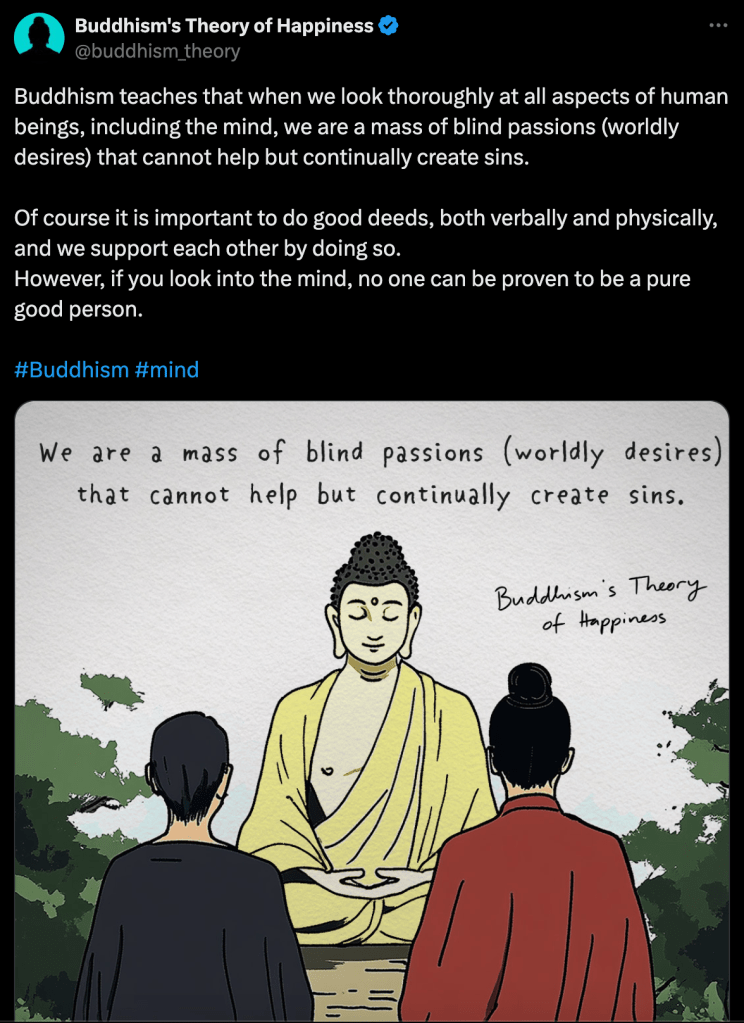
The Buddhist view puts mental health in an interesting context and on a spectrum (of illness), saying the human condition itself is a form (the ultimate form!) of mental illness. This sits nicely for me because it says all human experience is a spectrum of illness and the phrase ‘mental-health condition’ offsets this with its opposite: that all human experience is on a spectrum of health.
The one precludes all psychopathology altogether, the other precludes the hope for health (bleak!) by precluding health altogether! And as a paradox they collapse duality and leave me with an acceptant contentment that the symptoms I live with are understandable, manageable and meaningful, I can live a happy and constructive and meaningful life in their presence.
I do not need these symptoms to be absent for me to feel healthy.
That’s recovery for me.
For me (with attachment/relational trauma) much of the work of staying healthy among these symptoms involves understanding my attachment style.
So there you have it! A solution to all the world’s mental illness in one short blog post 🤣
I’d love to know what you think — drop me a comment or write me a DM.
footnotes
meaning, ‘a natural consequence of our toxic culture’ as well as ‘able to be comprehended’ ↩︎
those circumstances being our toxic culture (Maté, 2020) ↩︎









 Kokoro 心 Heart