Blog

150619

We went to a Bloomsday reading organised by Isobelle Carmody at the natural ampitheatre of University of Queensland. I didn’t know Bloomsday was a thing, and I’ve never ventured very near the works of Joyce, though it’s likely I have Irish in my cultural heritage. We each had a 15 minute slot in which we had to read whatever we could — the intention was to get through the whole book in three days, and it was crazy, reading such a wonky text I was entirely unfamiliar with. By the time the end of my 15 minutes was approaching, I felt a bit like I was going mildly insane. My eyes were losing focus, and I began to just not say words that were right there in front of me.

Of course it inspired me to think about writing some weird stream-of-consciousness narrative over ten years, updating daily in some hypertext kind of way. For now though I’m content to be playing with WordPress again, though I’m still having trouble just getting the post-preview function to work (and the login page won’t even load in Safari, so I can’t test that browser to see if the glitch is caused by the privacy settings I have in place on Firefox), there seem to be numerous glitches happening with ‘blocks’, and there’s less room for interesting graphics than there are on platforms I’ve played with like Wix.

#.

The Tolkien movie was a bit of a dud, more of a shallow romance than the bio(e)pic I was hoping for. It inspired me to think of literary fellowships, so I was glad to meet with James Not Joyce this morning and do an ad hoc instance of our writing group. The movie touched also on the idea of the power of literature, art and music to change society and culture for the better, but overall I came away from the movie feeling more despondent than inspired, though that may have been caused by the three sparlos we drank on the way, plus hunger.

I’m finding it really helpful to be involved in even a dishevelled writing group, and if I’d had the courage this morning I would have told James I’d like to talk with him again about the meaning of friendship, and let him know that I’d like to be his friend (because I want to be friends with someone who actively thinks about what friendship even is).

#.

Preparing the A3 bio sheet we were asked to write for the Bloomsday reading, I realised I couldn’t quite remember how to write the kokoro symbol I use in Bodhi 心 Schier-Paine. I rarely write the character in longhand, and the anxiety I felt about getting the character right on the spot, it got me wondering about (young) people who are mostly writing on keyboards and touch screens – the anxiety I felt would be debilitating if a person had learned to write primarily using digital technology instead of in longhand. The psychological benefits of handwriting are something that interest me, and I worry sometimes about the ‘future shock’ effect of how technology is outpacing are ability to evolve and keep up with it.

140619

I heard back from Kill Your Darlings, who didn’t want the Facebook essay, so I’m sending it elsewhere today. I also heard back from Ironlak, who had filled the position already, but the search continues there as well. I’ve got an application in with a place called Liquid State, who deliver social-media solutions to community and health organisations.

#.

There’s a biopic about Tolkien out now, which we might go see later tonight because we’re child-free for the evening.

#.

I sent a pitch for the Facebook essay to Overland, and I pitched my essay about how reading literature has made me a better dad to Meanjin. Shoot for the stars eh – there’s always the moon to fall back on.

#.

I wrote to an author I used to work with at Wakefield Press, because we’re arranging for me to edit his latest poetry manuscript. You can find his work here, and Dodging the Bull is the collection of stories I edited for him at Wakefield.

130619

It’s my first time back using WordPress again for a while, and the new backend is making me a bit woozy, but I’m sure I’ll warm to it – I’m sure it’s just as intuitive as it always was. Can’t figure out how to get the post-preview function to work :/ Just shows ‘page not found’.

#.

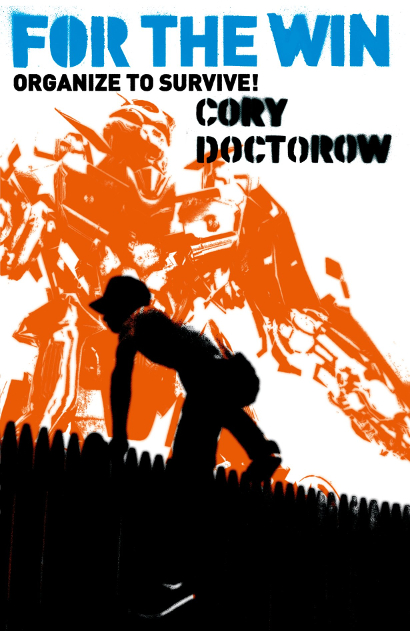
Cory Doctorow’s second novel, For the Win, which I wrote about here, can be downloaded free.

#.

Kevin Rudd said on Rebel FM today that some union leader should be sacked because he was damaging the ‘corporate brand of the Labor Party’. Straight from the horse’s mouth: our government is not an entity that serves the people, but a business that serves its leaders, in pursuit of profit. SMH 😦

#.

I learned about something called ‘hauntology’ recently, which somewhat salves the anguish I feel when I hear shit like that from people like K Rudd. I’m drafting an essay for a literary and cultural theory subject I’ll be taking next semester, in which I hope to explore some weird combination of hauntology, the political disposition of disconnected generations, Hollywood propaganda, and the practice of primates who fling shit at visitors when they’re held in captivity.

We are a self-domesticated species, us humans, so I feel like it shouldn’t be too much of a stretch to make the analogy that Hollywood propaganda is not unlike primate shit-flinging.

#.

I’ve also started reading a very interesting long-form essay called Capitalist Realism: Is there no alternative?, by the late Mark Fisher, who was an influential music writer and blogger at k-punk. So far he seems to be saying that ‘capitalist realism’, originally a play on ‘socialist realism’, is a term he has expanded to describe the belief that capitalism is the only viable economic structure we can hope for.

It’s a great essay so far, riddled with salient pop-culture references and names for ideas/feelings I’ve been living with for decades and been unable to describe, such as the above hauntology. (I think hauntology comes into it — but this may just be me conflating surrounding reading with the essay.) Here’s a link to Zero Books’ page for the book.

Cory Doctorow’s novel, For the Win

I really enjoyed reading For the Win, Cory Doctorow’s second novel about kids wreaking havoc with systems most of their local adults would claim they don’t understand. At first I was dubious, because there’s a lot of overtly expository economic brain-dumping going on, and also because the opening line was a dud.

But I started to warm to it and eventually realised that Doctorow is doing what I love Milan Kundera so much for doing: interweaving non-fiction-ish philosophical asides with a fiction narrative. Doctorow’s story here was way more accessible to me (an 80s-born Australian nerd who would like to find more time for gaming in his life) than Kundera’s stories, because I am definitely not a 20s-Czech-born French public intellectual. But I love Kundera’s stories for the way they weave in philosophy, and I came around to Doctorow’s way of doing it.

Doctorow is not exactly a master stylist (there are some clunky phrases in there, and some repetition of character description that felt cut-pasted), but neither was H G Wells, or Kundera, for that matter, or PKD, or Asimov. These are ideas novelists, who I love for their ability to squeeze powerful intellectual motives into usually-engaging literary and genre fiction, even if the prose is a bit less than aesthetically pleasing. And I know Doctorow from his powerful online activism, so I didn’t turn to For the Win for delicately undulating prose.

It’s worth a read if you’re interested in unionism, worker rights, global economics and the exploits of highly precocious teens with attitude. If you’re just into gaming though, I expect you’ll be disappointed. The in-game stories were pretty lame (compared to, say, Ready Player One), so I wasn’t surprised to read in the book’s acknowledgements that Doctorow had to call in research support for that subject as well as his pan-cultural references (which also felt a bit glib).

The chunk of economics download I like the best:

And that’s the real reason the powerful fear open systems and networks. If anyone can set up a free voicecall to anyone else in the world, using the net, then we can all communicate with the same ease that’s standard for the high and mighty. If anyone can create and sell virtual wealth in a game, then we’re all in the same economic shoes as the multinational megacorps that start the games.

And if any worker, anywhere, can communicate with any other worker, anywhere, for free, instantaneously, without her boss’s permission, then, brother, look out, because the Coase cost of demanding better pay, better working conditions and a slice of the pie just got a lot cheaper. And the people who have the power aren’t going to sit still and let a bunch of grunts take it away from them.