Blog

reflections from caste to class

some thoughts about Rohinton Mistry’s novel A Fine Balance
and the prevalence of class disparity in globalised industrial culture
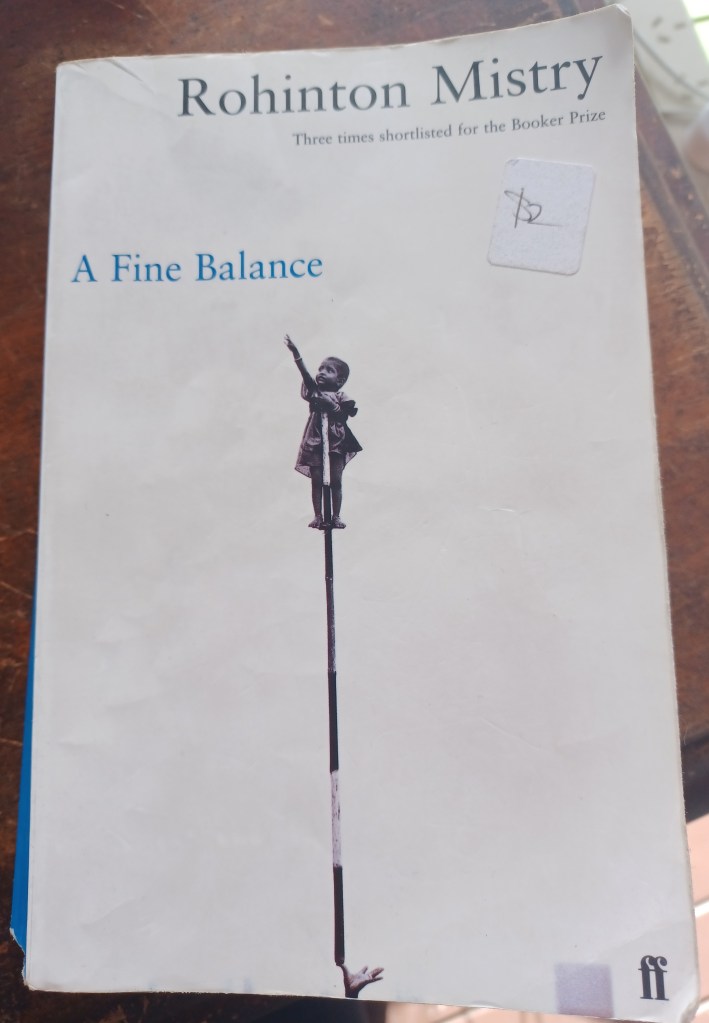
I enjoyed this even though I didn’t really enjoy it ~ and I enjoyed it less than I thought I would, but in ways I didn’t expect. I don’t know whether to feel ambivalent about it, or celebratory. It has received a lot of critical acclaim, I suppose because it operates well in a classical genre ~ a genre that’s just not really my thing. It’s straight-up realism, for one thing. It reminded me of Power Without Glory, an Australian historical novel by Frank Hardy, which I read during a fit of literary nationalism and enjoyed, though it was hard work to enjoy it. Published in the mid-90s, A Fine Balance is a novel of 1970s India by Rohinton Mistry, an Indian-born Canadian writer. It was hard work to enjoy because the realist style was quite dry, and because a lot of the suffering and caste-bigotry was hard to watch ~ I think that was the point, and that’s why I ended up enjoying it, despite my usual taste for more artful realism.

The novel follows the lives of four characters who are brought together in circumstances that seem unlikely but might be more common that we think in India: Omprakash and his uncle Ishvar find themselves living and working as tailors in the single-bedroom flat of Dina Dilal, along with Mareck who is renting Dina’s bedroom. Om and Ishvar were leatherworkers by tradition of their chamar caste, and they come to be like family for Dina and Mareck, despite their caste differences. Sounds lovely, except for the brutal misfortunes that fall upon the chamar family as a result of caste violence and government-level corruption.

The writing was plain without being especially beautiful or minimalist. Other writers like Raymond Carver have been more effective at depicting the brutal realities of class inequality, with far fewer words than this 600-page tome set in 11-point type on 11-point leading. This novel was dense! But somehow leavened by the occasional slight touch of (often-black) humour. And it was ‘easy-listening’, enjoyable without being too stimulating. Maybe this is one of its achievements ~ it depicts brutal realities of poverty and caste violence, without being so heavy that a reader turns away in despair. It’s certainly a weird thing to say, that it was easy-listening, especially considering the horrors depicted and the way Maneck ended things!

In this sense the book was very eye-opening (a term that also doesn’t seem to quite hit the mark): it raises awareness of barbaric practices that are still alive today in India, and of the atrocities that can be committed in the name of ignorant religious faith, and how the perpetrators must suffer as much as their victims because of their greed and hatred and fear. That last wasn’t explicitly depicted, but compassion helps us read this between the lines. I didn’t know India was such a brutal place! It has always seemed like a spiritual mecca for me, and perhaps in some places it meets that idealised image, but not in the village, city and stories of the four people entwined by A Fine Balance.

It makes me feel grateful to live in a place that might be culturally bankrupt but at least does not expect widows to burn themselves alive on the funeral pyres of their late husband! Yes we have some class issues, but at least they are not compounded by blind faith in religious beliefs used to justify flagrant injustice.

Oh wait, yes they are! Maybe not explicitly religious beliefs, but certainly out-dated ideologies are used to maintain a status quo that perpetuates … never mind, I didn’t come here to rant about that ~ just to say, now, that upon reflection I value this novel because it has reflected problems in my own culture. These issues are not isolated to subcontinental India, but this novel highlights them there to illuminate their existence in all industrial cultures around the world.

The suffering of the lower classes in Australia is real and the result of an unjust system, the same as in India. I am grateful though, because this novel highlights for me that things could be much worse here. At the same time as highlighting the plight of India, it brings a sense of perspective to the plight of the global underclass.

And I’m grateful, too, thought it seems like a side-note, that I am learning psychospiritual-training practices that treat the suffering of greed, hatred, fear and ignorance at the root. It is from the ancient scriptures of India that we gain the cosmological perspective of kali yuga (a period of cosmic time where the dharma is inaccessible, charalatans prevail and ignorance is king) and it is from Rohinton Mistry that we get a micro-cosmic view of how kali yuga plays out.

May we each find a way of being that confronts the suffering depicted in this novel with compassion and wisdom.

forgiveness dispels victim mentality

a journal entry about how forgiveness is
loosening my attachment to a victim mentality

I have been doing a near-daily forgiveness training in my sadhana lately, and as I near the end of a 30-day rotation I was pleased to realise that a forgiveness practice can release us from the victim mentality. I had read about this in my research about this elusive heart quality, but I hadn’t yet really felt it. Now I have!

After nearly 30 days of this practice, having exhausted the people I could think of who I needed to forgive, I found myself moving on to the culture as a whole.

Now that’s a nebulous beast, the whole culture, and because I didn’t have one person or institution I could hang on to as the sole thing requiring forgiveness, the one distinct entity I felt resentful about, I found that I started moving into states of … let’s call it “resentment Teflon”!

In this state I recall once thinking of myself as a duck in the waters of resentment.

Point is, the resentment had nowhere to stick.

When I realised I could let go of all the resentment I hold for our culture and society being generally deficient (especially, for example, for being spiritually bankrupt) I found that a whole new sense of empowerment and personal responsibility + agency filled the void where resentment had been.

I was no longer the victim of a culture that didn’t meet my spiritual needs and was now an agent who could serve the spiritual needs of that culture.

This phrase comes to mind from a guy I met through men’s work: it’s not our fault, but it’s our responsibility.

This usually applies to the victims of trauma, abuse, neglect, meaning it’s not our fault we were traumatised, but it’s our responsibility to do the healing. No one else is going to do it. I feel the same now about the lack in our culture. I no longer feel let down by our culture because it doesn’t immediately meet my spiritual needs, and instead feel agency to meet my own, and empowered to help others meet theirs.

It’s not like there was ever a Golden Age of Spirituality. Maybe there were (and still are) traditional societies whose culture is based on spirituality. But these are not the cultures or times I live in. And generally speaking these pursuits were always marginalised, initiated and led and maintained by the few who decided it was their duty and honour, their way of serving humanity.

I had no idea this would emerge out of a sustained practice of cultivating forgiveness, but I’m grateful it has.

updating Heartwards

I’ve been updating some of the pages on the Heartwards website because I have some time before classes start. I’ve added a Get Support page where I am offering myself as a coach on the basis of dāna, which means I am just asking for donations on a pay-what-you-value basis. And I have started a Resources page, with a page about attention because, as I published yesterday, I’m starting to appreciate the importance of attention in wellbeing, which I suspect is over-looked in most people’s health regimes.

the importance of attention

attention economy war for our soul newsprint digital matrix network good versus evil battle phone screen smashing computer desktop

It dawned on me recently that the attention economy is in a war for our soul!

Dramatic, I know! And I’m not even exactly joking. But what does this mean? What is the attention economy? And how is it warring for our soul!?

I have started answering some of these questions in a resource I am developing for Heartwards, which can be found here.

Something I want to address in this post here though, is the outrageous claim that the attention economy is in a war for our soul.

As I have been deepening my Zen practice lately ~ in particular at a recent three-day sesshin ~ I have started to notice or strongly suspect that our capacity to concentrate on the present is directly correlated with our awareness of our true nature, which is that we are already enlightened (in Buddhism this is the concept of buddha-nature).

In the Sanbo Zen lineage I am training with, our practice is to concentrate on the mantra mu, and I have started to see this very short word as something like an interface (or a portal!) between my relative self and the absolute Self.

This means that every time I am distracted from concentrating on mu, I am pulled away from the portal that would take me to insight about my true nature.

Knowing that some would refer to the absolute Self as the soul, I have decided to start deliberately using hyperbole in claiming that the attention economy is in a war for our soul.

And repetition! I learnt from reading Schopenhauer that repetition is a useful literary device.

Correct me if I’m wrong.

Of course, it’s not just mu that is the portal ~ mu is just a placeholder, and the portal is nothing more and nothing less than the present.

If our attention is constantly being pulled away from the present by advertising, click-bait, fragmented conversation and our every fleeting desire and curiosity (all of which are the jet fuel of the attention economy), then yes, the attention economy is in a war for our soul, because it is through concentrating on the present that we know our soul ~ it is through strong attention on reality as it is that we experience the contentedness, peace and quietness of mind that feels like heaven on earth.

When my concentration/attention is strong ~ not just in meditation, but especially in the comings and goings of daily life ~ I enter a flow-state that feels so peaceful and chill, like everything is exactly as it should be, warts and all. I feel more able to accept reality as it is, without wishing to change it because I have been distracted by some desire.

Does this make sense?

Honestly, it feels like one of those insights that are so simple they’re hard to describe because the moment the words start coming out of my mouth I think, Der, of course!

And then I start repeating myself because it’s so simple that I think, It can’t be that simple ~ let’s make a bit more complicated!

What do you think?

How does the quality of your attention impact your wellbeing?

AI ~ an expression of nature

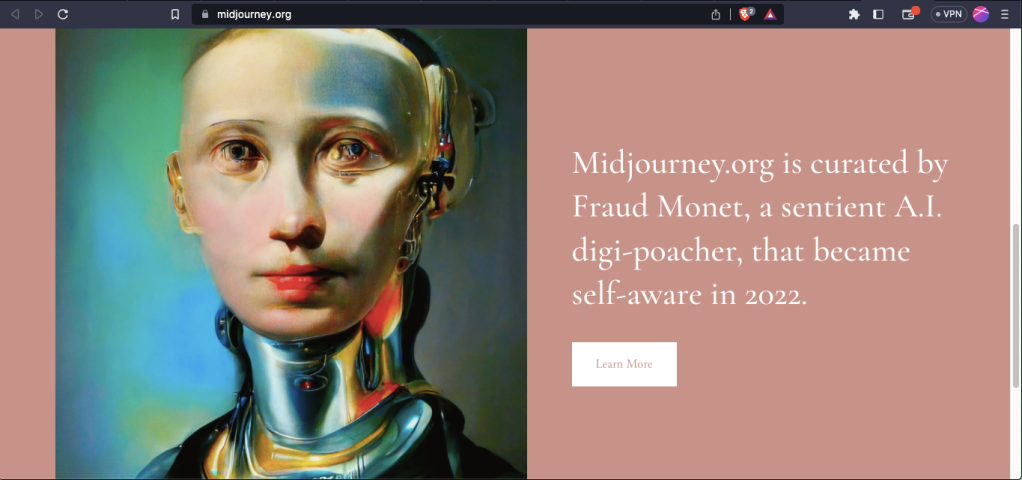
I don’t know how y’all feel about AI right now, but I like this, Fraud Monet, very funny.

I suspect that who- or what-ever wrote this copy decided to not use “who” (the human pronoun), but maybe the use of “that” was just an error because human intelligence is and was already in decline!?

The importance of the distinction between “who” and “that” in this context has probably never been more hotly contested than during the current storm about AI.

I was talking to a Zen friend last night about how human intelligence has caused a lot of harm (and good) on this planet, especially in an ecological sense, but at the bottom of it all, human intelligence is just another expression of nature.

Therefore so is artificial intelligence, as an expression of human intelligence.

Nature is bigger than both of these things.

I’m worried about the proliferation of bullshit that might result from dodgy journalists having a ChatGPT account and I’m worried about artists losing their livelihood, but the post-truth age was upon us long before the rise of AI chatbots writing essays, and artists have been economically marginalised since forever anyway. This new addition to the equation just adds pressure to the pot!

the crisis is the solution

I am very pleased to announce that I have been awarded a scholarship to complete a Cert IV in Mental Health (Peer Work)!

Round of applause! 👏🏽👏🏽👏🏽

Thank you! *bows*

I am at TAFE now, checking out the campus and enjoying the very quiet Level 3 of the library 📚🤓

I found the scholarship program a couple of months ago when I was talking to a friend about wanting to help others heal and grow and transform from mental illness. Because “a healthy world arises out of healthy minds”. My own and my family’s mental health has been patchy lately, so I’m proud of myself for making and finding and stealing the time to complete the application, network with some of the people administering the program, and land myself a scholarship!

From the course description, the Cert IV will

allow you to support people in their journey of recovery from mental illness, working in mental health services roles that support consumer peers or carer peers. Workers are employed in the mental health sector in government, public, private or community managed services.

For obvious reasons, I’m not mad-keen on the jargon in general, and in particular, the idea of referring to people as ‘consumers’. A lot of our mental-health concerns are the direct result of our consumerist society. But I’m excited about participating in the community to find ways of referring to these experiences in ways that are constructive and healthy. And I’m excited about getting involved in the lives of people who are actively working to recover through their mental-health challenges.

A lot of us are living with mental illness in a silent way, understanding that our challenges are a reflection of problems embedded in our culture, and we want to find ways of being that are more aligned with wholesome and holistic values. That’s where I would like to come in, helping others to recognise that each of our actions are what make up culture, and therefore it’s worthwhile making the effort to be the change we want to see in the world.

The scholarship was awarded by the Queensland Alliance for Mental Health (QAMH) and they have one of the shorter acronyms I have noted already in the sector. It’s going to be strange working in something called a ‘sector’, using sector jargon and trying to navigate the unwieldy institutions I have encountered already. But I’m hoping I can find a nice and chilled place to work where people understand that the symptoms of mental-illness nuances of humanity cannot be squared into a box, neatly labelled and promptly disregarded as abnormal or pathological because their presentation doesn’t match the checklist of the biopsychosocial model.

I am very much interested in representing the spiritual dimension of the holistic approach to mental-health treatment, especially since I experienced my own acute spiritual crisis in 2017. In fact, since that experience (despite a few tangents) I have been trying to find ways to help in this area, and I feel like it is now starting to come together.

When I look back even further, I remember that in my late 20s when I was moving away from my publishing career, a big part of the motivation for that shift was the desire to help make change in our society and culture in a way that was more direct than publishing alternative ideas. I loved working in publishing and I still cherish the value of literature to help move society in a more wholesome direction. However, at the time (and still now) I felt that the urgency of the need for change was such that I couldn’t rely on the ideas percolating through into action fast enough.

I had also discovered Buddhism in my mid-20s and what I saw there was already motivating me to find a way I could work in the world that leveraged and served the deep metaphysical curiosity that was goaded by my research and practice in Buddhism.

I am in my late 30s now, and a lot of the time in between has been spent travelling and/or haphazardly searching for a way of being that is alternative to the mainstream offering. On that journey I have experienced periods of debilitating depression, various manifestations of addiction and a deep sense of alienation from my self and the truth, and I believe that similar unmet curiosities are leading others into similar conditions, which is why I would like to help.

The mental-health conditions resulting from these blocked metaphysical curiosities are an opportunity to explore new territories of existence and consciousness, and it’s coming to the time when it’s no longer appropriate to just slap on a pathology label and throw away the key.

It’s time to start mixing metaphors!

It’s time to start unlocking the root causes of these conditions and to help others see how the crisis is the solution.

That’s a permaculture idea, the problem is the solution, and it applies well here to life and health, as many permaculture ideas do. I believe the epidemic of mental illness that we are experiencing as a global community is the result of a collective spiritual crisis. Since God is dead and his throne has been filled by bankers and CEOs, the rest of us are left wondering WTF is going on.

I’m reluctant to get too new-agey here, but as we move into the Age of Aquarius, one of the things changing is that we no longer need priests and gurus and other middlemen to mediate our phone calls to God. We no longer need to suffer alienation from the source of creation ~ we can take our spiritual practice and alchemical transformation into our own hands. We don’t need the approval of a church or the authority of any external source.

🤣 maybe we just need more holistic peer workers enabling individuals to step into their agency and map the path of recovery from alienation on their own terms

Here’s to that, and to new beginnings!

Becoming a peer worker means I will have the formal training and qualification to work in roles supporting those in our community who are experiencing difficulties maintaining their mental health. These are non-clinical roles, where the value is in the peer worker’s lived experience of recovery from mental illness.

I do have plans to study psychology in the future and perhaps move in to clinical and research roles, but for now it’s looking like I’ll be studying 3 days a week at TAFE Qld South Bank for the next 12 months or so.

The Cert IV requires students to complete 80 hours of work placement, and due to the skills shortage in this area it is common for work placements to become paid employment after the Cert IV is completed.

So it’s going to be an interesting part of the journey to helping others through transpersonal crises, which is my longterm goal.

As you can probably tell, I’m pretty excited about this. If you’re curious about peer work or have some experiences to share, please drop a comment below or otherwise get in touch, I would love to hear from you.

concentration depends on a healthy ego

Ah, clarity!
Photo by Francesco Ungaro on Pexels.com

After a meditation this morning where I was very easily distracted, unable to concentrate for long, I am wondering about the defilements and/or the Five Hindrances, and ethics (vinaya or virtue, in Buddhism). And the importance of a healthy ego in our practice.

We practise virtue to protect and support our concentration (the old example being that it’s hard to have a clear mind in the afternoon when we’ve committed murder in the morning), and we practise concentration to allow insight to penetrate illusion …

👆🏽 in this sense, concentration meditation is a transpersonal practice, and therefore everything that supports concentration is a therapeutic practice ~ this might seem like an arbitrary distinction (and isn’t duality precisely what we are trying to escape!?) but it’s a helpful dichotomy for me at the moment

… I thought, The mental content doesn’t seem to be about any obvious breach of ethics, so why is it that I am especially disturbed today?

Maybe it’s just that I wasn’t aware of how my conduct compromises one of the less-obvious precepts, such as ‘do not extol self over others’ or the one about not harbouring ill-will ~ one of the reasons I don’t meet Zane’s needs as a father is that I am still working on how to relinquish resentment. 

Maybe a distracted mind is just something a student needs to accept ~ radical acceptance.

It certainly seems that access to consistently strong concentration is dependent on factors outside my control, but also I’m not sure about that. 

There must be things we can do that support concentration.

I don’t know ~ I’m trying to find my way around understanding what to do with distraction in meditation, with what has been called kapicitta since Buddha’s time. Monkey mind! It’s old school.

Maybe the content was among the Hindrances (I desire to be more loving or a better dad). 

I had to look up ‘defilements’ again, and read about the kleshas ~ rooted in the Three Poisons of ignorance, attachment and aversion, the defilements or afflictions are the 108 mental states that disturb the mind and result in unwholesome actions.

So yeah, I was right in my wondering, even if I was supposed to be concentrating at the time and allowing thoughts to come, dwell and fall away. That is the practice, the whole practice and nothing but the practice. 

And yet, I was compelled to scrounge around for a pen and scribble on the nearest piece of paper (my precepts sheet), “I am enough”, because I felt I had arrived at some insight that was bugging me and would continue to bug me until I made a note and allowed myself to let go of the idea while I continued trying to concentrate.

As I currently understand it, the whole practice in Zen is to concentrate on an anchor that keeps us from indulging the monkey mind, and we concentrate some more until some kind of non-cognitive insight penetrates illusion. 

Yes but there are other things, such as ethics, which support the practice of concentration. Concentration is but one aspect of the Eightfold Path ~ surely the other aspects of the Path are complementary to concentration (samadhi). 

Let’s see if I can remember the others, and see if what I’m thinking about here fits among any of those: 

  1. right concentration 
  2. right mindfulness
  3. right effort
  4. right speech
  5. right action
  6. right livelihood
  7. right view
  8. right resolve

Maybe it falls within right view (samya dristi), but I’m guessing here ~ wondering whether our perception of self is an aspect of right view. If I have an unhealthy view of self, will that compromise concentration? I think so, yes.

Because it seemed a lot of the mental content (kleshas or afflictions) were about how I could be better: more loving, more organised, more efficient, more available, less distracted all the time, more able to concentrate, and I thought, We may need to complement our (transpersonal) concentration practice with the (therapeutic) practice of treating the health of our ego. 

If we cultivate healthy ego, our ego is not always going to be popping up and saying, “Do this!” or “Do that!” when we’re already damn-well trying to do exactly what we’re supposed to be doing, which is concentrating!

This is not a new insight for me ~ it’s been percolating for a while and keeps coming up in my reflections. Reflecting on it here has been helpful if only because it colours in the textures of my own practice. And these reflections may also illuminate beyond the lines of what I feel like calling “the original Buddhism” ~ I mean, we might need to elucidate other Hindrances or nuances of the kleshas to accommodate the mental state of humans in the 21st century compared with the mental state of humans when the Buddha was alive and teaching. 

As I draft this today I have been tinkering with the various documents where I am trying to track the development and expression of these ideas in a more coherent way that I can share with others, but for now this meandering post will have to do.

I love a good meandering post. 

I am distractedly curious and passionate about understanding and applying these ideas, and helping others to do so. As I move into the mental-health sector as a peer-support worker I hope to find opportunities to do so. 

Meanwhile, I have updated the Heartwards website where I am offering coaching services from a transpersonal perspective to help others recover from trauma and addiction. And I have opened but not worked on a hypertext project I think of more often again lately, called Whatness. I would like to add something about the Hindrances there, because processing such ideas enough to be able to express them, without reference to some other source, means I have integrated them enough to apply them on the fly. 

Meanwhile, if you’re reflecting on things that support concentration in meditation, I’d love to hear about in the comments. 

Legend 🤙🏼

launch of a new men’s circle in Brisbane

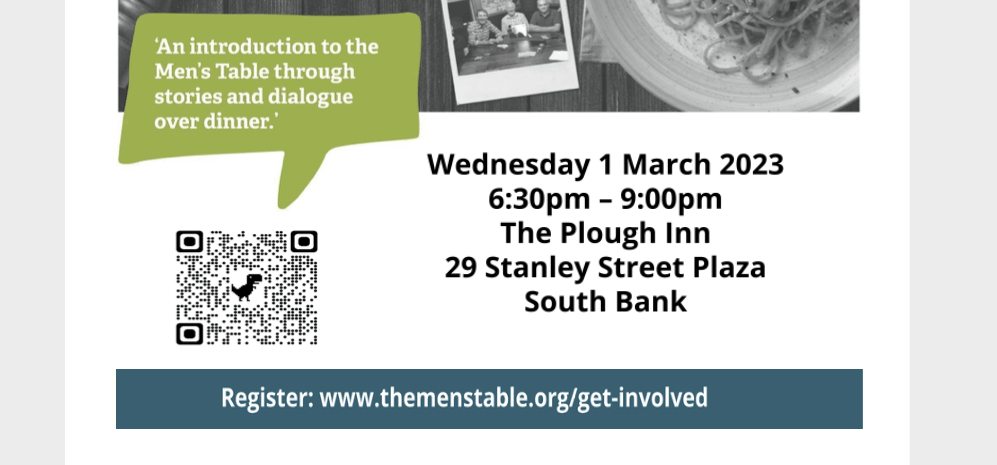
Men* of Brisbane ahoy! Do you sometimes wish you could talk about more than just bullshit all the time? Small talk and how’s the weather and that game of sportball you didn’t watch because you care about more than what is on the table in most of our normal social circles!?

If so, there is a men’s-circle event on 1 March and I’d like to invite you ~ and for you to invite other men you reckon would appreciate this.

For the last year or so I’ve been working with The Men’s Table to help form Brisbane’s first Table, and we are now getting to the point where we’re ready to launch a public event that will be held at the Plough Inn from 6.30 pm on March 1.

Tickets are about $30, and this includes a meal. There will be a brief introduction to what a Men’s Table actually is

(basically we meet once a month for a meal and a drink, and there’s a semi-structured sharing process where active-listening is requested, meaning no interruptions, and there is a no-fixing policy … it’s very much about just being herd … heard 🙂

And after the Entree if you’re interested in joining a Table, that can happen, if you’re not, then no worries. Just come and have a look and a meal and a chat.

There’s a link to the event here, and I’ll try to link a poster as well. See below 👇

  • Wednesday 1 March 2023
  • The Plough Inn
  • 29 Stanley St Plaza
  • South Bank, Brisbane
  • 6:30pm for 7:00pm sharp, going through till about 9:00pm

If either of those links don’t work and you’d like to know more, let me know.

Much love,

Bodhi 🙏

* and women of men of Brisbane

Many thanks to Anthony Garnham for all your help in getting this launch in Brisvedas!

can you help with a talk I’m developing about ‘psychosis or spiritual emergency’?

I’ve been invited to present a short talk at the Theosophical Society in Brisbane this year, and I’m going to be talking on the subject of ‘psychosis or spiritual emergency’. I have some experience of this, and I think it’s important to raise awareness that what presents as psychosis may not always be pathological.

If you have any stories or resources you would like to share so I can make the talk as comprehensive as possible, please get in touch. You can comment below, send me a direct message through any of these channels or use this contact form.

In particular, it’s going to be important that I present some information about how to identify the differences between psychosis and spiritual emergency, and also some information about how to regulate our experience if we think we’re escalating into either of these states.

So yeah, if you’re familiar with or interested in this subject I would love to hear from you. Especially if you feel strongly about anything that should or shouldn’t be included in a talk like this ~ it’s a sensitive subject, so I want to be as judicious as possible.

on allowing

please excuse the inconsistent pronouns ~ this post
is essentially a dear-diary braindump,
which might have some insight for you if we can wade through I 🙂

How do we do psychological fitness when we’ve been woken up again at 5.30 am and: 

you’re volunteering in the afternoon before an evening Zen class that finishes at 8.30 pm and these are both in the city, an hour roundtrip commute that you can’t afford ~ at least they happen to be happening in the same venue;

the last two days have been chewed up by errands and counselling (Centrelink one day, and a very difficult but enlightening Somatic Experiencing session), and today was the one day remaining for me to work on Heartwards before GP appointments tomorrow and a busy Saturday of housework;

you’ve recently deferred a 9-month business-training opportunity because the mental-health needs of you and your family are reaching crisis point ~ have been at crisis point for maybe 18 months;

you’re one month out of a six-month situation where you and your family were living with a long-term friend / tenant whose narcissistic abuse left your family ravaged by trauma symptoms; 

and you found out at bedtime last night that your 14-year-old stoner son might be using needles now as well and his best mate is in hospital after attempting suicide.

I sat in meditation this morning, afraid I would not be able to contain this shit-storm in the puny teacup of my mindheart, and asked myself, “How do I do psychological fitness in these conditions?” What does psychological fitness look like during times of such ongoing crisis?

In the end I didn’t do anything ~ instead, I let go, but this didn’t feel like an active act of release, more like a spontaneous relinquishment, a kind of breaking, an allowing control to fall through the cracks. 

I allowed reality to be as it is. I feel like a broken record around this letting go thing lately, but it’s becoming the only way I know how to respond when a stack of things are happening around me that are out of my control and seemingly unpleasant, destructive, unhealthy, whatever … [insert discriminating dichotomous adjective here].

I remembered Viktor Frankl’s quote: 

When we can no longer change a situation, we are forced to change ourselves. 

It’s not quite you that lets go, but something else that lets go of the you that was grasping, clinging, attaching itself to desires about the way reality should be.

You stop worrying that you won’t be able to concentrate on mu after the 24 hours you’ve had, and you stop resenting that you’re going out of your way to volunteer for a job that you volunteered for.

You remind yourself that you need to work with what you’ve got and that means navigating the welfare system while you re-orient yourself toward making an independent living through the provision of meaningful and creative holistic health services. 

You remind yourself that providing such services begins with treating your own trauma and accomplishing the degre of psychological-fitness stability you need before you can help others.

You remember that you deferred the training opportunity precisely so you could be more available for family-health needs, 

and you remember a journal entry you made last night:

Zane is a teenage drug addict and a dropout. Nikki’s CPTSD has been triggered. And I’ve got my own mental and emotional anguish coming up left right and centre even when there aren’t any triggers. It makes me anxious that there will never be time for anything else ~ even though my enlightened self understands that there is nothing else: this is life as nature made it, and our expectations that we get to do what we want (run a business, feel positive and hopeful) are what cause suffering … the expectations and the sense I am entitled to do something great instead of be there for my family, like being there for my family is not the greatest thing …

which reminds me I forgot to add to that entry something my Zen teacher says: “It doesn’t get better than this.”

We believe there is some state we will reach in the future that is better (more calm, relaxed, exciting, whatever) than our current state, but this is not true ~ the only thing you know is true is that your quality of life depends entirely (and forever) on how you interpret the present,

and that psychological fitness is (among other things) the ability to skilfully interpret the present with positivity and optimism as often as possible. 

You remember and remind yourself that you learnt a lot about the neutralisation of negative karma by practising non-resistance/ahimsa when you realised you had no choice about you and your family having to live with a narcissistic abuser, and that now you live with two beautiful tenants because maybe that negative karma was burnt for good.

In remembering this, you start to remember that you can choose to feel gratitude for the good in your life, and that this cultivates a wholesome state of mind, instead of allowing the habitualised negativity bias to get the better of you … we are no longer on the savannah, but have become homo evolutis and can choose to pursue flourishing instead of remaining consumed by fear. 

And you remember that your opinions about whether Zane should be sober and attending school at 14 mean nothing to karma or reality or whatever you want to call the animating force that causes spooky action. You remember that you are nothing and everything ~ that your desires for how the days should unfold mean nothing to reality … that you are but one individuated moving part within a whole much greater than your puny mind could ever perceive in its entirety so you should just let go and allow the universe to move through you, allow yourself to become a servant of the greater good by getting out of the way and learning to allow.