
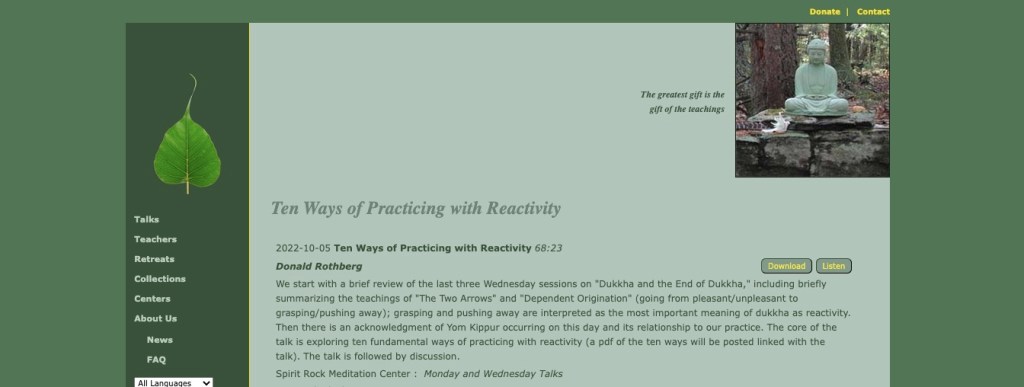
Here is a talk by Donald Rothberg called “Ten Ways of Practicing with Reactivity”, which helped me with something like an insight about a false belief I suffer from. He says that if a child’s parents get divorced, that child may believe it was their fault and because they don’t have the capacity to reframe this false belief, they may experience the cognitive distortion that any future relationship trouble is their fault. I can certainly vouch for this, and I hope I can remember this in future to prevent myself from berating myself endlessly when even the most minor disturbance occurs in my family of choice.
At that link you’ll be able to download a resource listing the ten ways of practising with reactivity, the first of which is to cultivate wisdom. Easier said than done, but Donald provides the teaching of the Two Arrows to help us get started. If someone hurts us, or if we hurt another, that is the First Arrow – if we then begin berating ourselves or ruminating on the hurt, that is the Second Arrow. If we lash out, that’s another Second Arrow, et cetera et cetera, ad nauseum. We may not be able to prevent another from hurting us, and we often are not able to refrain from acting with reactivity, but we can be skillful about how we respond after the fact.
Something we can do after the fact is cultivate the heart practices. I have been starting to do this more recently, and it really helps – if we flood our minds with compassion or forgiveness, there is less room for resentment and anger. I also use this emotional first-aid resource that I developed for myself and have shared here before.
Donald also encourages us to use relatively mundane instances of unpleasantness to practise becoming aware of reactivity. When something vaguely unpleasant happens, something manageable and not too triggering, stay with it. This way we’ll be able to start noticing when reactivity is happening and how it feels – it’s an easy-to-remember way of practising mindfulness throughout the day.
I found it interesting that he talks about reactivity in the context of dukkha, that classically unpleasant experience of suffering or dissatisfaction in the Buddhist conception of our deluded interface with reality – that first one in the Four Noble truths, that suffering exists. He says that reactivity generally manifests as either grasping or aversion, and it seems to hold water for me.
Reactivity is a thing I’ve been trying to understand and move away from, so having it placed in the context of the Four Noble truths helps me feel like the experience is held in a container I trust and have faith in. I understand that grasping and aversion cause suffering because they fuel the wish for reality to be other than it is, and now reactivity is just another way of describing an experience that falls in the attachment basket.
The above are just the bits of Donald’s talk that landed with me – check out the rest of the talk and the accompanying document if you’re interested in learning how to be less reactive and more responsive in life.
 Kokoro 心 Heart