
Point One The preliminaries, which are the basis for dharma practice
Slogan One First, train in the preliminaries (the Four Reminders or the Four Thoughts)
Reminder Two Be aware of the reality that life ends; death comes for everyone; Impermanence
~~~
*TRIGGER WARNING*
considering the state of our world and minds,
the idea of suicide is bound to come up eventually;
I consider it great consolation that contemplating the inevitability of death
is a powerful antidote for the thought of self-inflicted death
the break in-between

I am pleased to report that I have recently dropped the whole work-eat-sleep-and-shit-till-you-die routine. I have taken a financial hit to gain more time affluence, meaning more time for reflection and meditation. The mere acts of writing thoughts and engaging with philosophy and exploring our spiritual nature are things that make my life worthwhile and I hadn’t been doing them enough due to the demands of employment.
It was getting depressing, to say the least – without time for reflection or anything other than work, life’s difficulties were causing a paralysis I could only imagine solving with suicide. I don’t know how people do it for decades in a row. I guess they adjust and reconcile themselves with certain sacrifices. But I don’t want to just adjust. I want to adapt, evolve, and I want to make sure I’m not making sacrifices I will regret on my deathbed.
Regret has always been my biggest fear.
I want to adapt and evolve and accommodate the making of meaning among the demands on my time now that I’m a husband and dad. I want to set the example for my son that there is more to life than just employment, but also for all the people I encounter because we can’t go on like this, depriving ourselves of meaning because material wealth is believed to be all we need for a happy life. Clearly it’s not, because we are all in the West wealthier than ever before and that wealth has been gained through the sacrifice of our collective wellbeing. And to think the word “wealth” was originally derived from weal.
We are less happy despite our relative affluence because increased affluence makes it easier to distract ourselves from facing up to the transformative power of suffering.
A lot of us are running ourselves into the ground for the sake of material security, and in the process neglecting what hopes we can have for psychospiritual security if we gave more time to reflecting on what really makes life worthwhile. And let’s face it, death is the only thing that makes life worthwhile. The word “security” is not quite appropriate in the context of the psychospiritual journey, because on this Path there are no guarantees. I’m not talking about securing a place in Heaven, but a certain few reflections can prepare us for the end of our lives and point us toward a karmic trajectory that is going to be more favourable than if we had neglected spiritual aspirations in favour of, say, yachts!
To help with this aspiration, the second Reminder in the lojong teachings is one of those reflections:
be aware of death; remember that everything is impermanent.
Everything dies, and not just biological organisms – ideas, feelings, thoughts, moods, and situations, are all fleeting. It’s easy to say and know that everything dies, and to think of organisms. But the reality of biological death or mortality is more distant from our immediate experience than emotions are, unless we cultivate a practice of reflecting on impermanence. With our thoughts, feelings and emotions we can see how they are born, dwell for a time, and then fall away. Remembering this helps to let go of attachment – to achievement and ambition, to objects and people, but also to pride and hubris and the over-inflated ego. To illustrate this I like the image of the butterfly.
The self-destruction of the caterpillar is such a perfect metaphor about dissolution of ego attachment. As the caterpillar turns into goo before it somehow morphs into a butterfly, so the ego must dissolve before we can transform into the compassionate beasts we always were.
Reflecting on the impermanence of the ego helps us to learn and grow, because reduced attachment promotes the healthy ego we need to admit we were wrong or don’t know.
Zane and I have butted heads a lot because I have low tolerance for people who can’t admit they were wrong, and Zane lacks the healthy ego development to be gracious about his own ignorance. But when I embrace Butterfly and relinquish my attachment to the value of Socratic ignorance, I am able to swallow my pride and humble myself before his misdemeanours and try to help him understand why some of his behaviours are problematic.
When I feel frustrated with Zane’s transgressions I can try, with sufficient training, to remember that the emotions will pass if I let go of attachment to whatever identity I think has been hurt or disgruntled by the behaviour. When I am able to do this I feel an acute sense of joy because I have dropped my misguided sense of self-righteousness for the purpose of helping a young human learn how to become a well-rounded adult. And we get along better and we smile and we laugh and we don’t scowl so much and I feel good about myself instead of feeling like a goddamn grouch.
To support the renunciation of self-attachment, I have recently introduced a practice of “training in the preliminaries” to my sadhana, because the preliminaries remind me that 1) human life is precious, 2) feelings are fleeting, and 4) attachment to things that are precious but fleeting is foolish and a primary cause of suffering. Of course there are four Reminders in the preliminaries, but the third Reminder about karma has less bearing on the mitigation of suicidal ideation, so I won’t go into that here.
It is enough to say for now that when I feel like ending things because my means for coping are so depleted that I think we’d all be better off without me (which is merely the result of unresolved childhood wounds and has no actual bearing on the nature of present reality), having familiarised myself with these preliminaries helps to mitigate my wish to terminate existence. What a relief!
~ ~ ~
I had a dream after reading about karma the other day and the whole vibe was about the importance of doing the right thing(s) in life so we don’t experience (unfortunate) rebirth and go through a whole other lifetime of suffering. But what about this lifetime? if, like me, we are on the fence about reincarnation. If we could let go of attachment to our thoughts and feelings (if we could stop mis-identifying with our emotions and moods as who we are) then our current lifetime would be so much easier to deal with and there would be fewer causes of wrong thought and action. It’s easy to not accrue negative karma when we’re feeling happy and relaxed, but how often are we in those states? The whole test of our mettle as karmic consequences is the way we think, speak and behave when we are distressed.
I hadn’t really expected that reflecting on impermanence would lead to reflecting on attachment and karma, but (lack of) awareness of non-permanence seems now to obviously underpin our (misguided) notions of identity and how we behave from that identity. When we are attached to a fixed identity, we suffer – when we are more loosely defined by a fluid identity rich with non-attachment, suffering is more easy to bear. When we are suffering less, we karma better.
Also, including these Reminders in my sadhana has helped me to see that they are each complements of the others – it is hard to think of rebirth without thinking of karma, and hard to think of impermanence without thinking about clinging, et cetera.
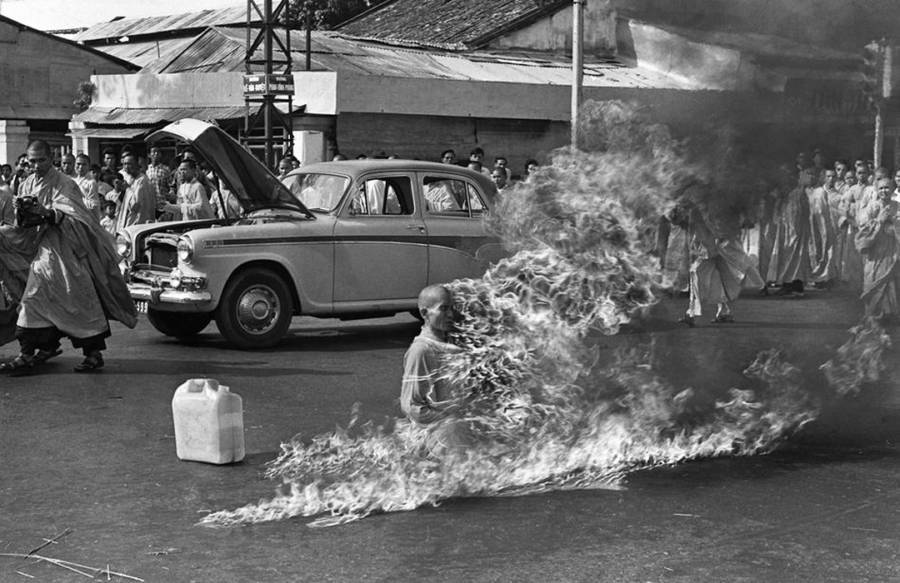
The reading that informed the above-mentioned dream was about the Buddhist perspective on suicide – tabs I had open from a recent post referencing the monk on the Rage Against the Machine cover – and the author made a very resonant point that suicide is almost always a result of a serious case of mistaken identity.
We mistake our thoughts and feelings for who we are, when what we are is really the vast space wherein that identity manifests temporarily and always in flux. We shoot ourselves in the head because we think that’s where our suffering comes from, tragically unaware that among that very hardware is the toolkit we can train ourselves to use for the mitigation of that suffering. Recognising the non-permanence of our thoughts/feelings is among the first steps in escaping the suffering caused by mistaking our mental/physical body as what we are.
I’m starting to sound like a broken record now.
A first step in recognising the non-permanence of our thoughts/feelings is the cultivation of mindfulness, supported by ethical conduct and leading to the experience of wisdom.
~ ~ ~
I pulled the blood-death card out of a tarot deck the other day, and was pleased because I take death to represent change more than anything else and I need some change – we need something to break and die to bring this period of turmoil to an end. I mean that in a personal or domestic as well as in a global sense. I need a break – we all need to be given a break for a while, but that’s not going to happen. We cannot put life on hold while we repair the damage we have caused.
Meanwhile, suicide is not an option, though my afflicted mind subjects me to considering it anyway.
There is potential for psychotic break, by which I mean a break from illusion, but I want to hold that at bay for now, work on the container I need for that to not spill over into spiritual emergency.
We can’t afford a holiday.
Where to next then? Maybe that break between thoughts – the space in-between, where stillness resides.
How to get there? I’m not sure that question is the purpose of this post.
I know I was pleased when, after pulling the blood-death card, I checked in with this lojong-writing practice and was reminded that Slogan One, Reminder Two is about awareness of death. Death as a meditation object. I’ve been thinking about this lately. I understand or believe it’s a powerful practice – for one, to awaken awareness of Reminder One, the preciousness of human life as an unsurpassed opportunity for liberation, but also as a motivation to be fully alive in the present, fully present in this life.
That’s a golden thing – something to be pleased about, to be sure to be sure.
Yet … I had been avoiding this meditation – as I avoided tonglen, the practice of exchanging oneself for others, a central meditation of the lojong teachings. These are practices that make me feel uncomfortable, just to think about. Perhaps for that reason entirely, they are exactly the practices I should be stepping into. But I have so much discomfort already – it seems like folly to actively seek more … but I sense a paradox here.
The discomfort I am currently experiencing due to tenancy issues outside the bounds of my control, it is base mundane banal … profane is the word I was looking for. The discomfort I would face in these practices has a much-more sacred vibe about it. By embracing existential or psychospiritual discomfort – by turning toward it as the kid in Stranger Things turned toward the monster he faced in the Upside Down – may the discomfort of profane angst evaporate. By confronting the sacred reality that all including life is impermanent, may our afflicted attachment to profane suffering fall away, allowing us to finally live.
So there’s that: confronting the uncomfortable existential truth of death and impermanence may be a root-cause treatment for the discomfort of relative or profane suffering; may we experience equanimity in the face of samsaric daily life by embracing our opportunity to practise enough virtue before an untimely death. This is how McLeod describes the teaching – let’s call it the vinaya argument, the argument from ethics or virtue.
He adds as well the reminder that after death, nothing but the results of virtuous or nonvirtuous actions will remain. As we say (but may not truly know without a death-contemplation practice), no material/profane gains can be taken with us through the grave. The death-scientists of Ancient Egypt may disagree with this, I dunno. They put coins on the eyes of the buried for reasons I don’t understand.
Whatever the result of any potential dissonance between the Buddhist and the Egyptian view, this Reminder buoys me in my recent decision to prioritise wellbeing over traditional employment. The decision was to sacrifice material wealth to gain more time affluence – to have more time for the contemplation of reality, so that I might die poor and happy instead of poor and unhappy, which is where the employment path was leading me. I was told by Nikki just now that when I was quitting my job I said it was partly because I wanted more time to contemplate death. Sounds like something I would say!
I’ll think on this some more over the coming weeks, and maybe I’ll add an edit to this post.
Meanwhile, do you have any guided meditations or other teachings you can recommend for the contemplation of death? And/or the practice of tonglen, of exchanging oneself for others? Absolute bodhicitta sounds very cool, and Shantideva assures us that this is the fastest Path:
They who desire shelter quickly
For themselves and for all others
Should use this sacred mystery,
The exchanging of oneself for others
Imagine how screwed you would be if everyone died!
 Kokoro 心 Heart