a Burgeoning of Authenticity

may enthusiasm reign superior

In my living experience of recovery from complex trauma, I being … lol, a relevant typo there … I begin to feel enlivened and enthusiastic again about the things and activities I have been passionate about all my life, but which I learnt to hide from a world/culture that considers them foolish or idealistic, such as reading, studying, applying and writing about the New Psychology, meaning books like Transcend and the Tao De Ching.

This work has always been my purpose, and I have known this on some level since I was a child. The culture I was raised in did not value this at all, so I harboured these passions in secret except from a few trusted friends. Otherwise it was repressed, hidden from the world, and the psychological force required to maintain this secrecy and to project a false-image was profoundly injurious, but also created a kind of counter-pressure, such that when my authenticity comes punching through again I experience it as almost overwhelming. (The Incubus song “New Skin” comes to mind.)

(Curiously, the first stanza, not the one about fallacious cognitions that has always been a kind of mantra for me.)

And I experience shame when I “indulge” this passion to wake-and-write, when I spend hours at a time writing page after page of longhand that over the years has become boxes and boxes of journals and scraps of notes that are now gathered around me like … not like … as a cache of half-written books.

The experience of wanting to bound out of bed and resume this life’s work is characterised by a burgeoning of authenticity that makes me happy. It may be a relative happiness compared to the genuine happiness of sukkha, but I’ll take it, because the energy of this motivates me to do the training of letting that relative happiness go so I can continue moving toward the deep contentment I know is my and everyone’s birthright.

I’ve been getting about 5 hours of sleep a night because I often wake up bursting with enthusiasm to be awake answering my calling, and weirdly I feel a mild shame around this as well, that I am not getting the amount of sleep that the “establishment” dictates is what an adult needs. (Jonah Takalua comes to mind.)

That shame says, If I am not getting the sleep an adult needs, then I must be an immature adolescent, like reading by torchlight under the quilt until stupid o’clock in the morning is some kind of heinous sin.

I understand that shame is an egoic attachment to one’s sense of inferiority, and I am grateful to be letting go of this as well.

I don’t actually read until stupid o’clock in the morning anymore, because I have sleep-hygiene skills I have taught myself on the journey of re-parenting, but I do often wake up before my alarm feeling energised and ready to seize the day (Dead Poets Society comes to mind), which is a feeling that has been far-too-infrequent in my adult life because our culture is not conducive to this kind of bounding-puppy enthusiasm.

Well, I plan to … not plan to … I am changing the culture of my own life, one morning leap out of bed at a time.

a modularity for transpersonal development

I got around to uploading the bones of what I’ve started calling “a modularity”, describing the framework that is developing around me for helping others recover from small-t trauma and experience sustainable genuine happiness.

If you’re interested in transcending the inherently limited personal/human ego and experiencing a much-expanded perspective of our true place in and relationship to reality, check it out.

If you value being happy, check it out!

concentration depends on a healthy ego

Ah, clarity!
Photo by Francesco Ungaro on Pexels.com

After a meditation this morning where I was very easily distracted, unable to concentrate for long, I am wondering about the defilements and/or the Five Hindrances, and ethics (vinaya or virtue, in Buddhism). And the importance of a healthy ego in our practice.

We practise virtue to protect and support our concentration (the old example being that it’s hard to have a clear mind in the afternoon when we’ve committed murder in the morning), and we practise concentration to allow insight to penetrate illusion …

👆🏽 in this sense, concentration meditation is a transpersonal practice, and therefore everything that supports concentration is a therapeutic practice ~ this might seem like an arbitrary distinction (and isn’t duality precisely what we are trying to escape!?) but it’s a helpful dichotomy for me at the moment

… I thought, The mental content doesn’t seem to be about any obvious breach of ethics, so why is it that I am especially disturbed today?

Maybe it’s just that I wasn’t aware of how my conduct compromises one of the less-obvious precepts, such as ‘do not extol self over others’ or the one about not harbouring ill-will ~ one of the reasons I don’t meet Zane’s needs as a father is that I am still working on how to relinquish resentment. 

Maybe a distracted mind is just something a student needs to accept ~ radical acceptance.

It certainly seems that access to consistently strong concentration is dependent on factors outside my control, but also I’m not sure about that. 

There must be things we can do that support concentration.

I don’t know ~ I’m trying to find my way around understanding what to do with distraction in meditation, with what has been called kapicitta since Buddha’s time. Monkey mind! It’s old school.

Maybe the content was among the Hindrances (I desire to be more loving or a better dad). 

I had to look up ‘defilements’ again, and read about the kleshas ~ rooted in the Three Poisons of ignorance, attachment and aversion, the defilements or afflictions are the 108 mental states that disturb the mind and result in unwholesome actions.

So yeah, I was right in my wondering, even if I was supposed to be concentrating at the time and allowing thoughts to come, dwell and fall away. That is the practice, the whole practice and nothing but the practice. 

And yet, I was compelled to scrounge around for a pen and scribble on the nearest piece of paper (my precepts sheet), “I am enough”, because I felt I had arrived at some insight that was bugging me and would continue to bug me until I made a note and allowed myself to let go of the idea while I continued trying to concentrate.

As I currently understand it, the whole practice in Zen is to concentrate on an anchor that keeps us from indulging the monkey mind, and we concentrate some more until some kind of non-cognitive insight penetrates illusion. 

Yes but there are other things, such as ethics, which support the practice of concentration. Concentration is but one aspect of the Eightfold Path ~ surely the other aspects of the Path are complementary to concentration (samadhi). 

Let’s see if I can remember the others, and see if what I’m thinking about here fits among any of those: 

  1. right concentration 
  2. right mindfulness
  3. right effort
  4. right speech
  5. right action
  6. right livelihood
  7. right view
  8. right resolve

Maybe it falls within right view (samya dristi), but I’m guessing here ~ wondering whether our perception of self is an aspect of right view. If I have an unhealthy view of self, will that compromise concentration? I think so, yes.

Because it seemed a lot of the mental content (kleshas or afflictions) were about how I could be better: more loving, more organised, more efficient, more available, less distracted all the time, more able to concentrate, and I thought, We may need to complement our (transpersonal) concentration practice with the (therapeutic) practice of treating the health of our ego. 

If we cultivate healthy ego, our ego is not always going to be popping up and saying, “Do this!” or “Do that!” when we’re already damn-well trying to do exactly what we’re supposed to be doing, which is concentrating!

This is not a new insight for me ~ it’s been percolating for a while and keeps coming up in my reflections. Reflecting on it here has been helpful if only because it colours in the textures of my own practice. And these reflections may also illuminate beyond the lines of what I feel like calling “the original Buddhism” ~ I mean, we might need to elucidate other Hindrances or nuances of the kleshas to accommodate the mental state of humans in the 21st century compared with the mental state of humans when the Buddha was alive and teaching. 

As I draft this today I have been tinkering with the various documents where I am trying to track the development and expression of these ideas in a more coherent way that I can share with others, but for now this meandering post will have to do.

I love a good meandering post. 

I am distractedly curious and passionate about understanding and applying these ideas, and helping others to do so. As I move into the mental-health sector as a peer-support worker I hope to find opportunities to do so. 

Meanwhile, I have updated the Heartwards website where I am offering coaching services from a transpersonal perspective to help others recover from trauma and addiction. And I have opened but not worked on a hypertext project I think of more often again lately, called Whatness. I would like to add something about the Hindrances there, because processing such ideas enough to be able to express them, without reference to some other source, means I have integrated them enough to apply them on the fly. 

Meanwhile, if you’re reflecting on things that support concentration in meditation, I’d love to hear about in the comments. 

Legend 🤙🏼

ego … it’s just like, your opinion, man

During a compassion meditation just now, something came up that I’m really proud of ~ and perhaps an insight I think will be helpful for anyone who has become aware they are acting out a conditioned response and weren’t able to stop. It hurts to let go of our conditioning while we are in the middle of such an emotional reaction, because when we try to let go, our ego thinks it is dying.

But it’s okay ~ compassion to the rescue!

It can hurt to renounce our egoic position because we conflate the ego with ourself and we feel like we’re letting ourselves down, but we’re not ~ we’re letting our ego get out of the way so our higher self can come through.

So I share this story for anyone who has experienced the exquisite pain of relinquishing egoic conditioning to allow a heartfulness to come through instead of the controll-y fear that a lot of us put up with inside us because of maladaptive coping mechanisms. I’ll see if I can be concise.

Today a decision was made in our family that I didn’t agree with*;

it was a decision that really, ultimately, has nothing to do with me, and getting in the way of it would have caused more conflict and tension than it was worth;

my ego/conditioning thought otherwise ~ that I should step in and dictate values, make ultimatums, control the situation and ‘fix’ the ‘problem’;

but I saw the egoic conditioning for what it was, sat myself down, selected a guided meditation that seemed appropriate (this one here) and submitted myself to a bit of ‘cultural re-education’.

I’m deeply grateful for that guided meditation, because it helped me find the space to remember I can let go of how I think reality should be, and allow reality to unfold as it sees fit, and wow, what a relief it was!

The suffering of resistance fell away, and something like a higher (compassionate) self kicked in.

I can be honest and say I wasn’t all that happy about it: there is something exquisitely uncomfortable and painful about the micro-ego-death it felt like I went through.

In my experience there is something really painful about relinquishing egoic control and recognising that my opinions about reality don’t mean shit to reality … in recognising that my conditioned ideas about how we should be raising our son are probably a bit shit.

But the pain is just my ego taking a hit, and that’s okay, necessary, especially as there is a compassion practice in my life to support that death and rebirth.

After some compassionate reflection, I feel lighter and liberated and refreshed and grateful because now there is more room in me for compassion to move in where egoic conditioning had once been “man-spreading”.

By renouncing my conditioned attachment to expectations and to values I borrowed from my parents and upbringing, I am able to move into alignment with compassionate values that tell me Zane’s mental health is more important than whether he’s going to school.

~ ~ ~

* The details are not super relevant, but sometimes they can help a person to relate to a story, so, what happened is: Zane was allowed to go out and see his mates after he bullshitted his way out of school for the second day in a row ~ after being out of school for six months. Whether this was a good or bad decision is not the point ~ he’s having a hard time lately, and forcing him to go to school would only make that worse, but I was worried that rewarding him for wagging would establish a problematic precedent. Any argument made on compassionate grounds is bound to trump what my ego thinks is best.

slogan one, reminder two: be aware of death; impermanence

Point One The preliminaries, which are the basis for dharma practice

Slogan One First, train in the preliminaries (the Four Reminders or the Four Thoughts)

Reminder Two Be aware of the reality that life ends; death comes for everyone; Impermanence

~~~

*TRIGGER WARNING*

considering the state of our world and minds,
the idea of suicide is bound to come up eventually;

I consider it great consolation that contemplating the inevitability of death
is a powerful antidote for the thought of self-inflicted death

the break in-between

Photo by Pixabay on Pexels.com

I am pleased to report that I have recently dropped the whole work-eat-sleep-and-shit-till-you-die routine. I have taken a financial hit to gain more time affluence, meaning more time for reflection and meditation. The mere acts of writing thoughts and engaging with philosophy and exploring our spiritual nature are things that make my life worthwhile and I hadn’t been doing them enough due to the demands of employment.

It was getting depressing, to say the least – without time for reflection or anything other than work, life’s difficulties were causing a paralysis I could only imagine solving with suicide. I don’t know how people do it for decades in a row. I guess they adjust and reconcile themselves with certain sacrifices. But I don’t want to just adjust. I want to adapt, evolve, and I want to make sure I’m not making sacrifices I will regret on my deathbed.

Regret has always been my biggest fear.

I want to adapt and evolve and accommodate the making of meaning among the demands on my time now that I’m a husband and dad. I want to set the example for my son that there is more to life than just employment, but also for all the people I encounter because we can’t go on like this, depriving ourselves of meaning because material wealth is believed to be all we need for a happy life. Clearly it’s not, because we are all in the West wealthier than ever before and that wealth has been gained through the sacrifice of our collective wellbeing. And to think the word “wealth” was originally derived from weal.

We are less happy despite our relative affluence because increased affluence makes it easier to distract ourselves from facing up to the transformative power of suffering.

A lot of us are running ourselves into the ground for the sake of material security, and in the process neglecting what hopes we can have for psychospiritual security if we gave more time to reflecting on what really makes life worthwhile. And let’s face it, death is the only thing that makes life worthwhile. The word “security” is not quite appropriate in the context of the psychospiritual journey, because on this Path there are no guarantees. I’m not talking about securing a place in Heaven, but a certain few reflections can prepare us for the end of our lives and point us toward a karmic trajectory that is going to be more favourable than if we had neglected spiritual aspirations in favour of, say, yachts!

To help with this aspiration, the second Reminder in the lojong teachings is one of those reflections:

be aware of death; remember that everything is impermanent.

Everything dies, and not just biological organisms – ideas, feelings, thoughts, moods, and situations, are all fleeting. It’s easy to say and know that everything dies, and to think of organisms. But the reality of biological death or mortality is more distant from our immediate experience than emotions are, unless we cultivate a practice of reflecting on impermanence. With our thoughts, feelings and emotions we can see how they are born, dwell for a time, and then fall away. Remembering this helps to let go of attachment – to achievement and ambition, to objects and people, but also to pride and hubris and the over-inflated ego. To illustrate this I like the image of the butterfly.

The self-destruction of the caterpillar is such a perfect metaphor about dissolution of ego attachment. As the caterpillar turns into goo before it somehow morphs into a butterfly, so the ego must dissolve before we can transform into the compassionate beasts we always were.

Reflecting on the impermanence of the ego helps us to learn and grow, because reduced attachment promotes the healthy ego we need to admit we were wrong or don’t know.

Zane and I have butted heads a lot because I have low tolerance for people who can’t admit they were wrong, and Zane lacks the healthy ego development to be gracious about his own ignorance. But when I embrace Butterfly and relinquish my attachment to the value of Socratic ignorance, I am able to swallow my pride and humble myself before his misdemeanours and try to help him understand why some of his behaviours are problematic.

When I feel frustrated with Zane’s transgressions I can try, with sufficient training, to remember that the emotions will pass if I let go of attachment to whatever identity I think has been hurt or disgruntled by the behaviour. When I am able to do this I feel an acute sense of joy because I have dropped my misguided sense of self-righteousness for the purpose of helping a young human learn how to become a well-rounded adult. And we get along better and we smile and we laugh and we don’t scowl so much and I feel good about myself instead of feeling like a goddamn grouch.

To support the renunciation of self-attachment, I have recently introduced a practice of “training in the preliminaries” to my sadhana, because the preliminaries remind me that 1) human life is precious, 2) feelings are fleeting, and 4) attachment to things that are precious but fleeting is foolish and a primary cause of suffering. Of course there are four Reminders in the preliminaries, but the third Reminder about karma has less bearing on the mitigation of suicidal ideation, so I won’t go into that here.

It is enough to say for now that when I feel like ending things because my means for coping are so depleted that I think we’d all be better off without me (which is merely the result of unresolved childhood wounds and has no actual bearing on the nature of present reality), having familiarised myself with these preliminaries helps to mitigate my wish to terminate existence. What a relief!

~ ~ ~

I had a dream after reading about karma the other day and the whole vibe was about the importance of doing the right thing(s) in life so we don’t experience (unfortunate) rebirth and go through a whole other lifetime of suffering. But what about this lifetime? if, like me, we are on the fence about reincarnation. If we could let go of attachment to our thoughts and feelings (if we could stop mis-identifying with our emotions and moods as who we are) then our current lifetime would be so much easier to deal with and there would be fewer causes of wrong thought and action. It’s easy to not accrue negative karma when we’re feeling happy and relaxed, but how often are we in those states? The whole test of our mettle as karmic consequences is the way we think, speak and behave when we are distressed.

I hadn’t really expected that reflecting on impermanence would lead to reflecting on attachment and karma, but (lack of) awareness of non-permanence seems now to obviously underpin our (misguided) notions of identity and how we behave from that identity. When we are attached to a fixed identity, we suffer – when we are more loosely defined by a fluid identity rich with non-attachment, suffering is more easy to bear. When we are suffering less, we karma better.

Also, including these Reminders in my sadhana has helped me to see that they are each complements of the others – it is hard to think of rebirth without thinking of karma, and hard to think of impermanence without thinking about clinging, et cetera.

The reading that informed the above-mentioned dream was about the Buddhist perspective on suicide – tabs I had open from a recent post referencing the monk on the Rage Against the Machine cover – and the author made a very resonant point that suicide is almost always a result of a serious case of mistaken identity.

We mistake our thoughts and feelings for who we are, when what we are is really the vast space wherein that identity manifests temporarily and always in flux. We shoot ourselves in the head because we think that’s where our suffering comes from, tragically unaware that among that very hardware is the toolkit we can train ourselves to use for the mitigation of that suffering. Recognising the non-permanence of our thoughts/feelings is among the first steps in escaping the suffering caused by mistaking our mental/physical body as what we are.

I’m starting to sound like a broken record now.

A first step in recognising the non-permanence of our thoughts/feelings is the cultivation of mindfulness, supported by ethical conduct and leading to the experience of wisdom.

~ ~ ~

I pulled the blood-death card out of a tarot deck the other day, and was pleased because I take death to represent change more than anything else and I need some change – we need something to break and die to bring this period of turmoil to an end. I mean that in a personal or domestic as well as in a global sense. I need a break – we all need to be given a break for a while, but that’s not going to happen. We cannot put life on hold while we repair the damage we have caused.

Meanwhile, suicide is not an option, though my afflicted mind subjects me to considering it anyway.

There is potential for psychotic break, by which I mean a break from illusion, but I want to hold that at bay for now, work on the container I need for that to not spill over into spiritual emergency.

We can’t afford a holiday.

Where to next then? Maybe that break between thoughts – the space in-between, where stillness resides.

How to get there? I’m not sure that question is the purpose of this post.

I know I was pleased when, after pulling the blood-death card, I checked in with this lojong-writing practice and was reminded that Slogan One, Reminder Two is about awareness of death. Death as a meditation object. I’ve been thinking about this lately. I understand or believe it’s a powerful practice – for one, to awaken awareness of Reminder One, the preciousness of human life as an unsurpassed opportunity for liberation, but also as a motivation to be fully alive in the present, fully present in this life.

That’s a golden thing – something to be pleased about, to be sure to be sure.

Yet … I had been avoiding this meditation – as I avoided tonglen, the practice of exchanging oneself for others, a central meditation of the lojong teachings. These are practices that make me feel uncomfortable, just to think about. Perhaps for that reason entirely, they are exactly the practices I should be stepping into. But I have so much discomfort already – it seems like folly to actively seek more … but I sense a paradox here.

The discomfort I am currently experiencing due to tenancy issues outside the bounds of my control, it is base mundane banal … profane is the word I was looking for. The discomfort I would face in these practices has a much-more sacred vibe about it. By embracing existential or psychospiritual discomfort – by turning toward it as the kid in Stranger Things turned toward the monster he faced in the Upside Down – may the discomfort of profane angst evaporate. By confronting the sacred reality that all including life is impermanent, may our afflicted attachment to profane suffering fall away, allowing us to finally live.

So there’s that: confronting the uncomfortable existential truth of death and impermanence may be a root-cause treatment for the discomfort of relative or profane suffering; may we experience equanimity in the face of samsaric daily life by embracing our opportunity to practise enough virtue before an untimely death. This is how McLeod describes the teaching – let’s call it the vinaya argument, the argument from ethics or virtue.

He adds as well the reminder that after death, nothing but the results of virtuous or nonvirtuous actions will remain. As we say (but may not truly know without a death-contemplation practice), no material/profane gains can be taken with us through the grave. The death-scientists of Ancient Egypt may disagree with this, I dunno. They put coins on the eyes of the buried for reasons I don’t understand.

Whatever the result of any potential dissonance between the Buddhist and the Egyptian view, this Reminder buoys me in my recent decision to prioritise wellbeing over traditional employment. The decision was to sacrifice material wealth to gain more time affluence – to have more time for the contemplation of reality, so that I might die poor and happy instead of poor and unhappy, which is where the employment path was leading me. I was told by Nikki just now that when I was quitting my job I said it was partly because I wanted more time to contemplate death. Sounds like something I would say!

I’ll think on this some more over the coming weeks, and maybe I’ll add an edit to this post.

Meanwhile, do you have any guided meditations or other teachings you can recommend for the contemplation of death? And/or the practice of tonglen, of exchanging oneself for others? Absolute bodhicitta sounds very cool, and Shantideva assures us that this is the fastest Path:

They who desire shelter quickly
For themselves and for all others
Should use this sacred mystery,
The exchanging of oneself for others

Imagine how screwed you would be if everyone died!

enough time

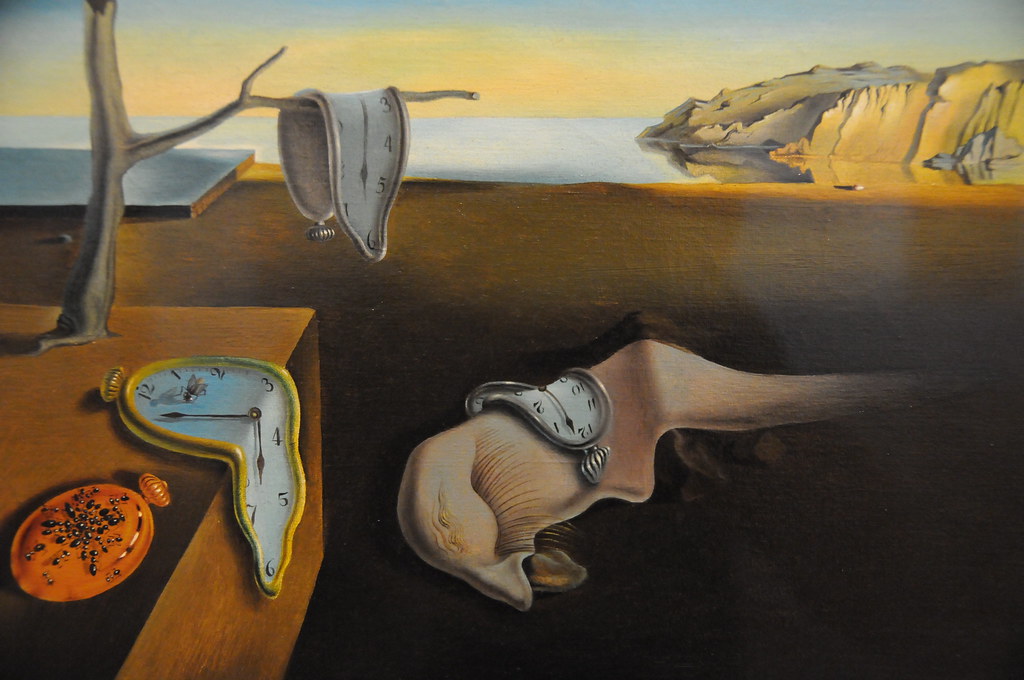
“The Persistence of Memory” by Salvidor Dali

My affirmation today is, again, I am enough. I am enjoying this theme and I think it’s worth reflecting on regularly. It can be expanded to include this is enough, and it makes me think now about gratitude. A quote we had on the wall for a while:

Gratitude turns what we have into enough.

That which is, is enough.

I got up early enough. There is enough time to do whatever needs to be done. I do enough of what I want. The weather is warm enough (this is easy today because the weather is perfect). I have enough energy to be productive enough today. I am enough without being productive.

The last few days have been “hijacked” by life, resulting in me not being able to do what I wanted to do, which was work on kHeart projects. Life has been this way a lot lately – enough to show me that there is something for me to be seeing.

What does that mean? What am I supposed to be seeing?

I am supposed to be seeing and looking at the reality that life doesn’t always go as we planned – in fact, it never does. We know the saying, “Life is what happens while you were busy making plans.” The future is never as we imagined it would be.

In the space between the present and the future, there is a line between getting our way and getting out of the way, between getting what we want and going with the flow.

I am beginning to see that the idea of attachment and non-attachment applies to time and events as much as it applies to material possessions.

I understand non-attachment in the material realm and am generally okay with not getting or having possessions. I am learning now that I have something to learn about accepting and adapting to situations where I don’t get what I want in terms of controlling the way I spend my time.

For most of my life I have been a loner, and I don’t mean that in a self-disparaging way: my upbringing lead to me being comfortable with being alone, and I was mostly happy with that. Sometimes I was lonely, but I adapted and came to enjoy having lots of time alone. I am mostly an introvert as well, so I need time alone to recharge. The “lone wolf” is a descriptor that applies better than “loner”: I have friends that I see now and then, but mostly I’m pretty self-contained.

I am seeing a narrative emerge here – a story I tell myself about myself – and I’m seeing that a guided journaling practice might help others to see where narratives are running the way they think about themselves.

I see it as a narrative because I see how I am telling you how I was or am. If it can be told, it is a narrative, and if it can be told one way it can be told another. It makes me think of the Taoist idea: if it can be named, it is not the Tao.

Meaning that if I can tell you about it, it is not the truth – if I can tell you about myself, I am not telling you about my true nature. Everything we tell about ourselves – every narrative we create to explain ourselves – is a fiction, a construct. It is not the truth, but a choice between various and myriad lies or fictions, illusions.

I’m getting obscure again, but this is ephemeral territory, the metaphysical and the esoteric. The exoteric is an example.

My son Zane has told me things about himself, like “I’m not the sort of person who … [insert character trait here] … likes to talk about his feelings … likes learning … likes slow movies.” When Zane has done this I have recognised that these are very much choices he is making about identity, not expressions of his true nature. These claims have been made over the last five years, between the ages of 9 and 14, a time of development when children begin realising they have an identity they need to understand. They are seeing that they are not just expressions of their parents, but individual entities and there seems to be an urgency to claim their own identity. When he has made these claims I have tried to say variations of “maybe that will change one day”, because I want for him to not become locked-in to one identity-choice or another. Imagine a person believing their whole life that they are not the sort of person who likes to talk about their feelings. (Like human beings can be sorted into this or that category like so many biscuits behind a barcode!) That would be a prison on the island of the illusion of independence – no man being an island and all that.

Something I don’t have to imagine is a person believing their whole life that they are happier when they are alone. I don’t have to imagine this because it is a belief I have been narrating to myself my whole life – because a bunch of people let me down early in life, and I decided I would be better of without them and they would be better off without me. Trouble is, “they” was a specific group of people back then, whereas now “they” applies to the whole amorphous group of people known as everyone other than me.

As an adult I choose to share my aloneness with a few select others who show that they care about me and are able to let me care about them, but because I was mistreated by a select few as a child – my brother, father and some kids at school – I must have told myself at some point that I am the sort of person who doesn’t need friends to be happy, that I am the sort of person who is happy to be alone.

After a slew of toxic relationships in my young adulthood (before I met Nikki) I had resigned myself to believing that I would be happier to be single my whole life than to continue from one toxic relationship to another. I had resigned myself to dying alone, using justifications such as “we are each alone at death anyway”.

I’m rambling a bit, but that’s okay because this has become an exercise in questioning the narratives that dictate my beliefs about my nature, true or otherwise.

I have been thinking, these last few days when I haven’t been able to get what I want, that I need to figure out how to get more solitude in my life(style).

That word “more” is a clue and a key. If we are saying we need more of this or that (more money, a job that is more fulfilling, more time, more time alone, more time alone doing this or that … it’s an endless list of more and more qualifications of what we want from what is) then we are not living from the awareness of enoughness.

Understanding this in relation to time is the challenge I am currently facing, which I choose to accept.

When I am frustrated that I am not getting the time I want, I see that attachment is at work and I remember that this is enough. That which is, is enough.

That is my affirmation today, should I choose to accept it.

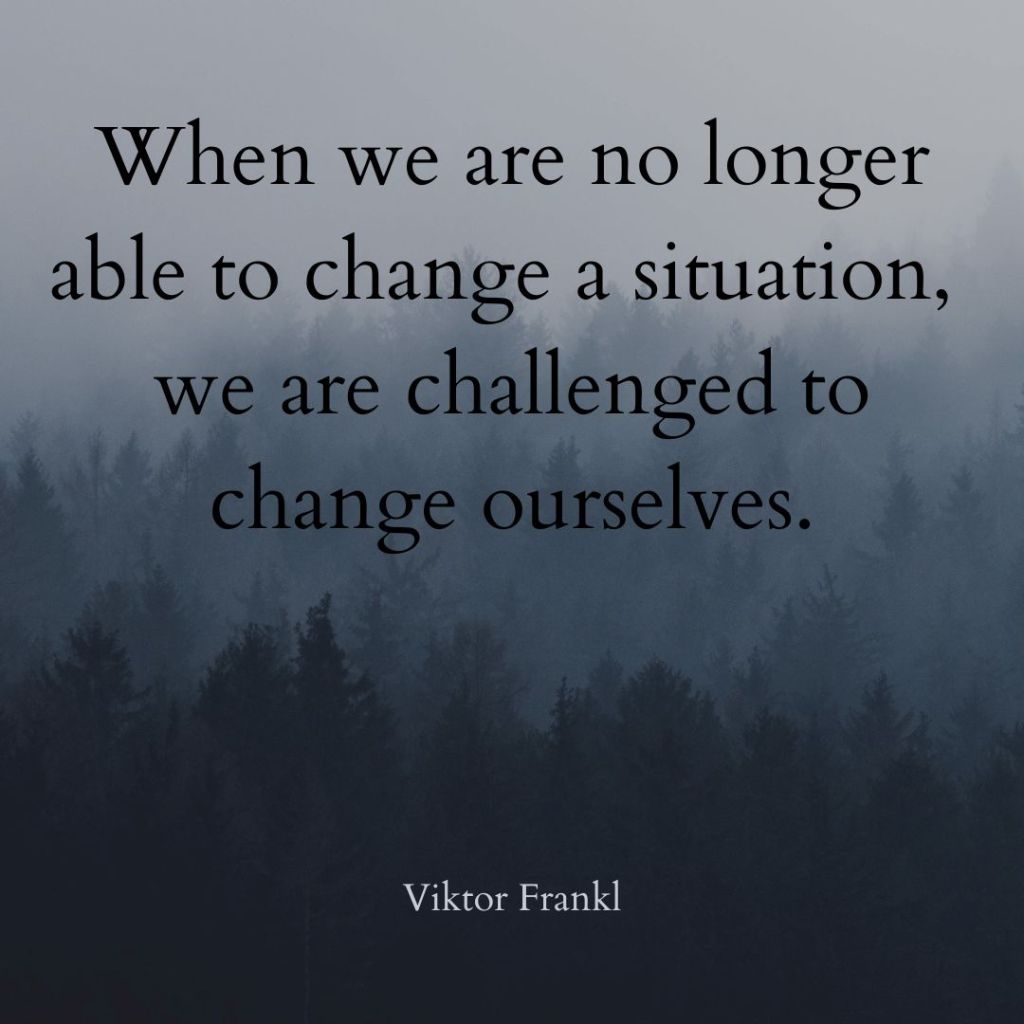
Frustration is a red flag that attachment is operating. I can try to make that which is different, or I can choose to adapt and feel grateful and allow whatever is to be. I can choose to get out of the way and allow my resistance to that which is to dissipate. And in this way I can allow a new narrative to write itself: I am equally happy when my time is spent alone or with people; if I cannot change the external conditions/situation dictating that I must spend more time with others than I am used to or would like, then I must accept only that which I can change, which is how I feel about the situation/condition. Remember Frankl:

When we are no longer able to change a situation,
we are challenged to change ourselves.

the motes fleet again

Photo by Iva Rajović on Unsplash

I wrote recently about a problem we’re having with a housemate, and it’s become clear now that we are living with an abuser. It sounds drastic when I put it on paper like that, but it’s true. We have been repeatedly abused by a person who is deeply unwell. I’m writing here to get my head around it, and to see what insight I can glean for Kokoro about psychospiritual wellbeing. I wrote in the other post about how situations like these are symptoms of culture that is psychospiritually unwell, and in this post I’d like to reflect on what I’ve learned about the dubious role of justice and control.

I may never understand This Person’s behaviour. This case is like a photographic negative, starting with someone who is profoundly unwell to see what we can learn about wellness. I’ve done lots of journalling and talking around this, and I’m still confused, so my apologies if the following is not always coherent.

We were going to have our first full day at home since the Incident, but we chose that day to ask if she had found a new place, whereupon she finally admitted that she had decided to not move out. We had been waiting patiently, not wanting to poke the hornet nest, but the idea of her staying three months until the end of the lease was not acceptable. I asserted a boundary: we cannot continue to live with her unless she apologises and starts being accountable for the way she treated us.

Continue reading the motes fleet again