
Busting the myth of psychopathology using … semantics!
(The pen is a mighty tool.)
And reflections on understanding what
mental-health recovery means for me.

An insight that is percolating in me at the moment …
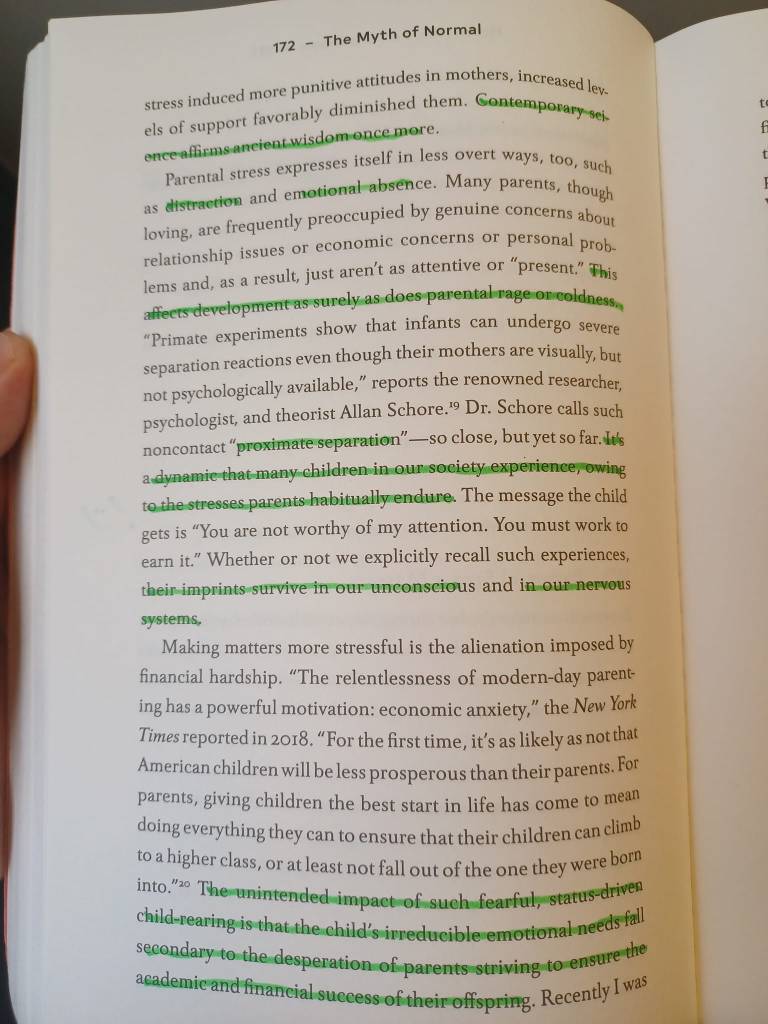
… after confirming with my therapist and the work of Gabor Maté that my condition is relatively normal and healthy (‘understandable’ is Maté’s term1) and our family dysfunction within the range of healthy …
… and while studying and practising peer work …
… is that “recovery” (from mental-health conditions or substance misuse or whatever) does not necessarily mean the absence of symptoms.
👆🏼That right there is a powerful insight for me!
The insight started with some unexpected reflection on my attachment style (disorganised) and the recognition that I don’t need assurance that my attachment with Nikki (or any significant other) is secure. In that mood I can safely practise the health-giving practice of authenticity.
a digression about boundaries
It is about authenticity: not needing that assurance that our survival depends on attachment.
A disorganised attachment style is a symptom, and “recovery” doesn’t necessarily mean living symptom free but means living in harmony (in good relationship) with the manifestation of the best response we know for these unnatural circumstances2.
An instance that illustrates this is the tussle between anxious and avoidant attachment styles (that tussle being called the disorganised attachment style): by knowing my symptoms as they manifest in certain traits and tendencies and reactive patterns, I can live with them and not worry that their occurrence means I have some problem. And without living in fear that if I’m triggered these maladaptive habits will over-run me before I can regulate. Which generally prevents me from engaging with certain important relationships because I’m anxious that I’ll fuck it up and further exacerbates symptoms.
They (the patterns) were how I adapted and they don’t need to dominate my interpretation and/or be maladaptive. I can see them for what they are, the same as when I know the types of cognitive distortions that tend to emerge when I am triggered.
I can see them as trauma responses and let them go, thereby exhausting the negative karma that caused them, reducing suffering and pointing me toward wholeness.
These models (such as attachment styles) help develop emotional and psychological granularity and vocabulary, enabling us to imagine and articulate a more nuanced inner landscape, helping us to navigate the experience of living with and thriving from/through the mental-health conditions that are an understandable response to the culture and world we live in today.
I like that phrase as it comes out now, and that’s where the insight really landed for me: mental-health conditions is good terminology because it clearly connotes illness but literally just means (denotes) the condition of health.
It puts our mental condition on a health spectrum, meaning it’s just varying degrees of health we’re talking about – eliminating and preculding the very concept of psychopathology.
I have a mental-health condition – I am in a condition of mental health.
It doesn’t sound like much, but it means something to me right now.
the Buddhist connection
Reflecting on this again after another shift at work, I really do like this phrase mental-health condition, and the acceptance that I live with symptoms, because mental-health symptoms are a natural consequence of the human condition, the human condition being characterised by suffering, delusion.
The Buddhist view puts mental health in an interesting context and on a spectrum (of illness), saying the human condition itself is a form (the ultimate form!) of mental illness. This sits nicely for me because it says all human experience is a spectrum of illness and the phrase ‘mental-health condition’ offsets this with its opposite: that all human experience is on a spectrum of health.
The one precludes all psychopathology altogether, the other precludes the hope for health (bleak!) by precluding health altogether! And as a paradox they collapse duality and leave me with an acceptant contentment that the symptoms I live with are understandable, manageable and meaningful, I can live a happy and constructive and meaningful life in their presence.
I do not need these symptoms to be absent for me to feel healthy.
That’s recovery for me.
For me (with attachment/relational trauma) much of the work of staying healthy among these symptoms involves understanding my attachment style.
So there you have it! A solution to all the world’s mental illness in one short blog post 🤣
I’d love to know what you think — drop me a comment or write me a DM.
 Kokoro 心 Heart