mental-health conditions 

Busting the myth of psychopathology using … semantics!
(The pen is a mighty tool.)
And reflections on understanding what
mental-health recovery means for me. 

An insight that is percolating in me at the moment …  

… after confirming with my therapist and the work of Gabor Maté that my condition is relatively normal and healthy (‘understandable’ is Maté’s term1) and our family dysfunction within the range of healthy …  

… and while studying and practising peer work …  

… is that “recovery” (from mental-health conditions or substance misuse or whatever) does not necessarily mean the absence of symptoms.  

👆🏼That right there is a powerful insight for me! 

The insight started with some unexpected reflection on my attachment style (disorganised) and the recognition that I don’t need assurance that my attachment with Nikki (or any significant other) is secure. In that mood I can safely practise the health-giving practice of authenticity. 

a digression about boundaries 

It is about authenticity: not needing that assurance that our survival depends on attachment.  

A disorganised attachment style is a symptom, and “recovery” doesn’t necessarily mean living symptom free but means living in harmony (in good relationship) with the manifestation of the best response we know for these unnatural circumstances2.   

An instance that illustrates this is the tussle between anxious and avoidant attachment styles (that tussle being called the disorganised attachment style): by knowing my symptoms as they manifest in certain traits and tendencies and reactive patterns, I can live with them and not worry that their occurrence means I have some problem. And without living in fear that if I’m triggered these maladaptive habits will over-run me before I can regulate. Which generally prevents me from engaging with certain important relationships because I’m anxious that I’ll fuck it up and further exacerbates symptoms.

They (the patterns) were how I adapted and they don’t need to dominate my interpretation and/or be maladaptive. I can see them for what they are, the same as when I know the types of cognitive distortions that tend to emerge when I am triggered.

I can see them as trauma responses and let them go, thereby exhausting the negative karma that caused them, reducing suffering and pointing me toward wholeness.  

These models (such as attachment styles) help develop emotional and psychological granularity and vocabulary, enabling us to imagine and articulate a more nuanced inner landscape, helping us to navigate the experience of living with and thriving from/through the mental-health conditions that are an understandable response to the culture and world we live in today.  

I like that phrase as it comes out now, and that’s where the insight really landed for me: mental-health conditions is good terminology because it clearly connotes illness but literally just means (denotes) the condition of health.  

It puts our mental condition on a health spectrum, meaning it’s just varying degrees of health we’re talking about – eliminating and preculding the very concept of psychopathology.  

I have a mental-health condition – I am in a condition of mental health.  

It doesn’t sound like much, but it means something to me right now.  

the Buddhist connection 

Reflecting on this again after another shift at work, I really do like this phrase mental-health condition, and the acceptance that I live with symptoms, because mental-health symptoms are a natural consequence of the human condition, the human condition being characterised by suffering, delusion. 

The Buddhist view puts mental health in an interesting context and on a spectrum (of illness), saying the human condition itself is a form (the ultimate form!) of mental illness. This sits nicely for me because it says all human experience is a spectrum of illness and the phrase ‘mental-health condition’ offsets this with its opposite: that all human experience is on a spectrum of health.  

The one precludes all psychopathology altogether, the other precludes the hope for health (bleak!) by precluding health altogether! And as a paradox they collapse duality and leave me with an acceptant contentment that the symptoms I live with are understandable, manageable and meaningful, I can live a happy and constructive and meaningful life in their presence.  

I do not need these symptoms to be absent for me to feel healthy.  

That’s recovery for me. 

For me (with attachment/relational trauma) much of the work of staying healthy among these symptoms involves understanding my attachment style.  

So there you have it! A solution to all the world’s mental illness in one short blog post 🤣 

I’d love to know what you think — drop me a comment or write me a DM.  

footnotes

  1. meaning, ‘a natural consequence of our toxic culture’ as well as ‘able to be comprehended’  ↩︎
  2. those circumstances being our toxic culture (Maté, 2020)  ↩︎

EP re-connecting with Self to avoid being an existential suckhole

This is the EP version of this idea that if we don’t have connection with self (which is the definition and consequence of trauma), there is a tendency to seek that connection with other, either other people or other stuff, things external to the self, and wind up sucking the other dry.

Insights are emerging out of some tension that has been plaguing the family for the last week or so1, and a very valuable lesson:

when we don’t have connection with self (which is the definition and consequence of trauma) there is a tendency to seek that connection with other, either other people or other stuff, things external to the self;

knowing our needs is a function of connection with self, meaning that we meet our psychological needs by connecting with self and to connect with self we need to be meeting our needs; 

when we give to, serve, or try to help others (without connection with self), we often end up doing the opposite of giving, which is sucking, taking, draining …

We end up sucking from others when we are trying to give, or when we think we love them, because instead of giving we are taking, sucking, a natural metaphysical consequence of there being a void or vacuum where our connection with self once was ~ we become a psychological blackhole, syphoning from others what we can only truly get from connection with self.

The formal term for this is “being an existential suckhole”.

I don’t mean to sound so obtuse ~ I’m just trying to work this out. 

We reconnect with self by recovering from or releasing trauma, and through contemplative transpersonal practices (because by ‘self’ I actually mean ‘the part of us that transcends personal identification’).

How do we release trauma and integrate the parts of ourselves that we exiled during events we found traumatising? I cannot articulate that right now but it’s a central aspect of the Heartwards modularity

I’m sure there’s literature around this and it sounds very much like something Buddha would say (I’m thinking of the “wrong objects” here) and I am interested in seeing that documentation but for right now the insight feels real enough to not need validation. 

I drafted a lot more for this post and have hacked it back to the above so I can get something up here for the day. More to come.

Photo by Andrea Piacquadio on Pexels.com
  1.  truth is it’s been plaguing us for years, generations, but this week it has come to a head again, as it does, crying to be seen ↩︎

a modularity for transpersonal development

I got around to uploading the bones of what I’ve started calling “a modularity”, describing the framework that is developing around me for helping others recover from small-t trauma and experience sustainable genuine happiness.

If you’re interested in transcending the inherently limited personal/human ego and experiencing a much-expanded perspective of our true place in and relationship to reality, check it out.

If you value being happy, check it out!

imagination + trauma release

Working with a Somatic Experiencing therapist yesterday, I realised we have this incredible interface between the mind and the body and it’s called the imagination ~ shaman’s know this, and we too can learn the language of the body by tuning in to the imagery that comes up during emotional episodes.

When I allowed it, mine was a snake uncoiling from a clay-lump of anxiety to eat up the meat-confetti of shame that was underneath an immense well of sadness. The trauma release that followed was blessedly story-free.

The body really does know the score … and … because I love mincing metaphors … the music is light and sweet.

envisioning a culture of happiness instead of productivity

I’m taking a Mental Health Day today because I started to notice my window of tolerance was narrowing – I was becoming easily irritable, easily triggered and generally just unhappy and stressed. A lot of shit’s been going down lately, and we can’t seem to get a break lately, so I decided to take one. I’m starting a small business, and part of the reason for doing this was so I could keep my own hours – what’s the sense of starting that and then doing 40 hours weeks because my conditioning says so!?

I have a vision for our culture where taking such Mental Health Days is normal and encouraged, more important than the days we are being productive at work. What’s the point of being productive if we’re fucking hating ourselves for it!? This is something like GNH instead of GDP but I don’t want to unpack that now.

A lot of sadness was near the surface for me yesterday and I figured something must be going on or coming through and I want to stop and be present for that.

Also, I need to fill my cup.

As I mentioned the other day, we are living with complex trauma and expecting ourselves to be “on” all the time is a bit silly – we need downtime, time to rejuvenate. By “we” I mean “Nikki and I” but also pretty much everyone in our whole culture, considering everyone is living complex trauma due to the nature of our society, which is pretty fucked up when you think about it, but that’s how it is and we need to see that in the face. 

I can’t remember what triggered the sadness orginally, but I know it had something to do with Zane. I had it affirmed by a Blue Knot counsellor that as parents we are often triggered easily during the time our children are the age we were when we were traumatised. 

I know it is this because of the emotions that came up when Zane came out while I was drafting this and said good morning, asked how my sleep was. I told him not good and he apologised, knowing that the sleeplessness was partly due to our concern around catching him smoking bongs in his room last night. I was doing the same thing at his age, and the subsequent heavy pot habit left me with a lot of unprocessed emotional pain. I told him (in not quite these words) I just want him to look after his brain, and it’s upsetting to watch him go down the path of self-harm but I have to trust that he’ll learn for himself.

He looked remorseful and/but said thank you, and it’s a weird thing because maybe his unexpected gratitude made me sad because trust is all I needed at his age (instead of the weird manipulative controlly things Mum used to say), or maybe it’s because she did say things like “I trust you” and going through this now as a parent is just too close to home. 

I want him to avoid the future pain I know is on the path of self-medication he’s on. 

But I’m not so naive that I believe I can actually prevent this for him – and when I really think about it, I wouldn’t want to deny him the opportunity to learn from his own karma. 

But that’s not even the guts of it. 

The guts of it is, I think, I’m sad because I don’t know which of the above I’m sad about, if any – I’m sad because I don’t remember those years of my life at all and that means I’ve lost something, a big part of myself and my history and that continuity of self we depend on for having a safe sense of being. 

Something like that. 

There’s a break in the narrative I use to understand and connect with my self.

Seems I repressed a lot of my adolescence – or I went somewhere else during that time because the pain was too much. 

I still do this, living in my head because being present in the body is too … unsatisfactory? Too much dukkha, not enough skill for coping with the suffering of samsara, much less the readily accessible capacity to transmute that suffering into joy.

That sort of alchemy is still a possibility though, which is nice to remember.

Yes, that’s why I’ve taken this Mental Health Day: to remember and spend some time with the “base metals” we transmute into “gold” through doing the work of accepting reality as it is.

That might not make a lot of sense off the bat – or it might … it might make perfect sense to you. Either way, here’s a button if you’re curious about it and would like to connect around this idea: 

Meanwhile yes, back to what the Blue Knot counsellor was saying: there is trauma in there and a shadow of course and the sadness is a healthy indication that this trauma is presenting itself to be seen, acknowledged, recognised, embraced, loved. 

One of the few things I am confident about is that by not resisting these things that come up from our wounds, the wounds express themselves (in the sense a wound expresses puss) and in doing so, the wound self-heals. 

Humans are self-correcting, like everything on Gaia. We just need to allow the process without interrupting it, without distracting ourselves, without self-medicating or working ourselves into the ground or whatever we do to avoid the pain.

If we resist what’s coming up, then we just push it back down into the unconscious where it continues to fester and it will inevitably come up again, only worse and more vague and difficult to understand because each time we push it down it becomes more and more muddled with that big amorphous painbody inside us, like a huge blob of secondhand bluetac we’ve accumulated from every house where we ever hung a poster. 

We can learn to be non-resistant by embracing what I am choosing to refer to as ahimsa, which is the classic Sanskrit word for “non-violence”.

Our resistance to reality (including … especially … the reality of the pain that wells up from our unconscious on the daily) is a form of violence. 

Metaphysical violence if you will. Psychological self-violence. Through the force of habituated will, we push away what we don’t like about reality. 

We can train ourselves to not do this, and if you’d like to learn this with me, get in touch for a 

Because that’s a huge part of what I’m doing at Heartwards as a trainer and coach in psychological fitness and integrative wellness: I am training myself in ahimsa, so that I suffer less and can help others to suffer less.

Thereby unleashing happy, healthy and empowered individuals who are resourced enough to do their good service in the world. Because resistance drains a lot of energy, and literally gets us nowhere. 

Suffering = Reality x resistance

Happiness = Reality x acceptance

And I envision a culture where we are all able to do this. Where it is respected to take Mental Health Days so we can check in with where our resistance is at because, for example, Gross National Happiness is more valued than Gross Domestic Product in this new culture.

Because what’s the point of being productive all the time if we’re hating ourselves while we’re at it!?

living with complex trauma

*TRIGGER WARNING* This post discusses childhood abuse, neglect and abandonment. If you feel distressed at anytime, try reaching out to one of the support lines listed here.

I rang Blue Knot yesterday because I found them when I searched online to find a hotline for people whose loved ones live with CPTSD. Nikki’s not been doing so well lately and it’s beginning to take its toll on me. This is something that is hard for me to say and has been hard for me to accept: it’s taking its toll on me; my wife is living with complex trauma, and mostly we manage but sometimes I run out of the capacity to cope with the challenges that come with loving and living with someone who has experienced complex trauma. Our son Zane is also living with complex trauma from being in the womb when Nikki was being abused by his biological father.

On top of that, as I was reminded by the counsellor at Blue Knot, I have my own complex trauma to live with. 

I called them to get support as someone whose loved ones have complex trauma in their background, and was reminded that I need support for the complex trauma in my own background. 

There is a new-paradigm understanding of trauma emerging – thanks to the likes of Peter Levine and Gabor Mate – and in this view we understand that developmental and relational trauma can result from early-life experiences that were normalised in the suburban 80s when I was being raised:

abandonment, emotional neglect and/or emotional incest, being abused and belittled by your siblings, bullied at school, bashed by thugs as a teenager … these are all experiences in my background, and this list doesn’t even account for the birth trauma itself and the trauma of industrial postnatal care for babies. 

Blue Knot reminded me that all of this is real. The symptoms I described on the call were confirmed as trauma related, and I recall ticking many items on the symptoms checklist when I read Levine’s Waking the Tiger. It was affirmed on the call that as parents, we are often triggered when our children go through the age we were when we were traumatised, which is definitely happening as Zane goes into the early teenage years.

It surprises me that I know I live with complex trauma myself, yet it took me feeling my wits’ end in supporting someone else through trauma recovery to remember or have the fact of my own trauma validated. (I think there might be a spectrum distinction between “complex trauma” and CPTSD and I certainly don’t feel like my lived experience of trauma amounts to a disorder, but I certainly exhibit many of the traits.) 

That’s how it goes I guess. The call with Blue Knot reminded me that the trauma I’m living with is very innocuous and hard to detect because the causal events are so normalised in our culture. On top of that, there are no physical scars I can show to prove my trauma is real, and no single causal event that resulted in traumatisation … that’s one of the things about complex trauma: there’s no single event we can pin down as the cause. I wasn’t abused in the sense that is typically understood to result in trauma – a lot of us weren’t, but still we are traumatised. Says something about our culture.

For these reasons, this kind of trauma often flies under the radar, causing a low hum of very subtle misery that is difficult to detect. The lack of self-love and -worth that results from such trauma has also been normalised, like it’s the only way of being we’ve ever really known anyway. 

A similar phenomenon is operating when we compare workaholism to heroin addiction: the latter is very obviously a harmful maladaptive coping mechanism that warrants treatment and is probably a symptom of trauma; the former is a harmful maladaptive coping mechanism that warrants treatment and is probably a symptom of trauma, but fails to be recognised as such because work addiction is normalised, even celebrated, yet it can rob someone of their life the same as heroin addiction can. 

So a thing that I pledge as a central purpose of Heartwards is to help shed light on this emerging new-paradigm view of trauma, and to help individuals recognise and treat the symptoms of complex trauma they notice in themselves. 

If we keep just fumbling along with our pain buried in the unconscious like hands into pockets in the depths of winter, we are going to just continue running ourselves and the planet into the ground as we seek to numb the pain or fill the void by sucking the world dry in our pleasure-seeking avoidance. 

The counsellor on the Blue Knot call said something about the unconscious: how we repress our pain and shame and try to hide from it. 

We cannot run from it forever. I believe that if we do not embrace and heal it in this lifetime, we will just come back for another round, again and again until we learn. 

Even in this lifetime, if we retain the trauma in our body because we don’t learn how to release it, we can think we are successfully avoiding it until it recurs again through a phenomenon described by Levine as “re-enactment”.

I don’t properly understand what re-enactment is or how it works, but I’m going to ask when I call Blue Knot back. 

They are a team-based counselling hotline, which means I won’t get the same counsellor each time but apparently they keep good case notes to make up for this, and it means I’ll get diverse perspectives. Their catchphrase is “empowering recovery from complex trauma”.

The person I spoke to was really great, and I recommend getting in touch if you’re living with complex trauma or someone who is. Even if you’re not sure but you have a vague suspicion that something was a bit off in your early development or upbringing, I reckon it’s worth a call. You might find explanations for symptoms that have been bothering you for ages but were just kind of resigned to living with. The number I called was 1300 657 380.

The main thing I got from the call today was that we can’t support our loved ones through recovery from complex trauma when we do not have enough internal resources left in our reserves. The analogy the counsellor used was from a teacup: we cannot share tea from an empty cup. This backs up my oxygen-mask analogy: we can’t help others if we’re dead.

I have only recently been able to start refilling my teacup after a very challenging 18 months or so, especially in the last 6 months while we were living with the abuser who triggered Nikki’s trauma, which I wrote about in other posts. We resolved that we would not leave anyone alone with the perpetrator, in case she caught someone alone and took the opportunity to manipulate or concoct a story while there were no witnesses around. 

The main advice from the call today was that the best way for me to support Nikki is by first taking care of myself.

This is not indulgent or selfish, anymore than putting on the oxygen mask is selfish before we start helping others in a plane crash.

We cannot help others when we’re dead – or when our own nervous system is so frazzled that every minor tension creates a flee response. 

As I continue doing the work of healing my child self, I will become more able to be available for Nikki and others when needed. 

If I neglect the work of healing my own trauma, I will continue fucking out when others need me most, 

and worse – I will continue attracting myself to situations where the original trauma response is seeking to exhaust itself. (I think that’s the gist of re-enactment.)

Not “fucking out” … that’s the wrong language, when falling to my knees in despair is really what’s happening each time my own and others’ trauma feels overwhelming. 

If I neglect the work of healing my own trauma, I will stagnate among the low hum of misery that expresses itself like puss from the unconscious, and my purpose to help others flourish will languish unrealised. 

Yours too maybe. 

If any of this resonates with you, get in touch or have a look around at Kokoro 心 Heart, where I’m working to promote a healthy world arising out of healthy minds. 

This page of resources might also interest you meanwhile. 

literary narrative therapy, a modularity

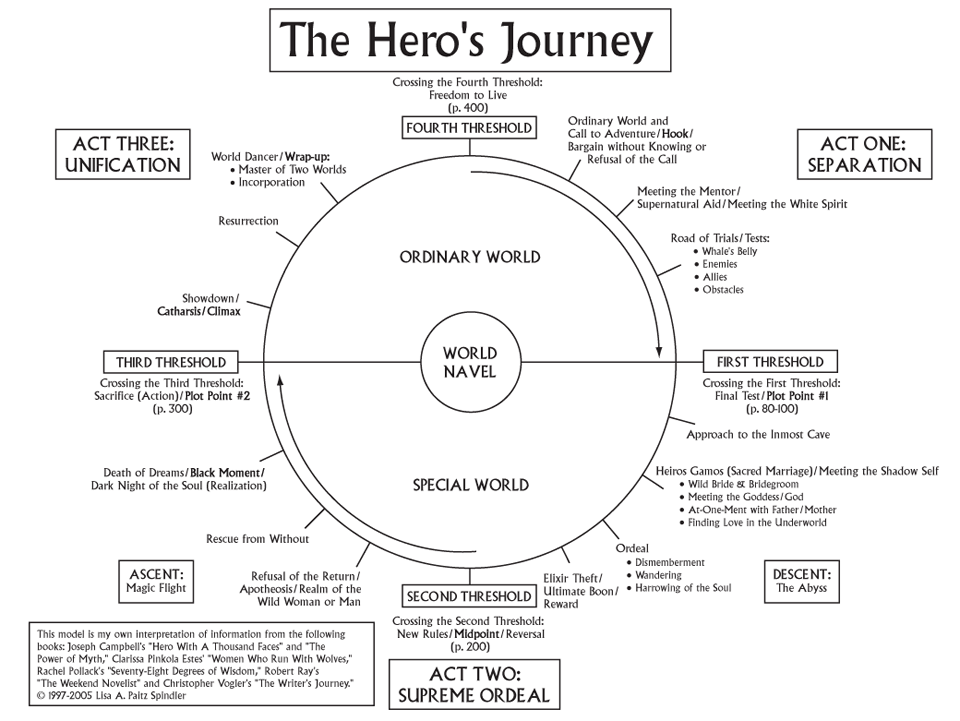
I am developing a psychological healing modality that uses narrative therapy as a way to rewrite the stories we tell ourselves about the past. This is not new — simply my iteration of something others have already been working on. I’m having fun with it. The structure of the program is based on Joseph Campbell’s mythological archeology of the Hero’s Journey, as described in [The Hero with a Thousand Faces].

To call it a modality sounds a bit too much like it’s anything like a comprehensive suite of training and practices that’ll be the cure for what ail’s ya, but of course no single modality is a panacea. They should be called modularities, because each nests with others in a way that is complementary toward some kind of whole. Literary Narrative Therapy (NFT) is being designed as a complement to other modalities in this way.

I’m uploading the documentation as an experiment in something like public-beta testing. I’m really excited about this because it feels bold and vulnerable and open-source to share this process publicly, a work/practice I am developing and exploring myself and for myself, with the intention of sharing the material and process in a more-formal package down the track.

Play with this and think of it like a sandbox. If you want to contribute, leave feedback and get in touch. The Journey is a narrative structure and set of narrative devices we can use to practice rewriting the neural pathways of old beliefs that no longer serve us. Often we feel like victims of our experience – of the things that happen to and around us, of culture and social pressures. Literary narrative therapy can help us to change our self-perspective from one of the Victim to one of the Hero.

The documentation can be downloaded as a PDF if you’d prefer to take these files AFK and play with them in the park, where they might get caught in the breeze and take you to nether regions of the spirit you may never have previously imagined. Here is the Journey Worksheet. Here is a worksheet for Background Reflections / Documentation.

These documents and the process will evolve at the Literary Narrative Therapy page on Kokoro 心 Heart.