
Point One The preliminaries, which are the basis for dharma practice
Slogan One First, train in the preliminaries (the Four Reminders or the Four Thoughts)
Reminder One Maintain an awareness of the preciousness of human life
I have been trying to reflect on slogan one this week, but not that much has been coming up that has caused me to remember to reflect. I didn’t nearly die, which is nice. We did have a pretty serious mental-health scare with our son though, which happened after I started long-handing this draft. Consider that a trigger warning I suppose.
I guess without a trigger, the first reminder of slogan one is a pretty broad sweep as far as philosophical subjects go, the idea that human rebirth is a rare opportunity to work on our karmic balance and move some way to a more enlightened way of being. In our culture we’re not exactly trained to do anything more with the idea of human existence than take it for granted. Maybe the Tibetans weren’t either and that’s why it was made the number-one slogan. Daily meditation would be a good way to bring these slogans to the fore each day, but I’m only just restarting my pogrom this week, and slowly at that.
When I grumbled at Zane recently for being selfish I thought (after a while), Hey, maybe a slogan like this could help me to be more patient. (He’s 12, so selfishness is almost a natural expression of emergent self-identity, considering he’s only just beginning to realise he may or may not actually have a self that’s independent from others – so the suffering begins.) This is a rare opportunity for Zane as well, and if awareness of this slogan meant he got a skerrick more compassion from me, that would be a leg up for him. Some of the other slogans will be a bit more specific to this kind of thing though I suspect.
Something else that came up while reflecting on this slogan was when we helped a guy at work who nearly fell off a ladder. And then my friend had a close call at work and texted me to stay safe. Two indirect encounters with mortality in one week (the week I was reflecting on this slogan …) combined with my dim awareness of this slogan has meant that I’m appreciating my own human life more at the moment, which makes tribulations easier to bear and makes the small triumphs more brilliant. Such is the power of a millennia-old psychotherapy.
I said to Nikki the other day that the human experience is both a blessing and a curse: we are, it seems, acutely more aware than other species that our suffering could be avoided, yet we are equally unable to avoid or assuage or mitigate that suffering. I mean, we could – that’s exactly the point of a psychotherapy such as Buddhism and teachings like the lojong, but who can remember this all the time? It is when we forget these teachings and practices that the tribulations begin to feel like a curse. The teachings remind us that being human is a blessing, the result of good karma and the opportunity to accumulate more, not something that should be squandered by, say, cursing our own existence.
This taps into something that is near and dear to my heart: the idea that thoughts are (mental) actions and therefore each thought comes with a karmic result; wishing to not exist (even without the intention to act on that wish), when considered alongside slogan one, must constitute a considerably negative mental action, with attendant negative karma.
Remember the Rage Against the Machine cover?
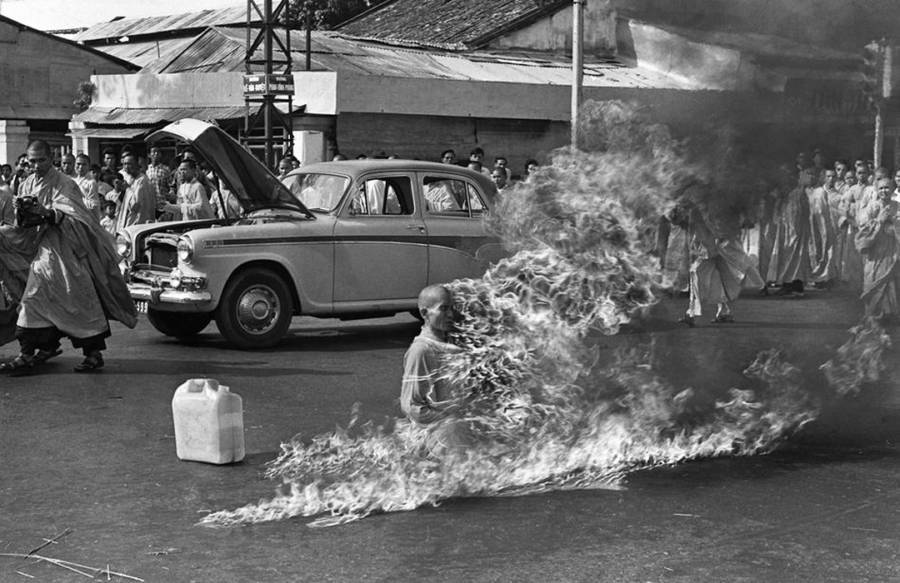
Even in the 90s before I knew more than rudimentary ideas about Buddhism, my friends and I knew the karmic sacrifice this monk had made by burning himself to death as a protest.
Even thinking about suicide has negative karmic consequences as far as I know, especially when considered alongside this slogan, and that might be all the take-away I need from reflecting on this slogan. I’m not going to mention this to Zane – introducing him to the dharma at a time in his development when everything we say is wrong by virtue of our having said it would be unskillful to say the least. Reflecting on this slogan has helped me enough to respond more compassionately to his our mental-health crises.
The slogan also came to mind when I was picking up some steel in the work truck. A trucker was grumbling at the office counter about how it’s always the drivers who suffer when the distributor is disorganised as they were on that day. That sort of ignorant and self-absorbed grumbling kind of annoys me: like everyone doesn’t suffer from how most adults these days are absolute numpties who couldn’t organise their way out of a wet paper bag! And I thought later that I’d like to have dropped some pithy comment about how rich we would be if we could transform such suffering into gold. Maybe it would have been taken literally, but sowing the seed of such a metaphor might have ended up yielding some sort of valuable reflection down the truck … um, track … for the poor suffering fellow.
I like the idea that dharma can be dropped among the most mundane situations if we have enough knowledge, experience and eloquence to do so without sounding like some kind of preacher. If we can thus enrich one person’s rare opportunity of human experience, then we are living the dharma and making good use of our own opportunity.
It’s been a great slogan to start on, and I’m enjoying the practice of reflecting on these slogans “weekly”. It’s probably been more like two weeks on the first slogan because I barely get time to scratch myself now that I’m working full-time for the first time since 2008, and I’m only just chipping away at the project, but I find it enriching to just know this project is in my peripheries. Ecoscaping is noble and rewarding work that means a lot to me, but there will always be a part of me that craves and needs a bit of intellectual and spiritual fodder in his diet.
 Kokoro 心 Heart