
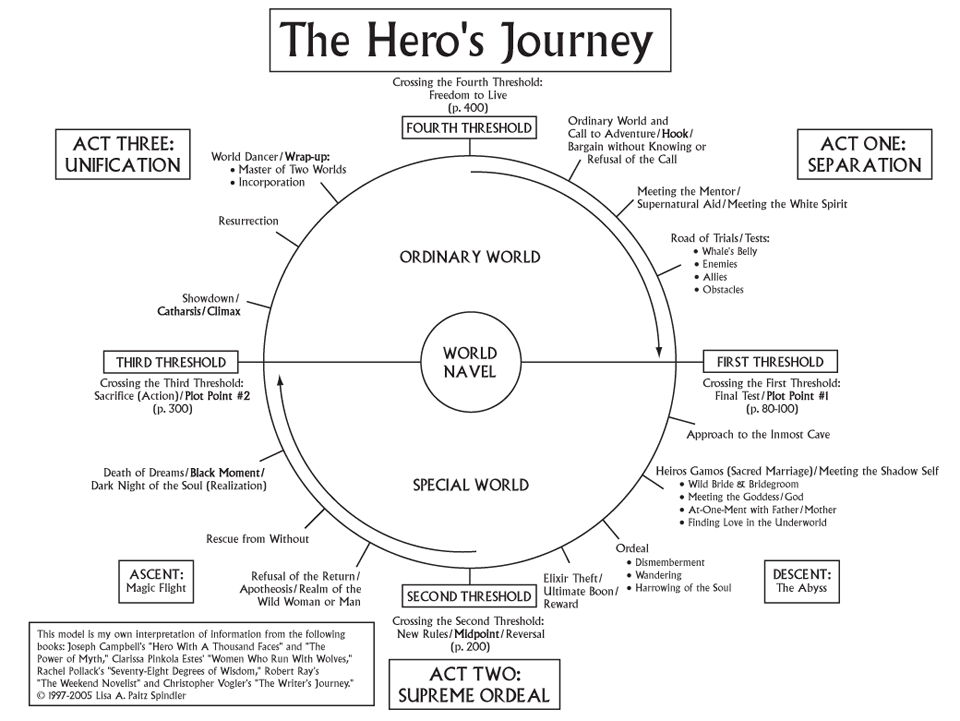
I am developing a psychological healing modality that uses narrative therapy as a way to rewrite the stories we tell ourselves about the past. This is not new — simply my iteration of something others have already been working on. I’m having fun with it. The structure of the program is based on Joseph Campbell’s mythological archeology of the Hero’s Journey, as described in [The Hero with a Thousand Faces].
To call it a modality sounds a bit too much like it’s anything like a comprehensive suite of training and practices that’ll be the cure for what ail’s ya, but of course no single modality is a panacea. They should be called modularities, because each nests with others in a way that is complementary toward some kind of whole. Literary Narrative Therapy (NFT) is being designed as a complement to other modalities in this way.
I’m uploading the documentation as an experiment in something like public-beta testing. I’m really excited about this because it feels bold and vulnerable and open-source to share this process publicly, a work/practice I am developing and exploring myself and for myself, with the intention of sharing the material and process in a more-formal package down the track.
Play with this and think of it like a sandbox. If you want to contribute, leave feedback and get in touch. The Journey is a narrative structure and set of narrative devices we can use to practice rewriting the neural pathways of old beliefs that no longer serve us. Often we feel like victims of our experience – of the things that happen to and around us, of culture and social pressures. Literary narrative therapy can help us to change our self-perspective from one of the Victim to one of the Hero.
The documentation can be downloaded as a PDF if you’d prefer to take these files AFK and play with them in the park, where they might get caught in the breeze and take you to nether regions of the spirit you may never have previously imagined. Here is the Journey Worksheet. Here is a worksheet for Background Reflections / Documentation.
These documents and the process will evolve at the Literary Narrative Therapy page on Kokoro 心 Heart.

 Kokoro 心 Heart