recovery is a process …

trigger warning suicidality

… not a product or a destination

I am very grateful to have had a call with my Peer Support Worker from Neami National today. I cancelled a number of appointments to clear my desk for three days of downtime during the TAFE holidays, but wanted to have this check-in, and I’m very glad I did.

She reminded me that recovery is not a thing we get to and then is over, finished, mission accomplished. It is a process, a journey, and it is important that I don’t become complacent when I am doing well. I need to remain vigilant, within reason ~ the cost-benefit scales are going to tip if I spend all the time I feel well just anticipating the next trigger and stumble.

She also helped me find some direction in navigating my path of trauma recovery, specifically. I am going to ask a Family Constellations practitioner if I can see them under Medicare on a Mental Health Care Plan. Circle of Security might also be an option, and Neami themselves ran a program of this ~ Nikki participated, and I understand there is a lot to be learned about how we can work with the attachment styles that resulted from attachment trauma, which is certainly a big factor in the constellation of things that trigger me.

When I am triggered, sometimes I get derailed from the wellness train for days at a time, and if things are going especially unwell, I can stay derailed for weeks, heavily dysregulated. It’s not okay. I can do my sadhana all I like and it does work, I am making slow but sure progress toward more-consistent wellbeing by applying myself to the modularity sadhana. But my sadhana is for the long-game and I need something more direct or immediate that’s going to help with the trauma so I don’t get so easily triggered.

After a wake-up call recently, wherein I spent a whole night feeling triggered and acutely suicidal, I am taking the process of trauma transformation seriously again ~ for one thing, I am seeing a friend who does Root Cause Therapy (RCT) at Creative Roots Breath Therapy. I never gave up the process altogether, though I have not done much Somatic Experiencing with Tracey lately. It’s definitely time to take deeper dive.

But yes, it was good to check in with my Peer Support Worker again. They provide a great (if little-known) service to the community, and if you’re curious about that, let me know. Or check out Neami here.

September dharma circle

Photo by Sagui Andrea on Pexels.com

We enjoyed another beautiful dharma circle on Saturday, our second. I am so grateful for Mónica and Natalie who arranged the whole thing using the running order / model we are beginning to co-create for a decentralised, non-hierarchical spiritual-practice group that operates in community. So exciting!

I’ve been so stretched this month and could not have pulled this together on my own. Mónica’s guided journey was deeply restorative for me and it was great to see some circlers from last month, plus a new circler Lo, welcome. And thank you Nat for holding the circle.

I feel very inspired about October and would like to cohost with someone at Brisbane Theosophical Society in Spring Hill (if we can arrange access in time). Does anyone want to share some thoughts and/or guide a journey with me for us? I can hold the container while someone takes the whole session, or share a mixture of short practices together.

There is a beautiful collaborative vibe around the place and I’m very happy to be a part of this.

If you are interested and happen to be in Brisbane, get in touch to chat about the circle and see if you’d like to get involved.

Brisvedas Dharma Circle

A disparate and spiritually secular sangha meeting locally around Brisbane to discuss the dharma and practice meditation together.

Not just a Buddhist group, but a group of anyone who seeks the truth through experiential means and is interested in being guided by an understanding of the ancient spiritual literatures.

We are hoping that anyone from any spiritual tradition will feel welcome to participate, events are co-facilitated by anyone who feels comfortable doing so.

forgiveness dispels victim mentality

a journal entry about how forgiveness is
loosening my attachment to a victim mentality

I have been doing a near-daily forgiveness training in my sadhana lately, and as I near the end of a 30-day rotation I was pleased to realise that a forgiveness practice can release us from the victim mentality. I had read about this in my research about this elusive heart quality, but I hadn’t yet really felt it. Now I have!

After nearly 30 days of this practice, having exhausted the people I could think of who I needed to forgive, I found myself moving on to the culture as a whole.

Now that’s a nebulous beast, the whole culture, and because I didn’t have one person or institution I could hang on to as the sole thing requiring forgiveness, the one distinct entity I felt resentful about, I found that I started moving into states of … let’s call it “resentment Teflon”!

In this state I recall once thinking of myself as a duck in the waters of resentment.

Point is, the resentment had nowhere to stick.

When I realised I could let go of all the resentment I hold for our culture and society being generally deficient (especially, for example, for being spiritually bankrupt) I found that a whole new sense of empowerment and personal responsibility + agency filled the void where resentment had been.

I was no longer the victim of a culture that didn’t meet my spiritual needs and was now an agent who could serve the spiritual needs of that culture.

This phrase comes to mind from a guy I met through men’s work: it’s not our fault, but it’s our responsibility.

This usually applies to the victims of trauma, abuse, neglect, meaning it’s not our fault we were traumatised, but it’s our responsibility to do the healing. No one else is going to do it. I feel the same now about the lack in our culture. I no longer feel let down by our culture because it doesn’t immediately meet my spiritual needs, and instead feel agency to meet my own, and empowered to help others meet theirs.

It’s not like there was ever a Golden Age of Spirituality. Maybe there were (and still are) traditional societies whose culture is based on spirituality. But these are not the cultures or times I live in. And generally speaking these pursuits were always marginalised, initiated and led and maintained by the few who decided it was their duty and honour, their way of serving humanity.

I had no idea this would emerge out of a sustained practice of cultivating forgiveness, but I’m grateful it has.

concentration depends on a healthy ego

Ah, clarity!
Photo by Francesco Ungaro on Pexels.com

After a meditation this morning where I was very easily distracted, unable to concentrate for long, I am wondering about the defilements and/or the Five Hindrances, and ethics (vinaya or virtue, in Buddhism). And the importance of a healthy ego in our practice.

We practise virtue to protect and support our concentration (the old example being that it’s hard to have a clear mind in the afternoon when we’ve committed murder in the morning), and we practise concentration to allow insight to penetrate illusion …

👆🏽 in this sense, concentration meditation is a transpersonal practice, and therefore everything that supports concentration is a therapeutic practice ~ this might seem like an arbitrary distinction (and isn’t duality precisely what we are trying to escape!?) but it’s a helpful dichotomy for me at the moment

… I thought, The mental content doesn’t seem to be about any obvious breach of ethics, so why is it that I am especially disturbed today?

Maybe it’s just that I wasn’t aware of how my conduct compromises one of the less-obvious precepts, such as ‘do not extol self over others’ or the one about not harbouring ill-will ~ one of the reasons I don’t meet Zane’s needs as a father is that I am still working on how to relinquish resentment. 

Maybe a distracted mind is just something a student needs to accept ~ radical acceptance.

It certainly seems that access to consistently strong concentration is dependent on factors outside my control, but also I’m not sure about that. 

There must be things we can do that support concentration.

I don’t know ~ I’m trying to find my way around understanding what to do with distraction in meditation, with what has been called kapicitta since Buddha’s time. Monkey mind! It’s old school.

Maybe the content was among the Hindrances (I desire to be more loving or a better dad). 

I had to look up ‘defilements’ again, and read about the kleshas ~ rooted in the Three Poisons of ignorance, attachment and aversion, the defilements or afflictions are the 108 mental states that disturb the mind and result in unwholesome actions.

So yeah, I was right in my wondering, even if I was supposed to be concentrating at the time and allowing thoughts to come, dwell and fall away. That is the practice, the whole practice and nothing but the practice. 

And yet, I was compelled to scrounge around for a pen and scribble on the nearest piece of paper (my precepts sheet), “I am enough”, because I felt I had arrived at some insight that was bugging me and would continue to bug me until I made a note and allowed myself to let go of the idea while I continued trying to concentrate.

As I currently understand it, the whole practice in Zen is to concentrate on an anchor that keeps us from indulging the monkey mind, and we concentrate some more until some kind of non-cognitive insight penetrates illusion. 

Yes but there are other things, such as ethics, which support the practice of concentration. Concentration is but one aspect of the Eightfold Path ~ surely the other aspects of the Path are complementary to concentration (samadhi). 

Let’s see if I can remember the others, and see if what I’m thinking about here fits among any of those: 

  1. right concentration 
  2. right mindfulness
  3. right effort
  4. right speech
  5. right action
  6. right livelihood
  7. right view
  8. right resolve

Maybe it falls within right view (samya dristi), but I’m guessing here ~ wondering whether our perception of self is an aspect of right view. If I have an unhealthy view of self, will that compromise concentration? I think so, yes.

Because it seemed a lot of the mental content (kleshas or afflictions) were about how I could be better: more loving, more organised, more efficient, more available, less distracted all the time, more able to concentrate, and I thought, We may need to complement our (transpersonal) concentration practice with the (therapeutic) practice of treating the health of our ego. 

If we cultivate healthy ego, our ego is not always going to be popping up and saying, “Do this!” or “Do that!” when we’re already damn-well trying to do exactly what we’re supposed to be doing, which is concentrating!

This is not a new insight for me ~ it’s been percolating for a while and keeps coming up in my reflections. Reflecting on it here has been helpful if only because it colours in the textures of my own practice. And these reflections may also illuminate beyond the lines of what I feel like calling “the original Buddhism” ~ I mean, we might need to elucidate other Hindrances or nuances of the kleshas to accommodate the mental state of humans in the 21st century compared with the mental state of humans when the Buddha was alive and teaching. 

As I draft this today I have been tinkering with the various documents where I am trying to track the development and expression of these ideas in a more coherent way that I can share with others, but for now this meandering post will have to do.

I love a good meandering post. 

I am distractedly curious and passionate about understanding and applying these ideas, and helping others to do so. As I move into the mental-health sector as a peer-support worker I hope to find opportunities to do so. 

Meanwhile, I have updated the Heartwards website where I am offering coaching services from a transpersonal perspective to help others recover from trauma and addiction. And I have opened but not worked on a hypertext project I think of more often again lately, called Whatness. I would like to add something about the Hindrances there, because processing such ideas enough to be able to express them, without reference to some other source, means I have integrated them enough to apply them on the fly. 

Meanwhile, if you’re reflecting on things that support concentration in meditation, I’d love to hear about in the comments. 

Legend 🤙🏼

slogan one, reminder two: be aware of death; impermanence

Point One The preliminaries, which are the basis for dharma practice

Slogan One First, train in the preliminaries (the Four Reminders or the Four Thoughts)

Reminder Two Be aware of the reality that life ends; death comes for everyone; Impermanence

~~~

*TRIGGER WARNING*

considering the state of our world and minds,
the idea of suicide is bound to come up eventually;

I consider it great consolation that contemplating the inevitability of death
is a powerful antidote for the thought of self-inflicted death

the break in-between

Photo by Pixabay on Pexels.com

I am pleased to report that I have recently dropped the whole work-eat-sleep-and-shit-till-you-die routine. I have taken a financial hit to gain more time affluence, meaning more time for reflection and meditation. The mere acts of writing thoughts and engaging with philosophy and exploring our spiritual nature are things that make my life worthwhile and I hadn’t been doing them enough due to the demands of employment.

It was getting depressing, to say the least – without time for reflection or anything other than work, life’s difficulties were causing a paralysis I could only imagine solving with suicide. I don’t know how people do it for decades in a row. I guess they adjust and reconcile themselves with certain sacrifices. But I don’t want to just adjust. I want to adapt, evolve, and I want to make sure I’m not making sacrifices I will regret on my deathbed.

Regret has always been my biggest fear.

I want to adapt and evolve and accommodate the making of meaning among the demands on my time now that I’m a husband and dad. I want to set the example for my son that there is more to life than just employment, but also for all the people I encounter because we can’t go on like this, depriving ourselves of meaning because material wealth is believed to be all we need for a happy life. Clearly it’s not, because we are all in the West wealthier than ever before and that wealth has been gained through the sacrifice of our collective wellbeing. And to think the word “wealth” was originally derived from weal.

We are less happy despite our relative affluence because increased affluence makes it easier to distract ourselves from facing up to the transformative power of suffering.

A lot of us are running ourselves into the ground for the sake of material security, and in the process neglecting what hopes we can have for psychospiritual security if we gave more time to reflecting on what really makes life worthwhile. And let’s face it, death is the only thing that makes life worthwhile. The word “security” is not quite appropriate in the context of the psychospiritual journey, because on this Path there are no guarantees. I’m not talking about securing a place in Heaven, but a certain few reflections can prepare us for the end of our lives and point us toward a karmic trajectory that is going to be more favourable than if we had neglected spiritual aspirations in favour of, say, yachts!

To help with this aspiration, the second Reminder in the lojong teachings is one of those reflections:

be aware of death; remember that everything is impermanent.

Everything dies, and not just biological organisms – ideas, feelings, thoughts, moods, and situations, are all fleeting. It’s easy to say and know that everything dies, and to think of organisms. But the reality of biological death or mortality is more distant from our immediate experience than emotions are, unless we cultivate a practice of reflecting on impermanence. With our thoughts, feelings and emotions we can see how they are born, dwell for a time, and then fall away. Remembering this helps to let go of attachment – to achievement and ambition, to objects and people, but also to pride and hubris and the over-inflated ego. To illustrate this I like the image of the butterfly.

The self-destruction of the caterpillar is such a perfect metaphor about dissolution of ego attachment. As the caterpillar turns into goo before it somehow morphs into a butterfly, so the ego must dissolve before we can transform into the compassionate beasts we always were.

Reflecting on the impermanence of the ego helps us to learn and grow, because reduced attachment promotes the healthy ego we need to admit we were wrong or don’t know.

Zane and I have butted heads a lot because I have low tolerance for people who can’t admit they were wrong, and Zane lacks the healthy ego development to be gracious about his own ignorance. But when I embrace Butterfly and relinquish my attachment to the value of Socratic ignorance, I am able to swallow my pride and humble myself before his misdemeanours and try to help him understand why some of his behaviours are problematic.

When I feel frustrated with Zane’s transgressions I can try, with sufficient training, to remember that the emotions will pass if I let go of attachment to whatever identity I think has been hurt or disgruntled by the behaviour. When I am able to do this I feel an acute sense of joy because I have dropped my misguided sense of self-righteousness for the purpose of helping a young human learn how to become a well-rounded adult. And we get along better and we smile and we laugh and we don’t scowl so much and I feel good about myself instead of feeling like a goddamn grouch.

To support the renunciation of self-attachment, I have recently introduced a practice of “training in the preliminaries” to my sadhana, because the preliminaries remind me that 1) human life is precious, 2) feelings are fleeting, and 4) attachment to things that are precious but fleeting is foolish and a primary cause of suffering. Of course there are four Reminders in the preliminaries, but the third Reminder about karma has less bearing on the mitigation of suicidal ideation, so I won’t go into that here.

It is enough to say for now that when I feel like ending things because my means for coping are so depleted that I think we’d all be better off without me (which is merely the result of unresolved childhood wounds and has no actual bearing on the nature of present reality), having familiarised myself with these preliminaries helps to mitigate my wish to terminate existence. What a relief!

~ ~ ~

I had a dream after reading about karma the other day and the whole vibe was about the importance of doing the right thing(s) in life so we don’t experience (unfortunate) rebirth and go through a whole other lifetime of suffering. But what about this lifetime? if, like me, we are on the fence about reincarnation. If we could let go of attachment to our thoughts and feelings (if we could stop mis-identifying with our emotions and moods as who we are) then our current lifetime would be so much easier to deal with and there would be fewer causes of wrong thought and action. It’s easy to not accrue negative karma when we’re feeling happy and relaxed, but how often are we in those states? The whole test of our mettle as karmic consequences is the way we think, speak and behave when we are distressed.

I hadn’t really expected that reflecting on impermanence would lead to reflecting on attachment and karma, but (lack of) awareness of non-permanence seems now to obviously underpin our (misguided) notions of identity and how we behave from that identity. When we are attached to a fixed identity, we suffer – when we are more loosely defined by a fluid identity rich with non-attachment, suffering is more easy to bear. When we are suffering less, we karma better.

Also, including these Reminders in my sadhana has helped me to see that they are each complements of the others – it is hard to think of rebirth without thinking of karma, and hard to think of impermanence without thinking about clinging, et cetera.

The reading that informed the above-mentioned dream was about the Buddhist perspective on suicide – tabs I had open from a recent post referencing the monk on the Rage Against the Machine cover – and the author made a very resonant point that suicide is almost always a result of a serious case of mistaken identity.

We mistake our thoughts and feelings for who we are, when what we are is really the vast space wherein that identity manifests temporarily and always in flux. We shoot ourselves in the head because we think that’s where our suffering comes from, tragically unaware that among that very hardware is the toolkit we can train ourselves to use for the mitigation of that suffering. Recognising the non-permanence of our thoughts/feelings is among the first steps in escaping the suffering caused by mistaking our mental/physical body as what we are.

I’m starting to sound like a broken record now.

A first step in recognising the non-permanence of our thoughts/feelings is the cultivation of mindfulness, supported by ethical conduct and leading to the experience of wisdom.

~ ~ ~

I pulled the blood-death card out of a tarot deck the other day, and was pleased because I take death to represent change more than anything else and I need some change – we need something to break and die to bring this period of turmoil to an end. I mean that in a personal or domestic as well as in a global sense. I need a break – we all need to be given a break for a while, but that’s not going to happen. We cannot put life on hold while we repair the damage we have caused.

Meanwhile, suicide is not an option, though my afflicted mind subjects me to considering it anyway.

There is potential for psychotic break, by which I mean a break from illusion, but I want to hold that at bay for now, work on the container I need for that to not spill over into spiritual emergency.

We can’t afford a holiday.

Where to next then? Maybe that break between thoughts – the space in-between, where stillness resides.

How to get there? I’m not sure that question is the purpose of this post.

I know I was pleased when, after pulling the blood-death card, I checked in with this lojong-writing practice and was reminded that Slogan One, Reminder Two is about awareness of death. Death as a meditation object. I’ve been thinking about this lately. I understand or believe it’s a powerful practice – for one, to awaken awareness of Reminder One, the preciousness of human life as an unsurpassed opportunity for liberation, but also as a motivation to be fully alive in the present, fully present in this life.

That’s a golden thing – something to be pleased about, to be sure to be sure.

Yet … I had been avoiding this meditation – as I avoided tonglen, the practice of exchanging oneself for others, a central meditation of the lojong teachings. These are practices that make me feel uncomfortable, just to think about. Perhaps for that reason entirely, they are exactly the practices I should be stepping into. But I have so much discomfort already – it seems like folly to actively seek more … but I sense a paradox here.

The discomfort I am currently experiencing due to tenancy issues outside the bounds of my control, it is base mundane banal … profane is the word I was looking for. The discomfort I would face in these practices has a much-more sacred vibe about it. By embracing existential or psychospiritual discomfort – by turning toward it as the kid in Stranger Things turned toward the monster he faced in the Upside Down – may the discomfort of profane angst evaporate. By confronting the sacred reality that all including life is impermanent, may our afflicted attachment to profane suffering fall away, allowing us to finally live.

So there’s that: confronting the uncomfortable existential truth of death and impermanence may be a root-cause treatment for the discomfort of relative or profane suffering; may we experience equanimity in the face of samsaric daily life by embracing our opportunity to practise enough virtue before an untimely death. This is how McLeod describes the teaching – let’s call it the vinaya argument, the argument from ethics or virtue.

He adds as well the reminder that after death, nothing but the results of virtuous or nonvirtuous actions will remain. As we say (but may not truly know without a death-contemplation practice), no material/profane gains can be taken with us through the grave. The death-scientists of Ancient Egypt may disagree with this, I dunno. They put coins on the eyes of the buried for reasons I don’t understand.

Whatever the result of any potential dissonance between the Buddhist and the Egyptian view, this Reminder buoys me in my recent decision to prioritise wellbeing over traditional employment. The decision was to sacrifice material wealth to gain more time affluence – to have more time for the contemplation of reality, so that I might die poor and happy instead of poor and unhappy, which is where the employment path was leading me. I was told by Nikki just now that when I was quitting my job I said it was partly because I wanted more time to contemplate death. Sounds like something I would say!

I’ll think on this some more over the coming weeks, and maybe I’ll add an edit to this post.

Meanwhile, do you have any guided meditations or other teachings you can recommend for the contemplation of death? And/or the practice of tonglen, of exchanging oneself for others? Absolute bodhicitta sounds very cool, and Shantideva assures us that this is the fastest Path:

They who desire shelter quickly
For themselves and for all others
Should use this sacred mystery,
The exchanging of oneself for others

Imagine how screwed you would be if everyone died!

What does it mean that our thoughts create reality?

I noticed upon waking this morning that I almost immediately began worrying, and I was able to bring myself back into the present of the body, which was a relief. It’s frustrating that my habitual tendency is to worry, because I know it just causes suffering, but I feel like it was a small win today to recognise that and make an effort to respond skilfully using some of the practices I have been taught.

Afterward I reflected on how the mind really does create (our interpretation of) reality and if we can become more aware of our habitual thought patterns and do the work of editing them, we can change (the way we perceive) reality, and by changing that perception we may as well have changed reality because the state of our perceptions determines our happiness and wellbeing more than the state of reality actually does.

This is my current understanding of what people mean when they say our thoughts create (our) reality: our perceptions are more real than reality itself. I understand this is something taught in Buddhism … “mind is the forerunner of all states” and “perceive all dharmas as dreams” … but I’m curious to know what the modern psychology and neuroscience says about this.

It could be the difference between happiness and suffering, because whether we are happy or suffering depends on our relationship with / interpretation of events, does it not?

So my affirmation today: remain mindful as much as possible, and know that awareness of thought patterns empowers me to choose how I feel; negative thought patterns do not have to be allowed their habitual free reign. 

dear Bodhi 心, we can’t pour from an empty cup

I wrote myself a love letter to practise an emotional first-aid exercise I learnt from Elizabeth Gilbert on Insight Timer.

Dear Bodhi,

I love you and I’m here for you. You’re going through a hard time right now and finding it difficult to cope. That’s okay – you’re doing a better job than you think. You’re always learning, and you try to be honest with yourself. That’s a great quality. You are aware of your feelings and are able to recognise when you have reacted because you feel triggered. This awareness is the first step to being able to regulate yourself during episodes of difficult emotions.

The training in Cultivating Emotional Balance is coming up soon and it’s really great that you’re wanting to pursue this training and be responsible for your thoughts, feelings, emotions and behaviours, especially reactive behaviours.

The space between stimulus and response is accessible and you can expand the interface by practising awareness through training such as CEB. You will learn a lot during the training and it feels like it will be a fulcrum period around which your life and being will be changed forever. You want to learn this training so that maybe you can deliver it as well – I think that’s a great idea and I think you can do it.

It’s okay and good even, that you’ve taken the time you need for yourself today. It is not selfish to meet your needs, especially because it makes it easier to be present for others’ needs when your cup is full.

We can’t pour from an empty cup.

By taking this time you’ve gained the space to see that you need some emotional first-aid and that’s something to be proud of. You have the psychological skills and techniques you need to help yourself when you’re in pain. I’ve attached them along with this letter, for your convenience.

You are deeply committed to understanding suffering and its true causes so you can be well and guide others on this path. What a beautiful thing to be doing! You’re a caring soul and you’ll help many because you feel deep compassion for yourself and others. Your lived experience of suffering is a rich resource and motivation from which you can learn a lot, about the true nature of reality and how to be happy.

You’re a good fella and you’re doing your best.

Keep up the good work 🙂

Love,

Bodhi 心

PS The toolbox of psychological skills and techniques I mentioned.

literary narrative therapy, a modularity

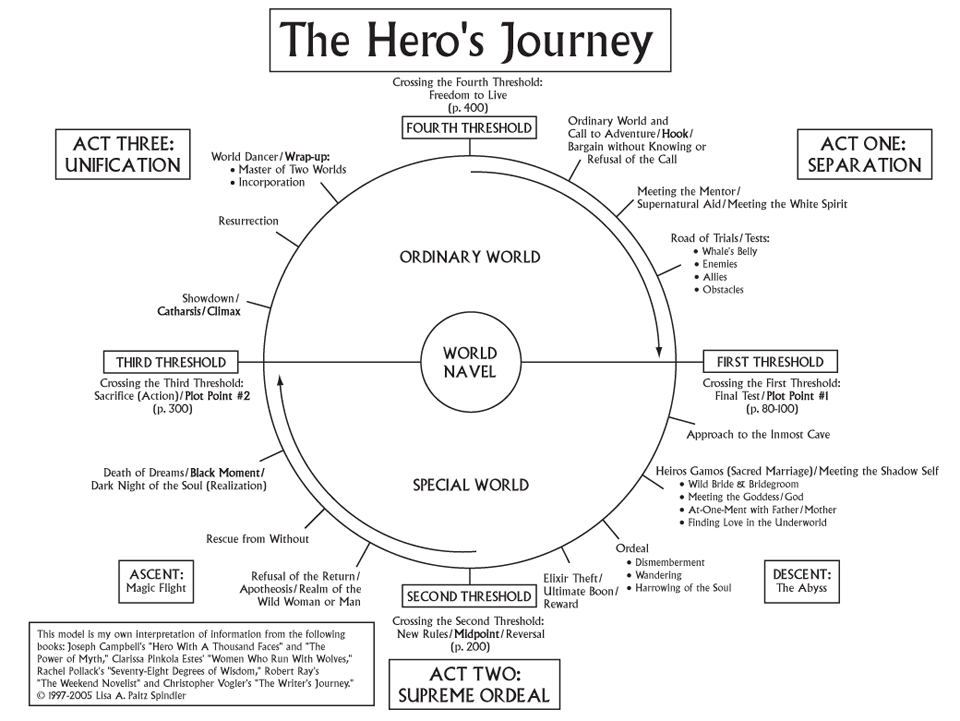
I am developing a psychological healing modality that uses narrative therapy as a way to rewrite the stories we tell ourselves about the past. This is not new — simply my iteration of something others have already been working on. I’m having fun with it. The structure of the program is based on Joseph Campbell’s mythological archeology of the Hero’s Journey, as described in [The Hero with a Thousand Faces].

To call it a modality sounds a bit too much like it’s anything like a comprehensive suite of training and practices that’ll be the cure for what ail’s ya, but of course no single modality is a panacea. They should be called modularities, because each nests with others in a way that is complementary toward some kind of whole. Literary Narrative Therapy (NFT) is being designed as a complement to other modalities in this way.

I’m uploading the documentation as an experiment in something like public-beta testing. I’m really excited about this because it feels bold and vulnerable and open-source to share this process publicly, a work/practice I am developing and exploring myself and for myself, with the intention of sharing the material and process in a more-formal package down the track.

Play with this and think of it like a sandbox. If you want to contribute, leave feedback and get in touch. The Journey is a narrative structure and set of narrative devices we can use to practice rewriting the neural pathways of old beliefs that no longer serve us. Often we feel like victims of our experience – of the things that happen to and around us, of culture and social pressures. Literary narrative therapy can help us to change our self-perspective from one of the Victim to one of the Hero.

The documentation can be downloaded as a PDF if you’d prefer to take these files AFK and play with them in the park, where they might get caught in the breeze and take you to nether regions of the spirit you may never have previously imagined. Here is the Journey Worksheet. Here is a worksheet for Background Reflections / Documentation.

These documents and the process will evolve at the Literary Narrative Therapy page on Kokoro 心 Heart.

the finish line

I finished my final end-of-year assessments a few weeks ago, and the results are in ~ I did pretty well! It feels great to have made it through a year of university study again ~ next year is an open book at this stage, but if I don’t defer to focus on freelancing I hope to make it through more than three weeks of the second year.

In 2002 I started a bachelor of English and philosophy at Adelaide Uni, straight outta high school, and I left three weeks in to the second year because … for a number of reasons. I ended up working in publishing for nearly ten years after that, and had my first full-time in-house job by the time I would have graduated, so it was no great loss, but this time going to uni has a different … vibe about it: I’m really keen to not let my literary skills be spent entirely on editorial and advocacy work, as had happened by the end of my ‘first’ career in publishing.

I say ‘first’ because it feels like the first iteration ~ this time I hope to maintain stronger focus on having my own work published, instead of focusing on the facilitation of others’ ideas, which was and is a joy, but I like to write more than I like to edit, so here’s to hoping for the next iteration.

I’ve got some nag champa burning and some Carbon Based Lifeforms playing, which is nothing unusual for a morning of study, but it feels more ceremonial this morning ~ and instead of working on assignments I’ve been using my morning writing time to work on chapters for a novel I’m writing. For the next three months or so I will be waking up at 6 am to pour myself into crafting words on a page that won’t be assessed according to a university rubric, which feels liberating and exciting.

I like the rubrics ~ they help direct the energies I give to writing, and I think they are set up to reflect a nuanced (albeit arbitrated) judgement of what constitutes good writing, which is mostly considered a subjective question. Learning some objective notions of what constitutes good writing has been interesting and helpful, but sometimes such objectivity gets in the way of just letting loose on the page to see what happens.

The other benefit of a university writing course is that you’ve got deadlines imposed on you that force you to produce material. Of course I’m excited about maintaining a writing practice over the summer, but there’s something daunting about maintaining a writing schedule without the deadlines enforced by a faculty.

I was pleasantly surprised when I received an envelope from the uni recently, and inside was a certificate notifying me that I had been admitted to the Creative Industries Faculty Dean’s List, ‘in recognition of [my] exceptional academic performance in Semester 1, 2019’. I achieved a GPA of 6.75, which kind of surprised me ~ I understand that I’m a halfway-decent writer, but one of the reasons I left uni in the early noughties is that I struggled to get my head around the academic expectations of the assessors, so even after all my experience in publishing I was still a bit daunted by meeting these expectations in 2019.

But I did it, and it feels really empowering.

I was talking to my neighbour recently about the freelancing work I do, and how it’s pretty easy money once I do the leg work of soliciting clients. He reminded me of the Dunning-Kruger Effect, which, according to Very Well Mind, is ‘a type of cognitive bias in which people believe they are smarter and more capable than they really are’. It works in the other direction too: people who are good at what they do often diminutise the skills and experience required to do it.

Editing has always come naturally to me ~ I was annotating the books I was reading in late high school. And writing is something I’ve also always had a natural affinity for … with? 🙂

I was thinking about it this morning, and about how I would be likely to say to someone if they asked: ‘Oh, it’s just a creative-writing degree ~ it’s not rocket science or anything.’ But the things I’ve learned this year about the craft of writing have reminded me (thankfully) that, in fact, there is a kind of science to writing ~ you have to experiment with methods, and if they don’t work you need to amend the material you’ve crafted until it does work. It requires a great degree of lateral thinking, and also the ability to observe things as they are and wonder about what will happen if you put them together.

That’s a definition of creativity I encountered in a Netflix documentary: creativity is the ability to take two or more existing things and put them together until you’ve created something new. A nice and simple definition.

Doing this with, say, two different chemicals in a lab to make polystyrene (to use an example from the doco) is one thing, but doing this with concepts requires a whole other level of creative ingenuity. And the results I’ve been getting at uni this year seem to suggest that I possess this ingenuity, which is definitely affirming. After struggling to overcome intellectual insecurities in my late teens and early adulthood, I slowly began to realise that yes, I was in the possession of intelligence and creativity, but it’s still been something I’ve struggled to accept as valuable in a culture dominated by ideologies that seem to prioritise material creativity and productivity ~ in the form of, say, medical or engineering innovation.

But this year I’ve formulated the beginning of a thesis for a New Weird novel that I genuinely hope will ‘create room in our collective psyche for new and innovative institutional ideals’ (to quote from the exegesis), and I live now with the confidence that such work is both imminently and immanently necessary.

I’ve learned (or, rather, been officially reminded) this year that there is great power in the written word to change the way we think and act in the world. I’ve never been one for direct action in the form of, say, protest activism, but I certainly share the sensibilities and values that inform such dissidence. But I think I’ve always suspected that something needs to change at a level deeper than just the streets. I have deep admiration for the people who protest at the coal-face of our culture’s iniquities, but I’m also convinced now more than ever that the real protest has to happen in the structures of our minds, which are informed (maybe even just straight-up formed) by the language and neurological structures we use to tell ourselves stories about the world and our experience in it.

I never really expected a first-year BFA in creative writing to have this kind of deep ideological impact on me ~ I really only expected to learn some neat skills about how to improve the craft of writing. So I guess I need to send props to the profs at QUT for the way they’ve handled the material this year. It’s been really inspiring, and I’m super proud of myself for being able to respond to that material in a way that I hope has done it justice.

It’s been a hell of a year ~ super busy because I’ve also been adjusting to living in a full-time relationship with someone I adore, plus I’m a sudden-dad of an eleven year old now, who has a huge heart even though he’s troublesome now and then (but what kid isn’t ~ and we want him to be troublesome, because we need young people to speak and act out against injustice, so we try to encourage that when he does it at home 🙂

I’ve got a few short pieces of writing that I have started shopping around, so hopefully over the next few months I’ll have a few announcements to make about those. And I’m thinking about throwing up my exegesis here, because I’m proud of it and it constitutes the begin of the first major work I’ll try to produce. (Well, second — but the first one kind of flopped, though I’ve noticed that many of the ideas are beginning to leech into this one.)

Meanwhile, I’ve got a novel manuscript to edit for Paul Mitchell, a guy I worked with at Wakefield Press yonks ago. And compost to turn! And bikes to ride. And books to read slowly …