In my living experience of recovery from complex trauma, I being … lol, a relevant typo there … I begin to feel enlivened and enthusiastic again about the things and activities I have been passionate about all my life, but which I learnt to hide from a world/culture that considers them foolish or idealistic, such as reading, studying, applying and writing about the New Psychology, meaning books like Transcend and the Tao De Ching.
This work has always been my purpose, and I have known this on some level since I was a child. The culture I was raised in did not value this at all, so I harboured these passions in secret except from a few trusted friends. Otherwise it was repressed, hidden from the world, and the psychological force required to maintain this secrecy and to project a false-image was profoundly injurious, but also created a kind of counter-pressure, such that when my authenticity comes punching through again I experience it as almost overwhelming. (The Incubus song “New Skin” comes to mind.)
(Curiously, the first stanza, not the one about fallacious cognitions that has always been a kind of mantra for me.)
And I experience shame when I “indulge” this passion to wake-and-write, when I spend hours at a time writing page after page of longhand that over the years has become boxes and boxes of journals and scraps of notes that are now gathered around me like … not like … as a cache of half-written books.
The experience of wanting to bound out of bed and resume this life’s work is characterised by a burgeoning of authenticity that makes me happy. It may be a relative happiness compared to the genuine happiness of sukkha, but I’ll take it, because the energy of this motivates me to do the training of letting that relative happiness go so I can continue moving toward the deep contentment I know is my and everyone’s birthright.
I’ve been getting about 5 hours of sleep a night because I often wake up bursting with enthusiasm to be awake answering my calling, and weirdly I feel a mild shame around this as well, that I am not getting the amount of sleep that the “establishment” dictates is what an adult needs. (Jonah Takalua comes to mind.)
That shame says, If I am not getting the sleep an adult needs, then I must be an immature adolescent, like reading by torchlight under the quilt until stupid o’clock in the morning is some kind of heinous sin.
I understand that shame is an egoic attachment to one’s sense of inferiority, and I am grateful to be letting go of this as well.
I don’t actually read until stupid o’clock in the morning anymore, because I have sleep-hygiene skills I have taught myself on the journey of re-parenting, but I do often wake up before my alarm feeling energised and ready to seize the day (Dead Poets Society comes to mind), which is a feeling that has been far-too-infrequent in my adult life because our culture is not conducive to this kind of bounding-puppy enthusiasm.
Well, I plan to … not plan to … I am changing the culture of my own life, one morning leap out of bed at a time.
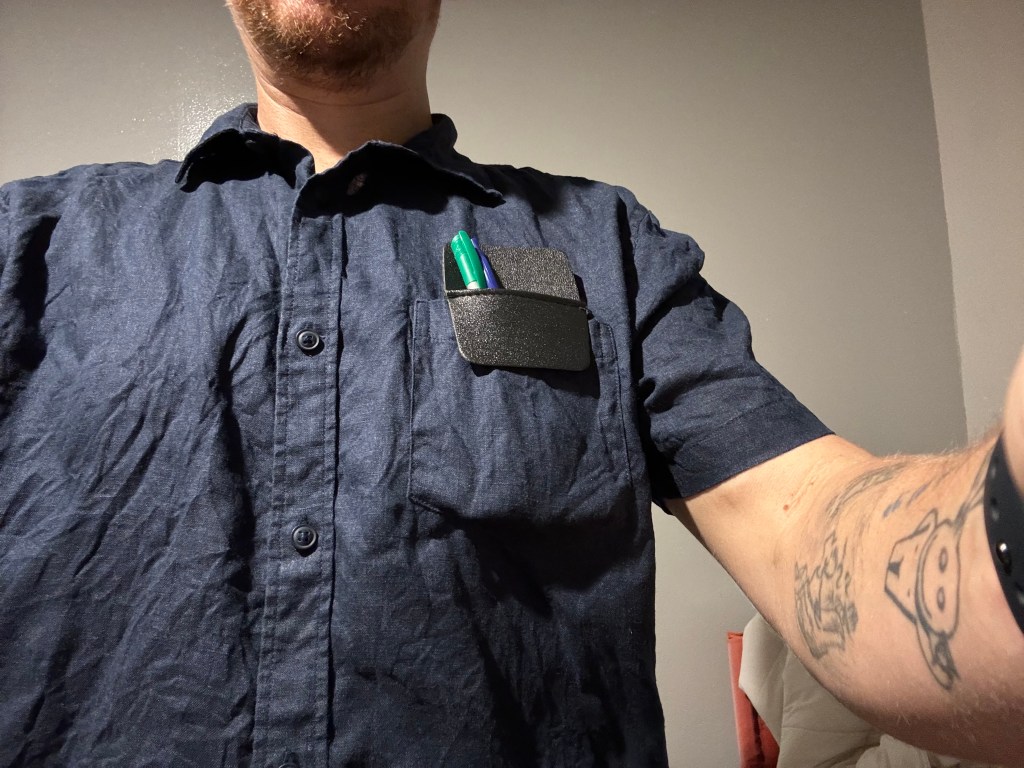
My pocket protector arrived in the mail today, much earlier than expected. I am happy about this for a slew of half-coherent reasons.
It’s Father’s Day, which I know only because my son reminded me, despite the fact I have been working hard on reparenting myself lately ~ so this is a nice and unexpected Father’s Day gift for myself. #
I am a middle-aged man now, and have been a father for sometime, which gives me “permission” to be as daggy as I like. #
It reminds me of a time when a dear and long-term but currently distant friend playfully teased me about the pocket protector I had fashioned out of cardboard, maybe 15 years ago when I was still in my 20s.
One of my pens had burst in the salvaged army-reserve jacket I wore at the time, and this friend, known to me alone as Knobelisque the Great, commended me for being the bogan-cum-mega-nerd I was back then, with my hobo-chic jacket and my cardboard pocket protector.
That was a time when I was earnestly and successfully applying myself to an unexpected publishing career, and some 5 or so years after my first real girlfriend told me, “Because you are a writer, you need to carry a notepad around ~ all writers do that.”
So I started doing that, and I have started doing that again, as well as now embracing the inner mega-nerd that has always just wanted to confidently wear a pocket protector.
Both of these friends are distant now, but I know they would be proud of me for saying, “Fuck it I’m wearing a pocket protector!” #
It fits perfectly in the new linen shirt I bought for myself recently, alongside the above-mentioned spiral notebook, which I am extra-celebrating since I re-read in Zen and the Art of Motorcycle Maintenance, that Robert Pirsig also carried a notepad in his shirt pocket.
I have never really identified as having heroes, but if I did I would say Pirsig is one of them, and I am not ashamed to say that I endeavour to emulate the attitudes he articulated in that singular novel.
Also, he depicts himself as 40 in that story, and I am also currently 40. Every other time I’ve read that book I was, obviously, younger than 40, and each of those times I assumed that Pirsig was maybe 60 and that Phaedrus was maybe 40.
This has been a tendency of mine ~ to always assume that wise folk are more adult than I am.
Reading that Pirsig was 40 at the time of that motorcycle journey with his son has reminded me that wisdom is not a factor of biological age, and on that note I am going to link here to an essay I wrote about the problems associated with typecasting young writers as insufficiently experienced to write about improving the human condition.
I was around 25 when I wrote and published this essay, and may or may not have been wearing a pocket protector, I don’t know.
I do know, thanks to recent personal research, that the reason I can’t remember these details has something to do with trauma-induced dissociative amnesia, which I have previously referred to by saying that “there is a blackhole where the recollection of my history should be”. #
I bought this linen shirt, and a pair of linen trousers, because I have recently moved to a Zen monastery in Brisbane, and am in training to become a monastic. This pocket protector complements that whole-arse lifestyle move in a way that I find incredibly punny:
in some traditions of Buddhism, primarily Tibetan, I believe, there is the practice of seeking refuge from fear in what are called “Dharma Protectors”. My practice being primarily informed by Zen, and with my otherwise-secular background, I don’t really go in for relying on entities that may or may not exist outside myself in some dimension of reality that requires special training or mantras or mandalas to access.
Each to their own.
And with Australian larrikinism deeply embedded in my bones and blood, I consider it funny that I would rather seek protection from a … what smells like faux-leather pocket protector … than from, as Carl Jung apparently said, “Imagining figures of light.”
That said, I do very much believe in and value the power of the imagination to heal both psychological and physical injury, but my current understanding is that the power of imagination stops there, at the personal and therapeutic level.
Imagination may also facilitate transcendence of the personal and support the stabilisation of transpersonal awareness, I don’t know.
What I do know is that my pocket protector will save my shirt from getting soiled by ink. #
“Top Down and Bottom Up Processing: How Our Mind Creates Our Sense of Self and the World and How to Restart the Process” by Josh Korda, Dharmapunx teacher and Buddhist chaplain
we (unconsciously) attract and are attracted to romantic partners because their loving style is similar to what we learned to expect in our upbringing ~ mindfulness of the body interrupts that unhealthy cycle … if we want to become conscious, we have to go through the body.
In this podcast, Josh describes the psychological mechanism that causes us to choose partners who replicate the loving style of our caregivers, regardless of course, whether that loving style was healthy or not.
I have wondered for soooooo many years, why do we attract and feel attracted to partners who are just like our parents? This is a whole phenomenon in the psychology world. Some say we are able to heal our attachment traumas in and through these relationships we attract because of this patterning mechanism that Korda describes. But we all know of someone who continues attracting an abusive partner and we’re all standing around watching this train wreck happening yet the person can’t see it coming. That person might be ourself.
Frustrating doesn’t really cut it, to say how it feels to be in or witnessing these cycles.
I was halfway through this episode and couldn’t finish the rest at the time, and was eagerly anticipating the second half because this question of how to restart the process has been on my radar for yonks.
I thought there might be some specialised trick, a hack from the convergence of neuroscience and ancient Buddhism, and it is a hack from that convergence, but it’s just the application of mindfulness ~ in particular, mindfulness of the body.
Mindfulness of the body is the first of the Four Foundations of Mindfulness, followed by mindfulness of feelings, mind and phenomena … mindfulness of kāyā, vedanā, cittā and dhammas.
The body is where bottom-up processing occurs.
Top-down processing is not embodied, and is encoded with our cache of stored memories from the past ~ when we are in top-down we are filtering stimuli through the lens of our past.
When we are embodied we are filtering stimuli only through the present.
Buddha described a causal chain: feelings and impulses (bottom-up) precede thoughts (top-down) in our experience, so we think we are making conscious decisions but our thoughts are actually just following our feelings. This causal chain has been validated by modern neuroscience. (I think this is correct, but I’ve confused myself in writing it, because Buddha also said, “Mind is the forerunner of all states.”) Korda relates the image of the monkey (mind) that thinks it is steering the elephant.
By cultivating awareness of the body, we get ahead of that causal chain and are able to see reality as it is, in the present, without interpreting stimuli through the filter of our conceptual database from the past.
In top-down we unconsciously find ourselves attracted to loving styles that were modelled in our upbringing (even if they were unhealthy) and by cultivating bottom-up processing through mindfulness of the body and feelings, we can let go of the trauma and escape this cycle of continuing to attract partners who trigger our old abandonment and attachment wounds.
If we want to become conscious, we have to go through the body.
It’s not magic, but this insight and its application is key to the work I am doing on myself and imparting to others through posts like this.
Have a listen, apply the practice, let me know what you think.
Busting the myth of psychopathology using … semantics! (The pen is a mighty tool.) And reflections on understanding what mental-health recovery means for me.
An insight that is percolating in me at the moment …
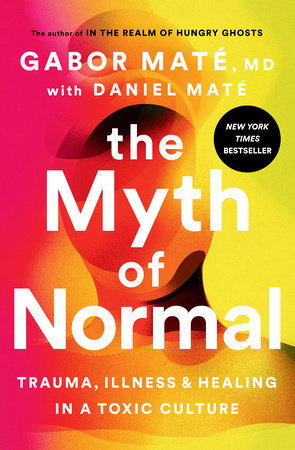
… after confirming with my therapist and the work of Gabor Maté that my condition is relatively normal and healthy (‘understandable’ is Maté’s term1) and our family dysfunction within the range of healthy …
… and while studying and practising peer work …
… is that “recovery” (from mental-health conditions or substance misuse or whatever) does not necessarily mean the absence of symptoms.
👆🏼That right there is a powerful insight for me!
The insight started with some unexpected reflection on my attachment style (disorganised) and the recognition that I don’t need assurance that my attachment with Nikki (or any significant other) is secure. In that mood I can safely practise the health-giving practice of authenticity.
a digression about boundaries
It is about authenticity: not needing that assurance that our survival depends on attachment.
A disorganised attachment style is a symptom, and “recovery” doesn’t necessarily mean living symptom free but means living in harmony (in good relationship) with the manifestation of the best response we know for these unnatural circumstances2.
An instance that illustrates this is the tussle between anxious and avoidant attachment styles (that tussle being called the disorganised attachment style): by knowing my symptoms as they manifest in certain traits and tendencies and reactive patterns, I can live with them and not worry that their occurrence means I have some problem. And without living in fear that if I’m triggered these maladaptive habits will over-run me before I can regulate. Which generally prevents me from engaging with certain important relationships because I’m anxious that I’ll fuck it up and further exacerbates symptoms.
They (the patterns) were how I adapted and they don’t need to dominate my interpretation and/or be maladaptive. I can see them for what they are, the same as when I know the types of cognitive distortions that tend to emerge when I am triggered.
I can see them as trauma responses and let them go, thereby exhausting the negative karma that caused them, reducing suffering and pointing me toward wholeness.
These models (such as attachment styles) help develop emotional and psychological granularity and vocabulary, enabling us to imagine and articulate a more nuanced inner landscape, helping us to navigate the experience of living with and thriving from/through the mental-health conditions that are an understandable response to the culture and world we live in today.
I like that phrase as it comes out now, and that’s where the insight really landed for me: mental-health conditions is good terminology because it clearly connotes illness but literally just means (denotes) the condition of health.
It puts our mental condition on a health spectrum, meaning it’s just varying degrees of health we’re talking about – eliminating and preculding the very concept of psychopathology.
I have a mental-health condition – I am in a condition of mental health.
It doesn’t sound like much, but it means something to me right now.
the Buddhist connection
Reflecting on this again after another shift at work, I really do like this phrase mental-health condition, and the acceptance that I live with symptoms, because mental-health symptoms are a natural consequence of the human condition, the human condition being characterised by suffering, delusion.
The Buddhist view puts mental health in an interesting context and on a spectrum (of illness), saying the human condition itself is a form (the ultimate form!) of mental illness. This sits nicely for me because it says all human experience is a spectrum of illness and the phrase ‘mental-health condition’ offsets this with its opposite: that all human experience is on a spectrum of health.
The one precludes all psychopathology altogether, the other precludes the hope for health (bleak!) by precluding health altogether! And as a paradox they collapse duality and leave me with an acceptant contentment that the symptoms I live with are understandable, manageable and meaningful, I can live a happy and constructive and meaningful life in their presence.
I do not need these symptoms to be absent for me to feel healthy.
That’s recovery for me.
For me (with attachment/relational trauma) much of the work of staying healthy among these symptoms involves understanding my attachment style.
So there you have it! A solution to all the world’s mental illness in one short blog post 🤣
I’d love to know what you think — drop me a comment or write me a DM.
footnotes
meaning, ‘a natural consequence of our toxic culture’ as well as ‘able to be comprehended’ ↩︎
those circumstances being our toxic culture (Maté, 2020) ↩︎
I am very grateful to have had a call with my Peer Support Worker from Neami National today. I cancelled a number of appointments to clear my desk for three days of downtime during the TAFE holidays, but wanted to have this check-in, and I’m very glad I did.
She reminded me that recovery is not a thing we get to and then is over, finished, mission accomplished. It is a process, a journey, and it is important that I don’t become complacent when I am doing well. I need to remain vigilant, within reason ~ the cost-benefit scales are going to tip if I spend all the time I feel well just anticipating the next trigger and stumble.
She also helped me find some direction in navigating my path of trauma recovery, specifically. I am going to ask a Family Constellations practitioner if I can see them under Medicare on a Mental Health Care Plan. Circle of Security might also be an option, and Neami themselves ran a program of this ~ Nikki participated, and I understand there is a lot to be learned about how we can work with the attachment styles that resulted from attachment trauma, which is certainly a big factor in the constellation of things that trigger me.
When I am triggered, sometimes I get derailed from the wellness train for days at a time, and if things are going especially unwell, I can stay derailed for weeks, heavily dysregulated. It’s not okay. I can do my sadhana all I like and it does work, I am making slow but sure progress toward more-consistent wellbeing by applying myself to the modularity sadhana. But my sadhana is for the long-game and I need something more direct or immediate that’s going to help with the trauma so I don’t get so easily triggered.
After a wake-up call recently, wherein I spent a whole night feeling triggered and acutely suicidal, I am taking the process of trauma transformation seriously again ~ for one thing, I am seeing a friend who does Root Cause Therapy (RCT) at Creative Roots Breath Therapy. I never gave up the process altogether, though I have not done much Somatic Experiencing with Tracey lately. It’s definitely time to take deeper dive.
But yes, it was good to check in with my Peer Support Worker again. They provide a great (if little-known) service to the community, and if you’re curious about that, let me know. Or check out Neami here.
OxyContin is just the 👉🏽 pointing at the 🌙 of oxytocin
I’ve been suss for a while now about the connection between oxytocin (the love and bonding hormone) and OxyContin, the trade name for oxycodone, an extraordinarily potent narcotic and opiate prescribed for chronic pain such as terminal-cancer patients suffer.
Is it or is it not a bit suss that OxyContin (a powerful and highly profitable painkiller contributing to the prescription-opioid addiction epidemic) is a very-near anagram of oxytocin!? OxyConti … an nth of difference.
OxyCunti … I mean, could they be a bit more transparent with their marketing manipulation!?
Did they not think for a moment, “Hang on wait, people are going to clue on pretty quick that we’re literally pulling their subliminal heart strings and call us out for heinously exploitating pain for profit!”
Opiates can soothe emotional and psychological pain as well as physical pain because they replicate our endogenous opiates ~ endorphins, and oxytocin!
OxyContin replicates oxytocin 👈🏼 it’s something you can’t unsee 🤦🏼♂️
.
.
.
Please reach out if this resonates with you or if you’re concerned about yourself or a loved one’s relationship with addiction, because helping others transform this is where I’m heading with Heartwards and the peer work training I’m doing.
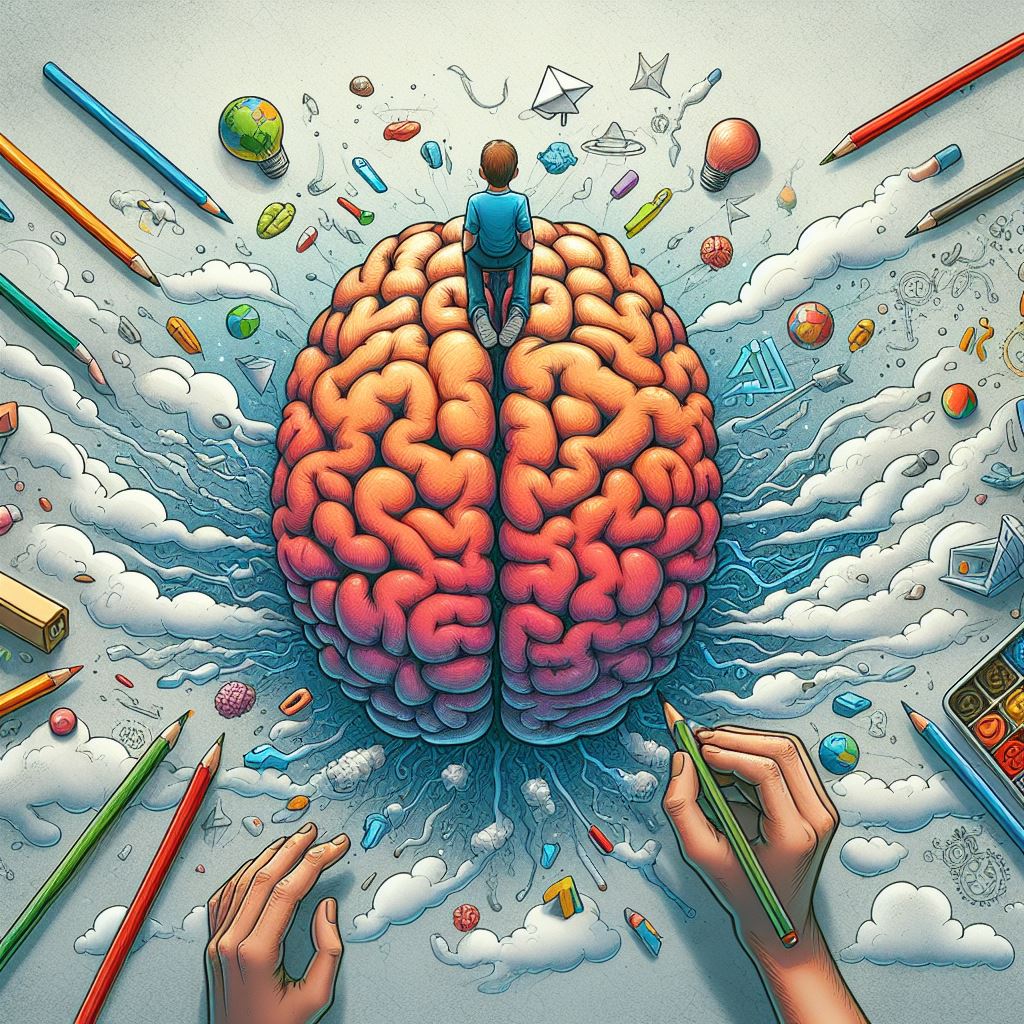
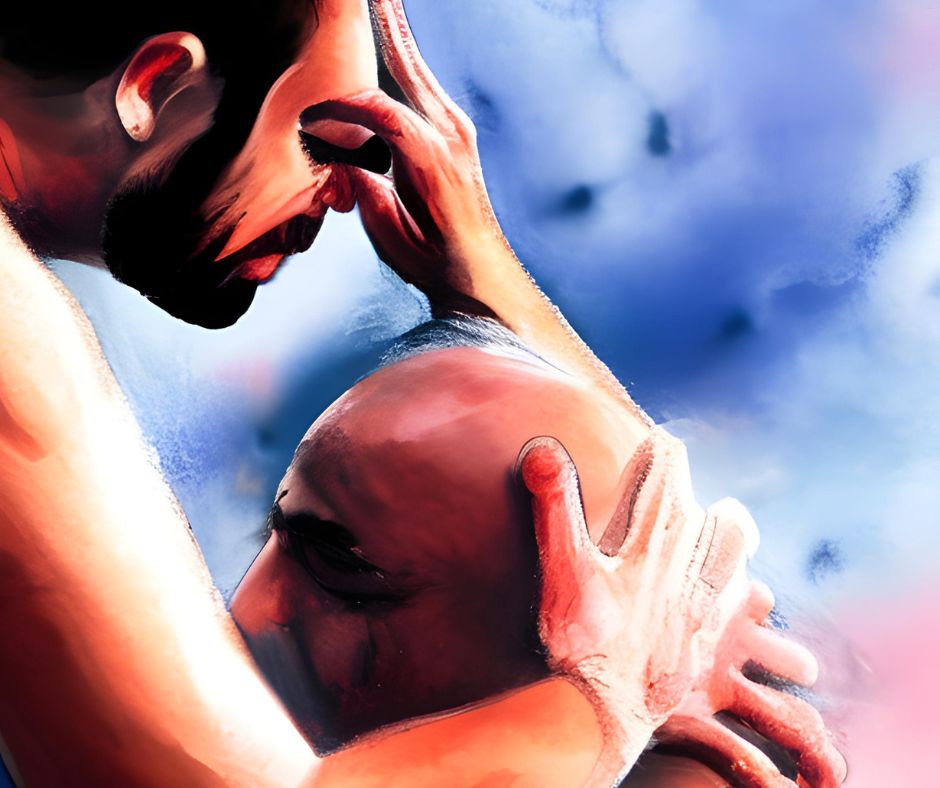
Canva generated AI art depicting “dad feeling self-compassion and trying to pull himself together so he can be there for others on father’s day trauma recovery reintegration” looks uncannily like myself embracing my wounded inner child
To all the men today who think they are a shit dad, I see you through me.
I see what constraints you are living with, between your childhood trauma and the toxic culture that has relegated us to the dustbin of the heartless-provider1. It’s very fucking hard to be compassionate and kind and patient with our kids today when generations behind us were not these things: we didn’t have the role models.
I understand, as you do, that not having the role models doesn’t excuse us from the responsibility to be the good-hearted men we know our kids need. We understand it’s not our fault that our parents didn’t love us the way we needed, but we also understand it’s our responsibility to find the love we need to give ourselves and our kids.
That though, is so fucking hard, especially in our culture, alone, divided, “the village” now a legend we hear about from traditional societies and pre-industrial Europe. It’s really really hard to act and live from our higher true self (where compassion and kindness are the default reactions) when our conditioning and ego and trauma is running the show most of the time because our nervous systems are fried and our default reactions are non-constructive, damaging, traumatising.
It’s very fucking hard to be aware enough, awake enough, and self-compasionate enough to not pass on the trauma we are carrying from generations past. It takes work to reconnect with our true self enough that our default reactions transform out of destructive habitual maladaptions into constructive and compassionate active responses.
On the journey of trauma recovery and conscious evolution, we are gradually ascending in a spiral that brings us inexorably closer to reacting with compassion as a default because that’s all our true self knows. But it’s a journey and a spiral, meaning we have to go through the same tests and lessons over and over again, learning something new each time, and evolving if we are aware of where we tripped up last time.
If you’re doing this, then you’re on the right track and you’re a much-better dad than you are probably giving yourself credit for.
Taking responsibility for your own love and healing and evolution is the absolute best fathering a man can do, because without that our kids are just getting some performance of what we think a father should be and that’s only ever going to be disingenuous, dishonest, not real.
Be your flaws and do the work of overcoming them, of recovering from and transforming trauma and becoming whole again, and know that you’re setting an example of a man who takes genuine happiness seriously and will not settle for some performance of happiness we copied from a fucking beer ad or something.
.
.
.
I made a video of this post because I know that some folk out there just can’t do reading sometimes and I wanted this compassion missive to reach as many as possible 👇🏼
What I mean by this is that we have been conditioned to provide materially for our families, at the expense of our own hearts and we are now expected to be loving and compassionate fathers despite having those parts of us conditioned out of us by culture. We were made into worker drones to serve the industrial economy and now we are trying to find our hearts again. ↩︎
The idea of “cultural safety” came up in class today, and it came to mind that even as an ostensible majority (white, male, educated, Western, relatively affluent) I often don’t feel culturally safe in a lot of social and professional settings because of my divergent, alternative and marginal(ised) spiritual values and beliefs.
It feels like a weird thing to say, that I feel marginalised or like a minority, considering that in many ways (white, male, educated, Western, relatively affluent) I am a majority. But what even is a majority these days anyway? When I fill in forms lately I’ve been listing my cultural background as “marginalised alternative”.
fauxpi prophecy of the rainbow warriors
I say fauxpi because apparently the prophecy of the rainbow warrior was appropriated by “hippies” from a Christian tract and attributed to the Hopi people.
Seeing a fauxpi prophecy about how the warriors of the rainbow would emerge to transform a ravaged earth, I was reminded that a much-bigger scale exists outside my puny concerns.
I’m not terribly interested in whether the alleged prophecy is “fakelore” or not, because it’s enough to be reminded that traditional societies had a much bigger vision of where we fit among the scheme of things.
I saw the prophecy after I’d been talking to Nikki at length about how I’m not doing well enough as a stepfather, and during all that talk I had remembered at least that I’m not the cause of or the solution for all of my stepson’s problems. A much-bigger scale exists outside my puny concerns, and in some way it’s borderline hubristic to think that my influence could make or break his future. There are many factors, outside me and/or my control that are causing Zane’s so-called problems.
Proverbs … because I kept hand-writing “prophecy” as proverbs, which fits better anyway, I think … And proverbs like the faux-Hopi one suggest a cosmology that reminds me it’s quite arrogant to think I could be the difference between Zane doing well or not.
There’s a much-bigger cultural momentum at the heart of these problems, as Gabor Maté identifies in The Myth of Normal, and the challenge of the rainbow warrior is to make change at a cultural level, not just at the family level.
I believe that is already happening. We are seeing more-awakened humans emerging to restore the ravaged Earth.
The prophecy might be spurious, but that doesn’t matter to me. The present is what matters, and I see change happening in the present ~ in myself, and in others around me. The hippie movement is alive and well and it’s wearing all sorts of clothes other than bell-bottomed jeans.
Seeing the prophecy recently has emboldened me to take seriously the calling to continue joining and co-creating the community movement to restore ways of being that are harmonious and sustainable.
I don’t know other words to describe it, but the feeling is strong: heal the internal wounds and help others do so to bring about a healthy world and culture; be healthy and happy and lead by example by, e.g., getting off sugar, learning tummo, healing my back pain and experiencing then integrating kensho, and/then help others to realise these ways of being,
as a service to the planet and our shared existence.
This comes off the back of angsting about Zane and reflecting that I can’t help him much but I can help people who are willing to be helped, people who are reaching out, and helping many this way to help the culture has more value than helping one teenager-I-can’t-help just because we happened to become family. The best I can do is continue working on myself so that I am able to be there when he’s ready.
Meanwhile I find it consoling that there is a much-bigger process of evolution I am a part of that transcends the wellness of a single stepson, stepdad and mother. By healing myself and helping to heal others, I serve a much broader cause.
identifying as trans(personal)
Related to the rainbow-warrior subculture and the experience of being “marginalised alternative”, I am starting to realise that I desire belonging among a suitable subculture, tired as I am of just drifting around on the edges of society, trying to be content with not quite fitting anywhere.
A student at TAFE shared their experience of coming out as trans in the Australian culture and how certain attitudes made this confronting for them. Not unusual ~ it’s well-known that coming out is confronting in a culture that has traditionally been quite homo- and trans-phobic.
It just makes me think of and realise that I feel a similar discomfort and don’t have a banner to fly under such as the rainbow flag of the queer community, though I’ve recently identified with the Mad Pride movement. That’s not quite what I’m looking for either because this unites folk under a banner of spiritual emergency (and even of being proudly pathologised) rather than spiritual emergence.
Where is the subculture for people who value the gradual benefits of prioritising transpersonal practices over, say, the gradual benefits of acquiring material wealth?
In that sense I am trans, in the sense I identify as more than just my personal self or ego. The “trans” label is already taken, so I’m not sure where to go from here. I don’t really need a label exactly, except that it might help me find more of my tribe. I think it’s not dissimilar from someone who realies they are neither male nor female and realises they can identify as non-binary. I feel something similar, except I would call it “non-dualist”. Non-dualary?
the destruction of small ideas
The Destruction of Small Ideas by 65daysofstatic
A classmate was talking about virtue signalling and how the teacher shouldn’t be politicising the classroom by subtly (and not so subtly) advocating that we all vote YES in the Voice referendum. I get it, there should be a separation between politics and education, the same as between church, state and the press, and I value that this classmate brings a self-identified “conservative” perspective because I value having my biases challenged.
Somehow though, we got on the topic of … wait, how did we get there … that’s right, this classmate had been triggered (their word) when other classmates that morning had said Australia is a racist country. This classmate believes Australia is much-less racist than it was, and I agreed ~ I said though, among your everyday people there is much less racism and yet, institutional and systemic racism persists:
First Nations people are marginalised, more incarcerated, have less access to opportunity because of systemic racism, that is undeniable.
Institutions and government departments take generations to catch up with the popular view.
He asked me, “What institutions and departments need to catch up?” and I sensed at this point that I was no longer in a conversation or reasoned debate, and was now embroiled in highly emotional polemic.
I said, “I don’t know,” which seemed to signal an opening to that I deserved to be torn down for my ignorance.
They said, “If they’re marginalised it’s because of alcohol.”
Starting to back away, I said, “What do you mean?”
They told me that when the conservative government took away cash from communities and they couldn’t buy alcohol, things improved. When the Labor government came in and revoked that because they are “do-gooders”, things went to shit again.
I asked, “Do you think we should deprive them of their right to choose and their right to dignity of risk by denying them cash?”
“If they were able to make informed choices we wouldn’t need to do that.”
“Wouldn’t it be better then, to provide education instead of revoking their freedoms?”
At which point, they said, “Yeah but hey, would you let a 4 year old play in the street?”
I said, “Okay, I’m going to call it because I need to go to the toilet and have lunch anyway, and these kinds of views make me deeply uncomfortable.”
By this point I’ve been feeling triggered myself for a while because blaming First Nations marginalisation on alcoholism was staggering enough, so I don’t remember exactly the defense they uttered, but as I walked away, I said, “I’m going to leave you with it to think about whether that’s appropriate.”
I find it unfathomable that a twenty-first century adult could so flippantly infantalise a whole demographic of humans. I find it unfathomable that seventeenth-century adults were able to do this without feeling appalled. But this person, when I told them I was struggling to know what to do about my stepson’s drug addiction, told me I should storm into his room and dump all of his shit onto the footpath if I didn’t want drugs in the house.
I don’t know if I’m some kind of virtue-signalling pinko-lefty bleeding-heart liberal, but I prefer to identify as a budding transpersonal psychotherapist. I had already seen some belligerence and bigotry in their way of presenting their views, so I’m not surprised it has come to this. I’m just glad it wasn’t my sarcasm that caused the problem, as I had been worried about.
the Buddhist path of recovery from addiction
Related to the faux-Hopi prophecy about an awakened people emerging to heal the ravaged earth, I was talking to my Zen teacher Arno recently in the car on the way home from the zendo, and a resolution formed (a sankalpa, you could call it): Why not just go for it and develop an addiction-recovery program that is unashamedly based on Buddhism. I confirmed with Arno that the attachment in Buddhism is like addiction, to illusion. I said, “Once we drop that addiction to illusion, aren’t we free?” and Arno agreed.
It’s a natural progression from there that a Buddhist path to recovery from addiction makes a lot of sense as a Heartwards offering.
He said it’s tricky though because the Buddha taught a transpersonal methodology and teaching Buddhism as an addiction-therapy program kind of detracts from that, or sells it short. But Buddhism is both therapeutic and transpersonal: as a person makes progress along the transpersonal path (letting go of their attachment/addiction to an illusory self) they are naturally going to experience therapeutic benefits. And the “therapeutic” practices like self-compassion support/complement the transpersonal progress/development.
As one practices letting go of their addiction to an illusory self, the “lesser” addictions will naturally fall away as well.
The hinaddictions to drugs and sex and whatnot, if the “greater” addiction to the illusory self, is the mahaddiction.
Such a program would be like Cultivating Emotional Balance (CEB), based on Buddhism and other ancient traditional contemplative practices, secularised and supported by neuro(science). Noah Levine is doing something similar already with Refuge Recovery, so there are models around already.
It has come to my attention that there is an opportunity to trade in crypto, and I don’t know what that means beyond a few ill-informed thoughts and half-considered assumptions:
crypto is gambling
shuffling currency around the market is just ‘skimming value’ off the top without actually contributing to society, and it’s immoral to make money without making value ~ to profit from merely shunting other people’s values around
I deserve to die poor
you need to be able to maths
I am not great at mathing.
The opportunity might be an opportunity to challenge a few of these beliefs.
At this stage I don’t know the difference between the terms “crypto” and “bitcoin”, I thought they were the same thing, but I do have a sense the ideology will resonate with me this time.
I think the opportunity has arisen due to a shift internally resulting from the work I’ve been doing to change the way I relate to myself and the world ~ these things present themselves when we are ready to embark on understanding them, in the same way we can try to read a certain book and not resonate or get anywhere with it, until one day it just does.
I’m thinking of The Prophet, which I just couldn’t get into despite many attempts until one day I found myself reading the whole thing aloud by the fire with the pet dog of a guy who had taken me in one winter when I was adrift on my bike for a while.
Another thing about crypto is it might change my relationship with money/currency and how it “should” be gained. After hearing maybe 15 years ago that money should only be made by trading goods and services that bring value to the community ~ shuffling existing value around (such as renting property or trading shares or currencies) was just ‘skimming’ off the top of what others contributed to society ~ I latched on to this belief. I still of course value bringing value and being of service and am now just wondering whether the “game” of crypto might be legitimised by the intention to use any proceeds for supporting services to community psychospiritual health, namely the activities falling under the umbrella of Heartwards.
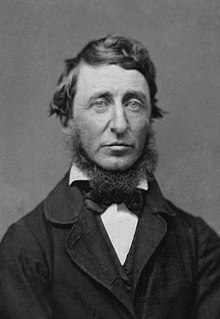
HDT, the OG of tiny homes!
Along the way, if it changes my relationship to the sort of abundance I need and deserve, then great. Because yes I’ve got some big plans and they’ll need more resources than I am accessing by through welfare.
I remember a fragment of a dream now, where a woman I knew was proudly declaring she was free of the welfare system.
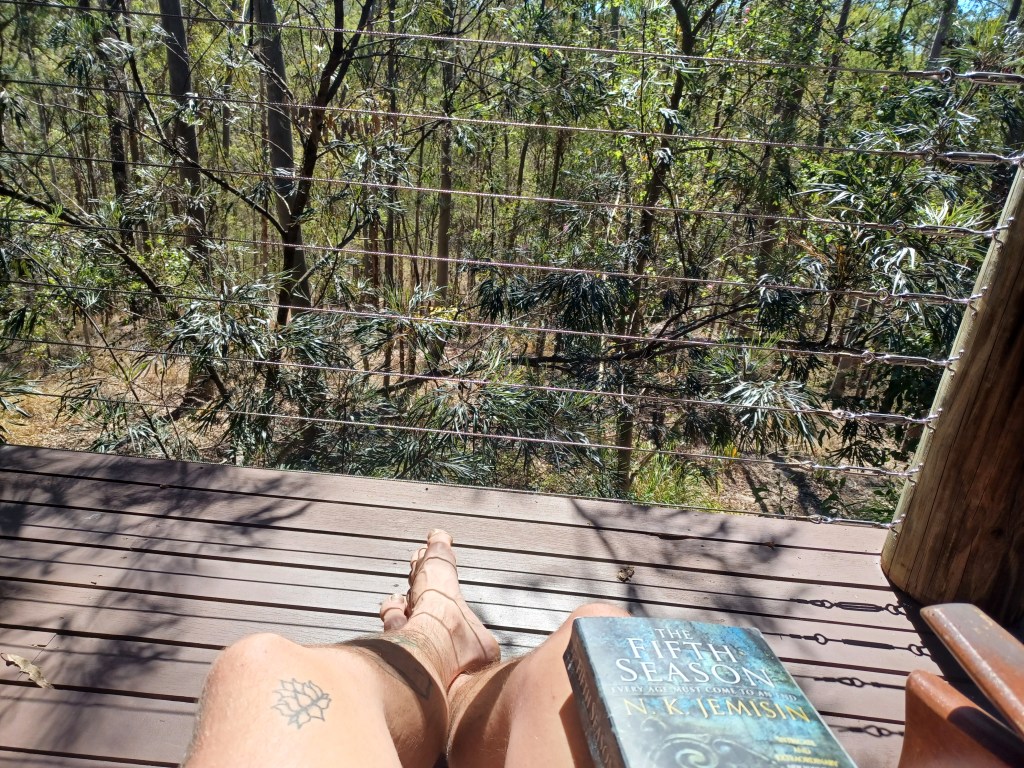
Free of the waged-employment system is also important, which makes me want to read more of the Transcendentalists like Henry David Thoreau and explains my curiosity about crypto. It was N K Jemisin’s Broken Earth trilogy that got me going about this in the morning when I was enjoying the back deck on a Sunday.
The first in the series, The Fifth Season, is a very powerful indictment of imperialism, slavery and exploitation that has got me thinking again about modern wage slavery.
There is no way to get ahead in our economy as someone who sells their time in physical or intellectual labour.
I want to make products and services that are valuable ~ products that sell themselves and services/programs that are replicable, maintaining a turnover of income. One thing that may not sell but would promote the training services and products would be a webinar perhaps about the modularity. People could then buy a self-paced course or recruit me as their trainer. That’s what I’m imagining and I feel it’s practical these days ~ not right now during TAFE but in the present as in the continuation of the future from here.
I’d like to have passive income, to work smarter not harder, but this requires undoing the coding that was written in me by my parents and their generation.
thoughtlogging
A blogging style has been inspired by Dave Winer, one of the OG bloggers from way back when the practice was about logging the web. Thought bubbles dropped in the browser throughout the day are then released at night, just a flow of thoughts and links, if only to keep my browser tabs from overflowing.
humility
Something else alive right now that I just want to note and would like to add to my somewhat daily recitals is that I have an opportunity to make some good connections at TAFE and do some good professional peer work. People are respecting me and valuing me (one of my fellow students even PMd to say so!) and I want to make sure that as I become more confident, because I am getting such positive feedback, that I don’t tip over too much into arrogance.
The risk of sarcasm and irony is high as well, because there is a lot of joking in class and we’re all mucking around a bit because the content is not very challenging and folk are a bit bored.
And hopefully if something happens and I fall from someone’s high-esteem (say I get too sarcastic and hurt someone’s feelings, as I’ve worried about with one classmate in particular who I like a lot and feel respect for but whose ideology is very different from mine) I am not too hard on my self, recognising that mistakes happen and I’m trying to keep my humility about me as my confidence grows again.
I’ve been through this before when I moved from Adelaide to Melbourne to work as a journal editor in my early 20s and suddenly meet with a peer group who valued and respected me. I didn’t know what to do with that feeling, but I think I did pretty well at not treading on too many people’s toes.
It’s related to something I’ve written about before, where I have an excess of joy to regulate when I come out of the depressive cycle, short of being manic-depressive.
wellness + recovery
I appreciated a peer practitioner saying in a video I cannot find right now, that
You don’t have to be perfectly well, to be in recovery
and, I would add, to hold the lamp for someone else on the path. I found the video👇🏼
I got around to uploading the bones of what I’ve started calling “a modularity”, describing the framework that is developing around me for helping others recover from small-t trauma and experience sustainable genuine happiness.
If you’re interested in transcending the inherently limited personal/human ego and experiencing a much-expanded perspective of our true place in and relationship to reality, check it out.






 Kokoro 心 Heart