mental-health conditions 

Busting the myth of psychopathology using … semantics!
(The pen is a mighty tool.)
And reflections on understanding what
mental-health recovery means for me. 

An insight that is percolating in me at the moment …  

… after confirming with my therapist and the work of Gabor Maté that my condition is relatively normal and healthy (‘understandable’ is Maté’s term1) and our family dysfunction within the range of healthy …  

… and while studying and practising peer work …  

… is that “recovery” (from mental-health conditions or substance misuse or whatever) does not necessarily mean the absence of symptoms.  

👆🏼That right there is a powerful insight for me! 

The insight started with some unexpected reflection on my attachment style (disorganised) and the recognition that I don’t need assurance that my attachment with Nikki (or any significant other) is secure. In that mood I can safely practise the health-giving practice of authenticity. 

a digression about boundaries 

It is about authenticity: not needing that assurance that our survival depends on attachment.  

A disorganised attachment style is a symptom, and “recovery” doesn’t necessarily mean living symptom free but means living in harmony (in good relationship) with the manifestation of the best response we know for these unnatural circumstances2.   

An instance that illustrates this is the tussle between anxious and avoidant attachment styles (that tussle being called the disorganised attachment style): by knowing my symptoms as they manifest in certain traits and tendencies and reactive patterns, I can live with them and not worry that their occurrence means I have some problem. And without living in fear that if I’m triggered these maladaptive habits will over-run me before I can regulate. Which generally prevents me from engaging with certain important relationships because I’m anxious that I’ll fuck it up and further exacerbates symptoms.

They (the patterns) were how I adapted and they don’t need to dominate my interpretation and/or be maladaptive. I can see them for what they are, the same as when I know the types of cognitive distortions that tend to emerge when I am triggered.

I can see them as trauma responses and let them go, thereby exhausting the negative karma that caused them, reducing suffering and pointing me toward wholeness.  

These models (such as attachment styles) help develop emotional and psychological granularity and vocabulary, enabling us to imagine and articulate a more nuanced inner landscape, helping us to navigate the experience of living with and thriving from/through the mental-health conditions that are an understandable response to the culture and world we live in today.  

I like that phrase as it comes out now, and that’s where the insight really landed for me: mental-health conditions is good terminology because it clearly connotes illness but literally just means (denotes) the condition of health.  

It puts our mental condition on a health spectrum, meaning it’s just varying degrees of health we’re talking about – eliminating and preculding the very concept of psychopathology.  

I have a mental-health condition – I am in a condition of mental health.  

It doesn’t sound like much, but it means something to me right now.  

the Buddhist connection 

Reflecting on this again after another shift at work, I really do like this phrase mental-health condition, and the acceptance that I live with symptoms, because mental-health symptoms are a natural consequence of the human condition, the human condition being characterised by suffering, delusion. 

The Buddhist view puts mental health in an interesting context and on a spectrum (of illness), saying the human condition itself is a form (the ultimate form!) of mental illness. This sits nicely for me because it says all human experience is a spectrum of illness and the phrase ‘mental-health condition’ offsets this with its opposite: that all human experience is on a spectrum of health.  

The one precludes all psychopathology altogether, the other precludes the hope for health (bleak!) by precluding health altogether! And as a paradox they collapse duality and leave me with an acceptant contentment that the symptoms I live with are understandable, manageable and meaningful, I can live a happy and constructive and meaningful life in their presence.  

I do not need these symptoms to be absent for me to feel healthy.  

That’s recovery for me. 

For me (with attachment/relational trauma) much of the work of staying healthy among these symptoms involves understanding my attachment style.  

So there you have it! A solution to all the world’s mental illness in one short blog post 🤣 

I’d love to know what you think — drop me a comment or write me a DM.  

footnotes

  1. meaning, ‘a natural consequence of our toxic culture’ as well as ‘able to be comprehended’  ↩︎
  2. those circumstances being our toxic culture (Maté, 2020)  ↩︎

EP re-connecting with Self to avoid being an existential suckhole

This is the EP version of this idea that if we don’t have connection with self (which is the definition and consequence of trauma), there is a tendency to seek that connection with other, either other people or other stuff, things external to the self, and wind up sucking the other dry.

Insights are emerging out of some tension that has been plaguing the family for the last week or so1, and a very valuable lesson:

when we don’t have connection with self (which is the definition and consequence of trauma) there is a tendency to seek that connection with other, either other people or other stuff, things external to the self;

knowing our needs is a function of connection with self, meaning that we meet our psychological needs by connecting with self and to connect with self we need to be meeting our needs; 

when we give to, serve, or try to help others (without connection with self), we often end up doing the opposite of giving, which is sucking, taking, draining …

We end up sucking from others when we are trying to give, or when we think we love them, because instead of giving we are taking, sucking, a natural metaphysical consequence of there being a void or vacuum where our connection with self once was ~ we become a psychological blackhole, syphoning from others what we can only truly get from connection with self.

The formal term for this is “being an existential suckhole”.

I don’t mean to sound so obtuse ~ I’m just trying to work this out. 

We reconnect with self by recovering from or releasing trauma, and through contemplative transpersonal practices (because by ‘self’ I actually mean ‘the part of us that transcends personal identification’).

How do we release trauma and integrate the parts of ourselves that we exiled during events we found traumatising? I cannot articulate that right now but it’s a central aspect of the Heartwards modularity

I’m sure there’s literature around this and it sounds very much like something Buddha would say (I’m thinking of the “wrong objects” here) and I am interested in seeing that documentation but for right now the insight feels real enough to not need validation. 

I drafted a lot more for this post and have hacked it back to the above so I can get something up here for the day. More to come.

Photo by Andrea Piacquadio on Pexels.com
  1.  truth is it’s been plaguing us for years, generations, but this week it has come to a head again, as it does, crying to be seen ↩︎

ego … it’s just like, your opinion, man

During a compassion meditation just now, something came up that I’m really proud of ~ and perhaps an insight I think will be helpful for anyone who has become aware they are acting out a conditioned response and weren’t able to stop. It hurts to let go of our conditioning while we are in the middle of such an emotional reaction, because when we try to let go, our ego thinks it is dying.

But it’s okay ~ compassion to the rescue!

It can hurt to renounce our egoic position because we conflate the ego with ourself and we feel like we’re letting ourselves down, but we’re not ~ we’re letting our ego get out of the way so our higher self can come through.

So I share this story for anyone who has experienced the exquisite pain of relinquishing egoic conditioning to allow a heartfulness to come through instead of the controll-y fear that a lot of us put up with inside us because of maladaptive coping mechanisms. I’ll see if I can be concise.

Today a decision was made in our family that I didn’t agree with*;

it was a decision that really, ultimately, has nothing to do with me, and getting in the way of it would have caused more conflict and tension than it was worth;

my ego/conditioning thought otherwise ~ that I should step in and dictate values, make ultimatums, control the situation and ‘fix’ the ‘problem’;

but I saw the egoic conditioning for what it was, sat myself down, selected a guided meditation that seemed appropriate (this one here) and submitted myself to a bit of ‘cultural re-education’.

I’m deeply grateful for that guided meditation, because it helped me find the space to remember I can let go of how I think reality should be, and allow reality to unfold as it sees fit, and wow, what a relief it was!

The suffering of resistance fell away, and something like a higher (compassionate) self kicked in.

I can be honest and say I wasn’t all that happy about it: there is something exquisitely uncomfortable and painful about the micro-ego-death it felt like I went through.

In my experience there is something really painful about relinquishing egoic control and recognising that my opinions about reality don’t mean shit to reality … in recognising that my conditioned ideas about how we should be raising our son are probably a bit shit.

But the pain is just my ego taking a hit, and that’s okay, necessary, especially as there is a compassion practice in my life to support that death and rebirth.

After some compassionate reflection, I feel lighter and liberated and refreshed and grateful because now there is more room in me for compassion to move in where egoic conditioning had once been “man-spreading”.

By renouncing my conditioned attachment to expectations and to values I borrowed from my parents and upbringing, I am able to move into alignment with compassionate values that tell me Zane’s mental health is more important than whether he’s going to school.

~ ~ ~

* The details are not super relevant, but sometimes they can help a person to relate to a story, so, what happened is: Zane was allowed to go out and see his mates after he bullshitted his way out of school for the second day in a row ~ after being out of school for six months. Whether this was a good or bad decision is not the point ~ he’s having a hard time lately, and forcing him to go to school would only make that worse, but I was worried that rewarding him for wagging would establish a problematic precedent. Any argument made on compassionate grounds is bound to trump what my ego thinks is best.

enough time

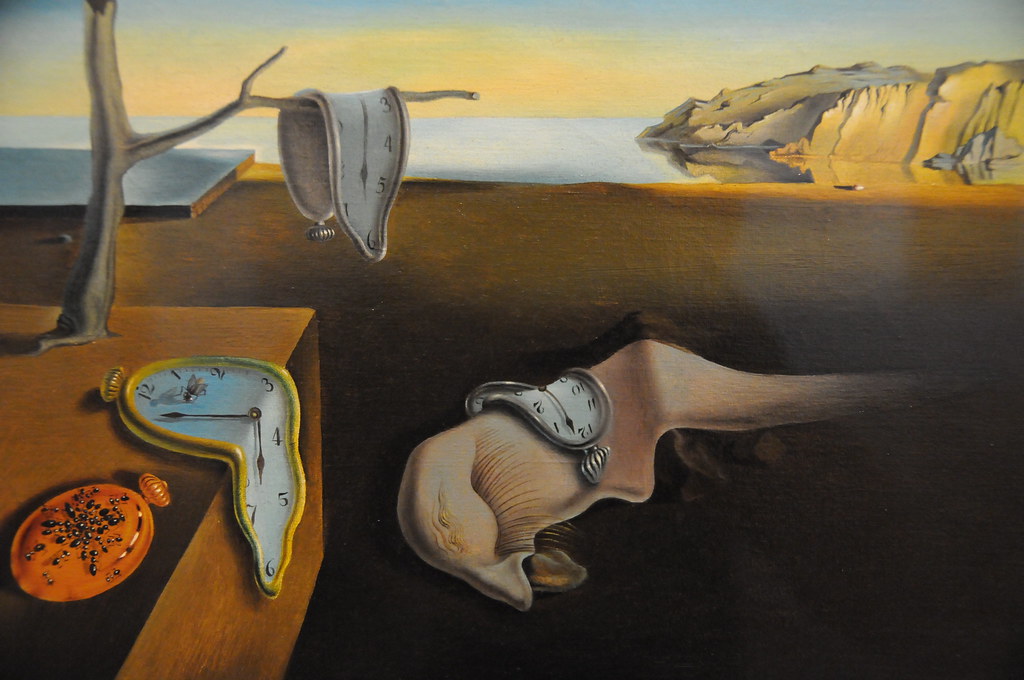
“The Persistence of Memory” by Salvidor Dali

My affirmation today is, again, I am enough. I am enjoying this theme and I think it’s worth reflecting on regularly. It can be expanded to include this is enough, and it makes me think now about gratitude. A quote we had on the wall for a while:

Gratitude turns what we have into enough.

That which is, is enough.

I got up early enough. There is enough time to do whatever needs to be done. I do enough of what I want. The weather is warm enough (this is easy today because the weather is perfect). I have enough energy to be productive enough today. I am enough without being productive.

The last few days have been “hijacked” by life, resulting in me not being able to do what I wanted to do, which was work on kHeart projects. Life has been this way a lot lately – enough to show me that there is something for me to be seeing.

What does that mean? What am I supposed to be seeing?

I am supposed to be seeing and looking at the reality that life doesn’t always go as we planned – in fact, it never does. We know the saying, “Life is what happens while you were busy making plans.” The future is never as we imagined it would be.

In the space between the present and the future, there is a line between getting our way and getting out of the way, between getting what we want and going with the flow.

I am beginning to see that the idea of attachment and non-attachment applies to time and events as much as it applies to material possessions.

I understand non-attachment in the material realm and am generally okay with not getting or having possessions. I am learning now that I have something to learn about accepting and adapting to situations where I don’t get what I want in terms of controlling the way I spend my time.

For most of my life I have been a loner, and I don’t mean that in a self-disparaging way: my upbringing lead to me being comfortable with being alone, and I was mostly happy with that. Sometimes I was lonely, but I adapted and came to enjoy having lots of time alone. I am mostly an introvert as well, so I need time alone to recharge. The “lone wolf” is a descriptor that applies better than “loner”: I have friends that I see now and then, but mostly I’m pretty self-contained.

I am seeing a narrative emerge here – a story I tell myself about myself – and I’m seeing that a guided journaling practice might help others to see where narratives are running the way they think about themselves.

I see it as a narrative because I see how I am telling you how I was or am. If it can be told, it is a narrative, and if it can be told one way it can be told another. It makes me think of the Taoist idea: if it can be named, it is not the Tao.

Meaning that if I can tell you about it, it is not the truth – if I can tell you about myself, I am not telling you about my true nature. Everything we tell about ourselves – every narrative we create to explain ourselves – is a fiction, a construct. It is not the truth, but a choice between various and myriad lies or fictions, illusions.

I’m getting obscure again, but this is ephemeral territory, the metaphysical and the esoteric. The exoteric is an example.

My son Zane has told me things about himself, like “I’m not the sort of person who … [insert character trait here] … likes to talk about his feelings … likes learning … likes slow movies.” When Zane has done this I have recognised that these are very much choices he is making about identity, not expressions of his true nature. These claims have been made over the last five years, between the ages of 9 and 14, a time of development when children begin realising they have an identity they need to understand. They are seeing that they are not just expressions of their parents, but individual entities and there seems to be an urgency to claim their own identity. When he has made these claims I have tried to say variations of “maybe that will change one day”, because I want for him to not become locked-in to one identity-choice or another. Imagine a person believing their whole life that they are not the sort of person who likes to talk about their feelings. (Like human beings can be sorted into this or that category like so many biscuits behind a barcode!) That would be a prison on the island of the illusion of independence – no man being an island and all that.

Something I don’t have to imagine is a person believing their whole life that they are happier when they are alone. I don’t have to imagine this because it is a belief I have been narrating to myself my whole life – because a bunch of people let me down early in life, and I decided I would be better of without them and they would be better off without me. Trouble is, “they” was a specific group of people back then, whereas now “they” applies to the whole amorphous group of people known as everyone other than me.

As an adult I choose to share my aloneness with a few select others who show that they care about me and are able to let me care about them, but because I was mistreated by a select few as a child – my brother, father and some kids at school – I must have told myself at some point that I am the sort of person who doesn’t need friends to be happy, that I am the sort of person who is happy to be alone.

After a slew of toxic relationships in my young adulthood (before I met Nikki) I had resigned myself to believing that I would be happier to be single my whole life than to continue from one toxic relationship to another. I had resigned myself to dying alone, using justifications such as “we are each alone at death anyway”.

I’m rambling a bit, but that’s okay because this has become an exercise in questioning the narratives that dictate my beliefs about my nature, true or otherwise.

I have been thinking, these last few days when I haven’t been able to get what I want, that I need to figure out how to get more solitude in my life(style).

That word “more” is a clue and a key. If we are saying we need more of this or that (more money, a job that is more fulfilling, more time, more time alone, more time alone doing this or that … it’s an endless list of more and more qualifications of what we want from what is) then we are not living from the awareness of enoughness.

Understanding this in relation to time is the challenge I am currently facing, which I choose to accept.

When I am frustrated that I am not getting the time I want, I see that attachment is at work and I remember that this is enough. That which is, is enough.

That is my affirmation today, should I choose to accept it.

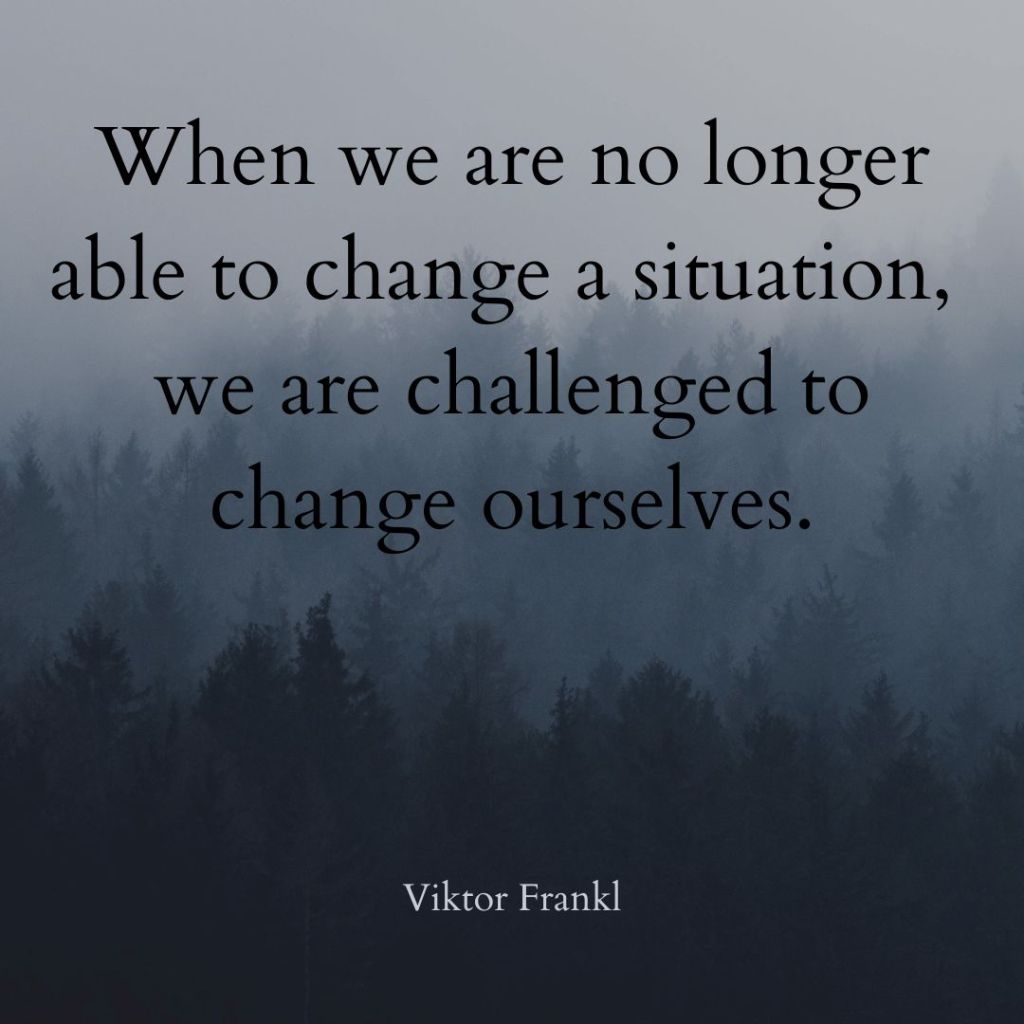
Frustration is a red flag that attachment is operating. I can try to make that which is different, or I can choose to adapt and feel grateful and allow whatever is to be. I can choose to get out of the way and allow my resistance to that which is to dissipate. And in this way I can allow a new narrative to write itself: I am equally happy when my time is spent alone or with people; if I cannot change the external conditions/situation dictating that I must spend more time with others than I am used to or would like, then I must accept only that which I can change, which is how I feel about the situation/condition. Remember Frankl:

When we are no longer able to change a situation,
we are challenged to change ourselves.