reflections from Indra’s Net, etc.

in habits I trust

With my room in a flu(mmo)x of books, towers of dishevelled documents, magazines, unhung decorations and an underwear drawer down to its last pair of trunks … I would have said previously that things are in disarray, but now I see that things are in a formative state ~ and that things, all things always, are in a formative state, as in always forming and reforming, never settling into one state or another, and as I type this I feel the relief that comes with beginning to know this at a deeper and deeper experiential level.1

I am still settling in at home, and I feel I have the time to be patient because there is a relatively secure future here. (I say “relative” because who knows what might happen.) Also I trust myself and the universe and I feel the universe trusts me because it senses that I am sensing that I am it.

I am of the universe in the same way a wave is of the ocean, not separate.

I deepen into becoming an instrument of this divine oceanic reality, and I am equipped to accommodate anything that happens, whether I like what happens or not.

I realised recently that I am not the boss of reality and I have been saying this jokingly to friends, but I mean it. [5.55]

Reality is the boss, and there is very little I can do to influence the untold number of events that unfold on its watch. But I watch what I can, and what I can influence is how I respond to events. By training myself to respond constructively to everything I observe, I form new mental, emotional and behavioural habits that are more and more wholesome every day.

In habits I trust.

I am piecing together some ideas that interest me very much about the (w)holistic importance of being responsible for my (and only my) mental, emotional and behavioural habits.

These ideas are grounded in the #dharma, sustained by near-constant mindfulness and #meditation in all action, and increasingly backed by #neuroscience, which makes me feel all boisterous and joyful because these ideas (when and only when applied) lead inexorably to the experience of something called sukkha (in Buddhism, and probably many other things in the world’s many spiritual traditions), which means “genuine happiness”.

Not fleeting happiness, not pleasure conflated with happiness.

Genuine, abiding contentment with all that is, without the overlay of judgement saying, “This is good, now I am happy,” or “This is bad, now I am unhappy.”

These (w)holistic ideas about personal responsibility have profound implications for collective wellbeing and long-term sustainability (a healthy world arises out of healthy minds) but their application does start with the individual. If the individual is lucky (as I am) to meet with what we all deserve, they will have the support of a community that understands these implications at least on some level,

and this collective support is what turns individual awareness and responsibility into a bonafide superpower. #sangha

These ideas have some very cool names … Indra’s Net (thanks Marc) … the morphogenetic field or morphic resonance (thanks Rupert Not Murdoch) … the holographic universe (thanks Einstein, Michael Talbot, et. al.), the #dharma … and are exemplified by the saying, “A rising tide lifts all boats” (thanks Pierce ~ may we discover together that JFK did indeed lift this from the Bible, and that maybe the Flood is actually a metaphor about a time in Biblical history when a flood of awakening wiped out swathes of ignorance in the psyche of humankind, because we know … or at least, strongly suspect … these episodes of collective awakening come in waves through history and can never really be talked about directly, so: metaphor to the rescue).

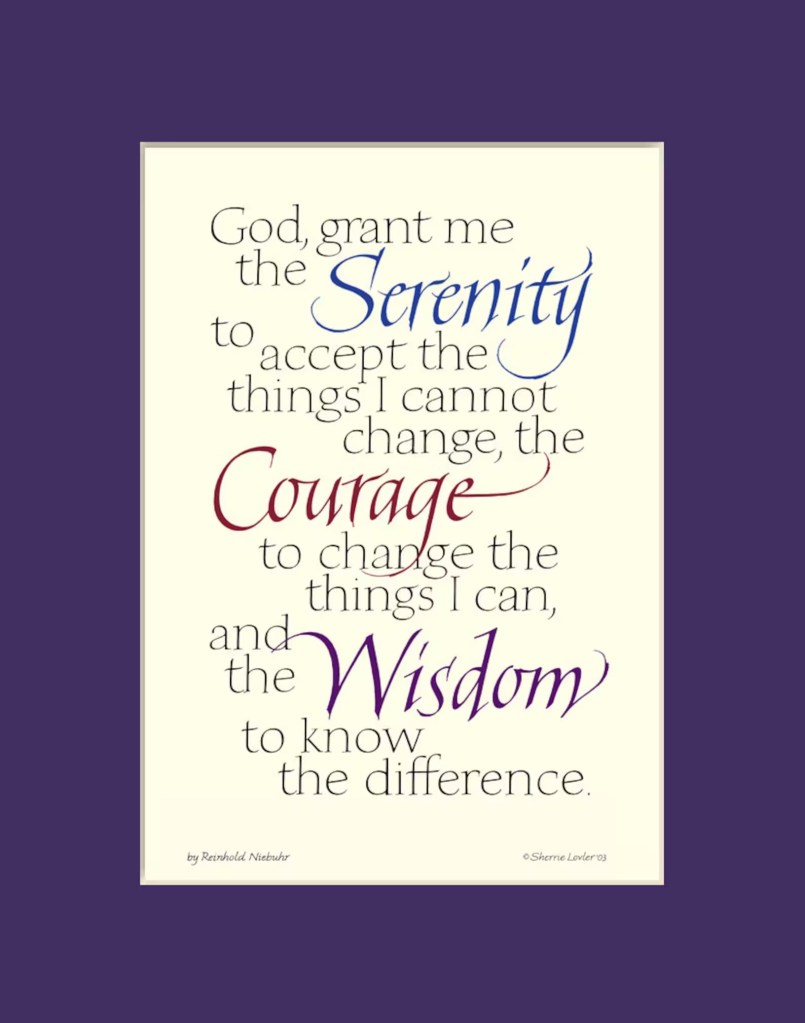
I don’t have the time or the desire to elaborate further on these ideas at the moment, because I have a group meditation to attend in 9 … 8 minutes. For now it will be enough to share the Serenity Prayer.
May I ask you to leave your notes below ~ as always, my intention for sharing these thoughts is to stimulate dialogue. If public dialogue is not your jam, get in touch directly here. If commenting on WordPress is a laborious chore because you don’t already have an account, please share this post with your comments on the socials, because it’s a dialogue we sorely need to help us transition from the doldrums of modern civilisation into whatever form is next.

  1.  I say “flu(mmo)x” because the confusion comes from within me (who is flux), not from within the state of my room, which is also in flux, but not necessarily confusing. ↩︎

vision and insight ~ in service of awakening and wholeness

bit of an update for anyone who’s curious because they know
things have been a bit misshapen for me recently

I held something very heavy for a visitor at work the other day, and it was only later when I was writing the case note at home (we had gone overtime on that shift before I realised I had completely spaced on writing the note at work) that I realised how heavy it had been, but also I realised that maybe it hadn’t seemed heavy at the time because, I realised, I must have a natural ability to hold this space for others without much in the way of formal training. 

I’ve said ‘realised’ a lot because that night after work was rich with insight.

I realised I am naturally good at this work, and that was pleasing to say the least ~ to know that I have a natural talent for helping people and for supporting them in distress just lights up my heart. Which leads to and supports the next thing 👇🏻

I had been reflecting that night after work, on a new opportunity I am exploring to live, volunteer and potentially ordain as a Zen monk at a Buddhist meditation centre in Springwood in the next few months years, and remembering that I have this vision to become a Buddhist Psychotherapist, coach, dharma teacher and author of new psychology. This has been a vision for a few years now, but I lose sight of it now and then, when life is especially stressful and demanding that my attention go more toward spot fires and admin than to long-term plans of the future and potential.

Which brings me to the other point of reflection that night – one I haven’t shared on the socials yet – which is that Nikki and I are separating. I haven’t been able to sense hope or even have sight of a future in the last two months because I have been couch-surfing and house-sitting through the separation. I have also not been able to maintain the practices and routines that keep my present in shape for the future I desire and deserve, one of genuine happiness in service to humanity and the planet. That’s why I say in the precise that things have been a bit misshapen lately. However, house-sitting for a month at my mum’s place, I have had the time and space to reflect and get back in touch with what feels like my sacred purpose here on this beautiful planet.

The curious mixture of emotions resulting from these reflections was a cocktail of high elation and deep sadness ( … interesting that these should be so dichotomised … 🤔 ) which reminded me that sometimes I have trouble regulating joy. The tinge of regret among the sadness and the hurt of recalling the moment when the separation was initiated … these were nuances that made this rich experience all the more stimulating. 

I was going to draft this post then, but needed to be up for something in the morning and am proud of myself for being able to regulate enough to rest because I am understanding more and more these days that the realisation of the above-mentioned vision depends, of course, on my own wellbeing and self-care. 

I say ‘of course’ because of course it’s obvious once you’ve realised this, but it’s only recently that I’ve begun to understand this, which seems weird now that I know it 🤔 😂 I wanted to post about that here soon, but the gist of it is the recent insight for me that my recovery of wellness from dependence on substances and other addictions depends on building a wholesome and self-compassionate lifestyle that naturally erodes that dependence and becomes the foundation for genuine wellbeing.

I always thought I needed to drop my addictions at once and then I would be able to build a wholesome lifestyle, but my whole approach around this has shifted. I now see that a lifestyle characterised by wholesome roundedness includes and naturally leads to the sort of healthy coping skills we need to manage stress without dependence on substances and behaviours that trigger substances in the brain.

This approach inspires a lot of hope in me, because it feels like the right way to go about this – compared to my former approach of dropping all my dependencies at once to ‘go clean’, hoping that I will magically develop the coping and stress-management skills I need to be okay with life’s demands without the support of drugs and maladaptive behaviours, like the ol’ coffee to wake up and weed to get sleep routine or the need to be drunk at a party to socialise. Which hasn’t actually been a problem for me since my early 30s. 

None of my dependencies have been a real problem for a while, actually. I’ve been saying and feeling like I’ve been in genuine recovery for a few years now, including the periods of setback that even now I can see (while I’m in them) are just a part of the journey. This confidence comes from having gradually improved my lifestyle to support not just sobriety but a thriving growth and an ever-deepening connection to my spiritual (or true) self. 

That improvement has been greatly supported by Nikki over the years, and part of the sadness I feel about our separation is that we won’t be supporting each other as closely in that as before. I am also happy and grateful though, that we are still supporting each other during this time of transition, because it means the love was real even if we are no longer compatible for the romantic and intimate closeness we had for the last seven years or so.  

Like I said, the emotions around this are mixed because that sadness co-exists with joy from knowing I am getting myself into a position where I can deepen my connection with and understanding of these Buddhist practices and ideas and become better able to support others in the journey from distress and suffering to ease and genuine happiness, thereby helping to bring about a more-harmonious and sustainable world for all. Note the subtitle of this blog: a health world arises out of healthy minds. I deeply believe this and can even say I know it on an intuitive level, and not just because Buddha said “mind is the forerunner of all states”.

Of course there is a unity between body and mind, and I have been feeling enthusiastic lately about learning primal and animal movement as part of my holistic health regime, but that’s for another post and another time.

I have spoken to my current Zen teacher Arno about this plan to ordain, and he supports it. If the plan comes through, I will be taking ordination with a different teacher – the abbot at Bodhi Chan Meditation Centre where Pathway Zen sit for our sesshins twice a year, in Springwood. The Sanbo Zen lineage I have been sitting with does not have a monastic tradition or pathway, believing the valid point that awakening must be pursued in the “marketplace” as a “householder”, compared to a monastic, who has taken “the path of homelessness”.

I value this idea alongside such ideas from Zen that “a day without work is a day without food”, inspiring the work-practice of samu. I am under no illusion that ordaining in the West will necessarily mean I don’t work at all and depend entirely on the lay community for my sustenance and accommodation. I do not expect this kind of support, though it may be the case that such lay–monastic community relationships exist even in humble Brisvedas. I expect that I will continue working part-time in the mental-health space, and of course I will always have general life affairs to manage.

I am not going away to the Himalayas to sit in a cave facing the wall for nine years. I will very much still be living in the “marketplace”, the only difference being that I will have taken some vows, be observing a set of monastic precepts, and training as a monk among those “worldly” obligations.

All that said, there is a possibility I will not be able or expected to work (in some traditions the monks are not even allowed to handle money).

I met Arno for coffee the other day after one of his talks at QUT, and got onto the question of whether I will be able to work if I ordain. I said I thought I could because I knew a Zen monk down south who worked part-time in disability support. Arno said no, if you ordain you will be dedicating yourself solely to the task of liberation.

And I find it interesting that I don’t baulk when I hear this ~ it doesn’t seem like some outlandish thing, to think I could do that. On the contrary, when I hear this I hear a call to ordain that I have been hearing for 10+ years and think it’s time to answer the phone!

Every individual has the potential to realise enlightenment in this lifetime (in this very moment!) and I am dedicating myself to realising that potential because I genuinely believe it’s the best way I can empower myself to genuinely help others and contribute to the wise, compassionate, sustainable and harmonious future we deserve.

So yeah, that’s a lot, and my first real post on the socials for a while. There’s been a lot to deal with lately that has kept me focused on IRL stuff, but I’m hoping that during the house sit and into the future I’ll have more time and consistency to write and share more.

EP re-connecting with Self to avoid being an existential suckhole

This is the EP version of this idea that if we don’t have connection with self (which is the definition and consequence of trauma), there is a tendency to seek that connection with other, either other people or other stuff, things external to the self, and wind up sucking the other dry.

Insights are emerging out of some tension that has been plaguing the family for the last week or so1, and a very valuable lesson:

when we don’t have connection with self (which is the definition and consequence of trauma) there is a tendency to seek that connection with other, either other people or other stuff, things external to the self;

knowing our needs is a function of connection with self, meaning that we meet our psychological needs by connecting with self and to connect with self we need to be meeting our needs; 

when we give to, serve, or try to help others (without connection with self), we often end up doing the opposite of giving, which is sucking, taking, draining …

We end up sucking from others when we are trying to give, or when we think we love them, because instead of giving we are taking, sucking, a natural metaphysical consequence of there being a void or vacuum where our connection with self once was ~ we become a psychological blackhole, syphoning from others what we can only truly get from connection with self.

The formal term for this is “being an existential suckhole”.

I don’t mean to sound so obtuse ~ I’m just trying to work this out. 

We reconnect with self by recovering from or releasing trauma, and through contemplative transpersonal practices (because by ‘self’ I actually mean ‘the part of us that transcends personal identification’).

How do we release trauma and integrate the parts of ourselves that we exiled during events we found traumatising? I cannot articulate that right now but it’s a central aspect of the Heartwards modularity

I’m sure there’s literature around this and it sounds very much like something Buddha would say (I’m thinking of the “wrong objects” here) and I am interested in seeing that documentation but for right now the insight feels real enough to not need validation. 

I drafted a lot more for this post and have hacked it back to the above so I can get something up here for the day. More to come.

Photo by Andrea Piacquadio on Pexels.com
  1.  truth is it’s been plaguing us for years, generations, but this week it has come to a head again, as it does, crying to be seen ↩︎

the difference between pain and suffering

With Heartwards I am developing courses and training programs in psychological fitness,

because it has come to my attention (in the last 15 years or so) that there are root causes for both happiness and suffering, and I believe those causes are psychological.

I can stop mincing about and worrying that people are going to think that what I’m doing here is quote/unquote woo-woo, because everyone brings their thing to the table, and this is the thing I bring.

We all would like to see a happier and healthier world, and my contribution to bring this about is the offering of psychological-fitness training.

I like the motto “a healthy world arises out of healthy minds”.

And I believe in the idea that a happy and healthy world arises when we learn to see the world (and ourselves) as happy and healthy.

The trick is we have to learn how to choose our conceptions, our cognitions, our thoughts and feelings about what happens in the world: how we perceive and interpret the world makes all the difference.

And the difference is between happiness and suffering.

I just saw on Instagram, an idea I aspire to embody: pain is inevitable, suffering is optional.

For example, it might be painful to feel we have failed at something that was important to us, but we transmute this and avoid suffering by choosing to see it as an opportunity to learn.

🤯 That’s called a growth mindset.

Now. It’s no great secret that the dichotomy of terms “happiness and suffering” comes from Buddhism, at least in my experience. And the idea that these result from “root causes” is also something I picked up from Buddhism (where the root causes of suffering are called the Three Poisons: desire, aversion and ignorance).

Turn this around and it means the root causes of happiness are things like gratitude, acceptance and wisdom – these are heart qualities we can use psychological-fitness training to cultivate internally, so that happiness is a more-spontaneous and more-frequent response to the world, no matter what state or events are happening around us.

We don’t need to suffer if we have the appropriate psychological skills at our disposal.

The Buddhist conception of suffering has rubbed a lot of people up the wrong way, I think.

Another translation of the term dukkha is ‘dissatisfaction’, and dukkha or suffering in this context refers to the dissatisfaction and the vague sense of unease we feel in life when we pursue happiness primarily in the domain of pleasure, motivated by desire and perpetuated by ignorance of the reality that sense gratification can only ever be fleeting, temporary, bound to keep us very much preoccupied with our trip on the hamster wheel of material success.

And it is a trip, in the sense that our preoccupation with the material world is based on delusion or hallucination.

Another way to discuss this without triggering aversion to the terminology of Buddhist psychology is through the dichotomy of hedonia (the pursuit of happiness through primarily external sense gratification) and eudaemonia (the experience of happiness from within).

Whichever way we want to peel the onion, in the end we come to the same conclusion:

  • happiness comes from within;
  • pursuing happiness in external sources of pleasure leads inexorably to suffering.

We all were told this at some point, that happiness comes from within. But how many of us were told how to find or experience this alleged internal wellspring of happiness?

That’s where psychological fitness comes in: we can train ourselves to embrace reality as it is, and this embrace results naturally in happiness,

which is not always pleasant.

Happiness is another word that’s heavily loaded, and we’d do well to use terms like contentment and equanimity instead, which I’d love to unpack another time.

The point for now is that Heartwards is a spiritual service

in the sense that ‘psychology’ was originally the study of the soul, not just of the mind or of the neuroses of human behaviour.

And all of the great so-called spiritual traditions are, at their heart, modalities of psychotherapy.

So that’s the update for today.

My desire for a sleep-in was frustrated by the cats this morning, and I felt sure my Sunday was ruined: anxiety started, rumination kicked in, and before I knew it I was kicking myself inside the head with all sorts of cognitive distortions.

Then I turned it around because I remembered that happiness is a choice we can make if we are in possession of the right psychological skills.

If that sounds like woo-woo, then carry on, nothing to see here.

If it sounds like something you’d like to learn more about and start applying in your life, get in touch.

psychedelics in history

Our friend Cliff gave me the name of a book today, something he said a while back was blowing his mind: The Immortality Key, which sounds a bit naff at first (like a Dan Brown novel), before I read the subtitle The secret history of the religion with no name. This sounds right up my alley. And I’m fond of Graham Hancock, who wrote the Foreword and whose TED talk was a game-changer for me, pointing out the hypocrisy and injustice of governments prohibiting mind-expanding drugs while capitalising on all the drugs that numb us and bring us down.

I’ll share that video below because it seems to illustrate the theme of The Immortality Key.

The blurbs and praise I’ve read suggest that The Immortality Key goes much deeper than the modern prohibition of consciousness-altering substances, arguing that psychedelic experience was central to the practice and spirituality of ancient Western religions.

One reviewer described it as “a spiritual adventure page-turner”, and others have said the author spins humour and travelogue into the argument, which ranges among a laundry list of disciplines and subjects:

  • history
  • comparative religion
  • linguistics
  • pharmacology
  • chemistry
  • biology
  • democracy
  • the unity of mankind
  • the religious war on women

No doubt there’s a bit of ethnobotany in there and some mythology — sounds fucking great! So I’m going to check it out and will let you know what I find. I feel confident it’s going to find it’s way onto my Goodreads shelf of books that have revolutionised my worldview.

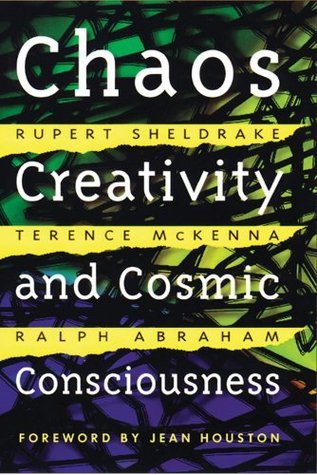
The last book I added to that shelf was a book of trialogues between Rupert Sheldrake, Terence McKenna and Ralph Abraham, Chaos, Creativity and Cosmic Consciousness, which I highly recommend as a wild exploration of many things, but in particular the connections between million-year-old psychedelic sacraments and the origins/evolution of consciousness.

I can vouch for this one, because I’ve actually read it instead of just hearing about it, so that’s an affiliate link above — if you buy the book through there I’ll get some money for a coffee.

If you’ve read either of these books or others like them, I’d love to read your thoughts in the comments below.