inner activism

Buddhism is the ultimate activism, and I’m not talking about the social justice movement Engaged Buddhism.

The argument is that materialism stems from not just greed, but also from seeking to soothe our suffering through consumption, through looking without ourselves for that thing that will ease our suffering, a thing that doesn’t exist outside ourself.

So while the Buddhist methodology teaches how to undermine greed in the world by treating our own desire, it also undermines our tendency to avoid pain by narcotising ourselves with whatnot.

When we are not treating our pain through consumption, we reduce demand in the capitalist system.

It might not seem like much because who is one person, what impact can their reduced consumption really have?

But we need to remember that we can’t directly influence anyone else’s mind, only our own. There is no person, no institution, government agency or corporation we can influence to change ~ applying pressure through direct action is admirable, but ultimately a pony show compared to the work of undermining the system from within, because we are the system.

Change ourselves, change the system.

And remember this quote from the Dalai Lama:

If you think you’re too small to make a difference, try sleeping with a mosquito!

mental-health conditions 

Busting the myth of psychopathology using … semantics!
(The pen is a mighty tool.)
And reflections on understanding what
mental-health recovery means for me. 

An insight that is percolating in me at the moment …  

… after confirming with my therapist and the work of Gabor Maté that my condition is relatively normal and healthy (‘understandable’ is Maté’s term1) and our family dysfunction within the range of healthy …  

… and while studying and practising peer work …  

… is that “recovery” (from mental-health conditions or substance misuse or whatever) does not necessarily mean the absence of symptoms.  

👆🏼That right there is a powerful insight for me! 

The insight started with some unexpected reflection on my attachment style (disorganised) and the recognition that I don’t need assurance that my attachment with Nikki (or any significant other) is secure. In that mood I can safely practise the health-giving practice of authenticity. 

a digression about boundaries 

It is about authenticity: not needing that assurance that our survival depends on attachment.  

A disorganised attachment style is a symptom, and “recovery” doesn’t necessarily mean living symptom free but means living in harmony (in good relationship) with the manifestation of the best response we know for these unnatural circumstances2.   

An instance that illustrates this is the tussle between anxious and avoidant attachment styles (that tussle being called the disorganised attachment style): by knowing my symptoms as they manifest in certain traits and tendencies and reactive patterns, I can live with them and not worry that their occurrence means I have some problem. And without living in fear that if I’m triggered these maladaptive habits will over-run me before I can regulate. Which generally prevents me from engaging with certain important relationships because I’m anxious that I’ll fuck it up and further exacerbates symptoms.

They (the patterns) were how I adapted and they don’t need to dominate my interpretation and/or be maladaptive. I can see them for what they are, the same as when I know the types of cognitive distortions that tend to emerge when I am triggered.

I can see them as trauma responses and let them go, thereby exhausting the negative karma that caused them, reducing suffering and pointing me toward wholeness.  

These models (such as attachment styles) help develop emotional and psychological granularity and vocabulary, enabling us to imagine and articulate a more nuanced inner landscape, helping us to navigate the experience of living with and thriving from/through the mental-health conditions that are an understandable response to the culture and world we live in today.  

I like that phrase as it comes out now, and that’s where the insight really landed for me: mental-health conditions is good terminology because it clearly connotes illness but literally just means (denotes) the condition of health.  

It puts our mental condition on a health spectrum, meaning it’s just varying degrees of health we’re talking about – eliminating and preculding the very concept of psychopathology.  

I have a mental-health condition – I am in a condition of mental health.  

It doesn’t sound like much, but it means something to me right now.  

the Buddhist connection 

Reflecting on this again after another shift at work, I really do like this phrase mental-health condition, and the acceptance that I live with symptoms, because mental-health symptoms are a natural consequence of the human condition, the human condition being characterised by suffering, delusion. 

The Buddhist view puts mental health in an interesting context and on a spectrum (of illness), saying the human condition itself is a form (the ultimate form!) of mental illness. This sits nicely for me because it says all human experience is a spectrum of illness and the phrase ‘mental-health condition’ offsets this with its opposite: that all human experience is on a spectrum of health.  

The one precludes all psychopathology altogether, the other precludes the hope for health (bleak!) by precluding health altogether! And as a paradox they collapse duality and leave me with an acceptant contentment that the symptoms I live with are understandable, manageable and meaningful, I can live a happy and constructive and meaningful life in their presence.  

I do not need these symptoms to be absent for me to feel healthy.  

That’s recovery for me. 

For me (with attachment/relational trauma) much of the work of staying healthy among these symptoms involves understanding my attachment style.  

So there you have it! A solution to all the world’s mental illness in one short blog post 🤣 

I’d love to know what you think — drop me a comment or write me a DM.  

footnotes

  1. meaning, ‘a natural consequence of our toxic culture’ as well as ‘able to be comprehended’  ↩︎
  2. those circumstances being our toxic culture (Maté, 2020)  ↩︎

the importance of attention

attention economy war for our soul newsprint digital matrix network good versus evil battle phone screen smashing computer desktop

It dawned on me recently that the attention economy is in a war for our soul!

Dramatic, I know! And I’m not even exactly joking. But what does this mean? What is the attention economy? And how is it warring for our soul!?

I have started answering some of these questions in a resource I am developing for Heartwards, which can be found here.

Something I want to address in this post here though, is the outrageous claim that the attention economy is in a war for our soul.

As I have been deepening my Zen practice lately ~ in particular at a recent three-day sesshin ~ I have started to notice or strongly suspect that our capacity to concentrate on the present is directly correlated with our awareness of our true nature, which is that we are already enlightened (in Buddhism this is the concept of buddha-nature).

In the Sanbo Zen lineage I am training with, our practice is to concentrate on the mantra mu, and I have started to see this very short word as something like an interface (or a portal!) between my relative self and the absolute Self.

This means that every time I am distracted from concentrating on mu, I am pulled away from the portal that would take me to insight about my true nature.

Knowing that some would refer to the absolute Self as the soul, I have decided to start deliberately using hyperbole in claiming that the attention economy is in a war for our soul.

And repetition! I learnt from reading Schopenhauer that repetition is a useful literary device.

Correct me if I’m wrong.

Of course, it’s not just mu that is the portal ~ mu is just a placeholder, and the portal is nothing more and nothing less than the present.

If our attention is constantly being pulled away from the present by advertising, click-bait, fragmented conversation and our every fleeting desire and curiosity (all of which are the jet fuel of the attention economy), then yes, the attention economy is in a war for our soul, because it is through concentrating on the present that we know our soul ~ it is through strong attention on reality as it is that we experience the contentedness, peace and quietness of mind that feels like heaven on earth.

When my concentration/attention is strong ~ not just in meditation, but especially in the comings and goings of daily life ~ I enter a flow-state that feels so peaceful and chill, like everything is exactly as it should be, warts and all. I feel more able to accept reality as it is, without wishing to change it because I have been distracted by some desire.

Does this make sense?

Honestly, it feels like one of those insights that are so simple they’re hard to describe because the moment the words start coming out of my mouth I think, Der, of course!

And then I start repeating myself because it’s so simple that I think, It can’t be that simple ~ let’s make a bit more complicated!

What do you think?

How does the quality of your attention impact your wellbeing?

envisioning a culture of happiness instead of productivity

I’m taking a Mental Health Day today because I started to notice my window of tolerance was narrowing – I was becoming easily irritable, easily triggered and generally just unhappy and stressed. A lot of shit’s been going down lately, and we can’t seem to get a break lately, so I decided to take one. I’m starting a small business, and part of the reason for doing this was so I could keep my own hours – what’s the sense of starting that and then doing 40 hours weeks because my conditioning says so!?

I have a vision for our culture where taking such Mental Health Days is normal and encouraged, more important than the days we are being productive at work. What’s the point of being productive if we’re fucking hating ourselves for it!? This is something like GNH instead of GDP but I don’t want to unpack that now.

A lot of sadness was near the surface for me yesterday and I figured something must be going on or coming through and I want to stop and be present for that.

Also, I need to fill my cup.

As I mentioned the other day, we are living with complex trauma and expecting ourselves to be “on” all the time is a bit silly – we need downtime, time to rejuvenate. By “we” I mean “Nikki and I” but also pretty much everyone in our whole culture, considering everyone is living complex trauma due to the nature of our society, which is pretty fucked up when you think about it, but that’s how it is and we need to see that in the face. 

I can’t remember what triggered the sadness orginally, but I know it had something to do with Zane. I had it affirmed by a Blue Knot counsellor that as parents we are often triggered easily during the time our children are the age we were when we were traumatised. 

I know it is this because of the emotions that came up when Zane came out while I was drafting this and said good morning, asked how my sleep was. I told him not good and he apologised, knowing that the sleeplessness was partly due to our concern around catching him smoking bongs in his room last night. I was doing the same thing at his age, and the subsequent heavy pot habit left me with a lot of unprocessed emotional pain. I told him (in not quite these words) I just want him to look after his brain, and it’s upsetting to watch him go down the path of self-harm but I have to trust that he’ll learn for himself.

He looked remorseful and/but said thank you, and it’s a weird thing because maybe his unexpected gratitude made me sad because trust is all I needed at his age (instead of the weird manipulative controlly things Mum used to say), or maybe it’s because she did say things like “I trust you” and going through this now as a parent is just too close to home. 

I want him to avoid the future pain I know is on the path of self-medication he’s on. 

But I’m not so naive that I believe I can actually prevent this for him – and when I really think about it, I wouldn’t want to deny him the opportunity to learn from his own karma. 

But that’s not even the guts of it. 

The guts of it is, I think, I’m sad because I don’t know which of the above I’m sad about, if any – I’m sad because I don’t remember those years of my life at all and that means I’ve lost something, a big part of myself and my history and that continuity of self we depend on for having a safe sense of being. 

Something like that. 

There’s a break in the narrative I use to understand and connect with my self.

Seems I repressed a lot of my adolescence – or I went somewhere else during that time because the pain was too much. 

I still do this, living in my head because being present in the body is too … unsatisfactory? Too much dukkha, not enough skill for coping with the suffering of samsara, much less the readily accessible capacity to transmute that suffering into joy.

That sort of alchemy is still a possibility though, which is nice to remember.

Yes, that’s why I’ve taken this Mental Health Day: to remember and spend some time with the “base metals” we transmute into “gold” through doing the work of accepting reality as it is.

That might not make a lot of sense off the bat – or it might … it might make perfect sense to you. Either way, here’s a button if you’re curious about it and would like to connect around this idea: 

Meanwhile yes, back to what the Blue Knot counsellor was saying: there is trauma in there and a shadow of course and the sadness is a healthy indication that this trauma is presenting itself to be seen, acknowledged, recognised, embraced, loved. 

One of the few things I am confident about is that by not resisting these things that come up from our wounds, the wounds express themselves (in the sense a wound expresses puss) and in doing so, the wound self-heals. 

Humans are self-correcting, like everything on Gaia. We just need to allow the process without interrupting it, without distracting ourselves, without self-medicating or working ourselves into the ground or whatever we do to avoid the pain.

If we resist what’s coming up, then we just push it back down into the unconscious where it continues to fester and it will inevitably come up again, only worse and more vague and difficult to understand because each time we push it down it becomes more and more muddled with that big amorphous painbody inside us, like a huge blob of secondhand bluetac we’ve accumulated from every house where we ever hung a poster. 

We can learn to be non-resistant by embracing what I am choosing to refer to as ahimsa, which is the classic Sanskrit word for “non-violence”.

Our resistance to reality (including … especially … the reality of the pain that wells up from our unconscious on the daily) is a form of violence. 

Metaphysical violence if you will. Psychological self-violence. Through the force of habituated will, we push away what we don’t like about reality. 

We can train ourselves to not do this, and if you’d like to learn this with me, get in touch for a 

Because that’s a huge part of what I’m doing at Heartwards as a trainer and coach in psychological fitness and integrative wellness: I am training myself in ahimsa, so that I suffer less and can help others to suffer less.

Thereby unleashing happy, healthy and empowered individuals who are resourced enough to do their good service in the world. Because resistance drains a lot of energy, and literally gets us nowhere. 

Suffering = Reality x resistance

Happiness = Reality x acceptance

And I envision a culture where we are all able to do this. Where it is respected to take Mental Health Days so we can check in with where our resistance is at because, for example, Gross National Happiness is more valued than Gross Domestic Product in this new culture.

Because what’s the point of being productive all the time if we’re hating ourselves while we’re at it!?

the difference between pain and suffering

With Heartwards I am developing courses and training programs in psychological fitness,

because it has come to my attention (in the last 15 years or so) that there are root causes for both happiness and suffering, and I believe those causes are psychological.

I can stop mincing about and worrying that people are going to think that what I’m doing here is quote/unquote woo-woo, because everyone brings their thing to the table, and this is the thing I bring.

We all would like to see a happier and healthier world, and my contribution to bring this about is the offering of psychological-fitness training.

I like the motto “a healthy world arises out of healthy minds”.

And I believe in the idea that a happy and healthy world arises when we learn to see the world (and ourselves) as happy and healthy.

The trick is we have to learn how to choose our conceptions, our cognitions, our thoughts and feelings about what happens in the world: how we perceive and interpret the world makes all the difference.

And the difference is between happiness and suffering.

I just saw on Instagram, an idea I aspire to embody: pain is inevitable, suffering is optional.

For example, it might be painful to feel we have failed at something that was important to us, but we transmute this and avoid suffering by choosing to see it as an opportunity to learn.

🤯 That’s called a growth mindset.

Now. It’s no great secret that the dichotomy of terms “happiness and suffering” comes from Buddhism, at least in my experience. And the idea that these result from “root causes” is also something I picked up from Buddhism (where the root causes of suffering are called the Three Poisons: desire, aversion and ignorance).

Turn this around and it means the root causes of happiness are things like gratitude, acceptance and wisdom – these are heart qualities we can use psychological-fitness training to cultivate internally, so that happiness is a more-spontaneous and more-frequent response to the world, no matter what state or events are happening around us.

We don’t need to suffer if we have the appropriate psychological skills at our disposal.

The Buddhist conception of suffering has rubbed a lot of people up the wrong way, I think.

Another translation of the term dukkha is ‘dissatisfaction’, and dukkha or suffering in this context refers to the dissatisfaction and the vague sense of unease we feel in life when we pursue happiness primarily in the domain of pleasure, motivated by desire and perpetuated by ignorance of the reality that sense gratification can only ever be fleeting, temporary, bound to keep us very much preoccupied with our trip on the hamster wheel of material success.

And it is a trip, in the sense that our preoccupation with the material world is based on delusion or hallucination.

Another way to discuss this without triggering aversion to the terminology of Buddhist psychology is through the dichotomy of hedonia (the pursuit of happiness through primarily external sense gratification) and eudaemonia (the experience of happiness from within).

Whichever way we want to peel the onion, in the end we come to the same conclusion:

  • happiness comes from within;
  • pursuing happiness in external sources of pleasure leads inexorably to suffering.

We all were told this at some point, that happiness comes from within. But how many of us were told how to find or experience this alleged internal wellspring of happiness?

That’s where psychological fitness comes in: we can train ourselves to embrace reality as it is, and this embrace results naturally in happiness,

which is not always pleasant.

Happiness is another word that’s heavily loaded, and we’d do well to use terms like contentment and equanimity instead, which I’d love to unpack another time.

The point for now is that Heartwards is a spiritual service

in the sense that ‘psychology’ was originally the study of the soul, not just of the mind or of the neuroses of human behaviour.

And all of the great so-called spiritual traditions are, at their heart, modalities of psychotherapy.

So that’s the update for today.

My desire for a sleep-in was frustrated by the cats this morning, and I felt sure my Sunday was ruined: anxiety started, rumination kicked in, and before I knew it I was kicking myself inside the head with all sorts of cognitive distortions.

Then I turned it around because I remembered that happiness is a choice we can make if we are in possession of the right psychological skills.

If that sounds like woo-woo, then carry on, nothing to see here.

If it sounds like something you’d like to learn more about and start applying in your life, get in touch.

such are the vicissitudes

Today I had the scent of the buddhas in my nostrils, after a brief and powerful breathwork practice with Keagan Bizzell and the Samford Valley Brotherhood.

Yesterday I experienced the hell of my own anger, but narrowly avoided the vortex of shame and self-loathing that often follow such destructive emotional episodes. I did so by catching myself in time and remembering to practice self-compassion, knowing anger is often a conditioned substitute for sadness. I wrote myself a love letter. It worked. It’s a technique I highly recommend.

The point is, I posted here a while ago about doing really well lately, and since then I have had some really shitty times because I wasn’t able to catch myself in time. By “shitty times” I mean “very difficult internal reactions to triggering external events”, and I don’t at all want to paint a half-truth on the socials.

I’ve been doing well lately, but there’s also been a lot of struggle. And sometimes I experience flow. Mostly I struggle, but the flow state is happening more frequently.

Such are the vicissitudes of life … uphill, down dale, etc. Happiness is rolling with the goods and the bads.

Today is good, but anything could happen. Anything could happen, and today will still be good if I can see the space where interpretation is made, and if I can find choice between happiness and suffering before reaction kicks in.

We can do this, and choose happiness. That’s what I’m learning, and that’s what I want to impart through Heartwards, which I wrote about recently here. And I started a Facebook group / page.

Today I had the scent of the buddhas in my nostrils, yesterday I experienced the hell of my own anger, and such are the vicissitudes of life …

becoming Possum – applied eudaemonics

re-adaptation
regarding adaptation
redoing adaptation

on accepting reality for long enough to learn adaptive coping mechanisms to replace maladaptive ones

because Possum inspires and motivates me to be a human animal capable of adapting to the urban environment that has displaced us from our natural habitat

I am disappointed with myself at the moment and doing my best to not berate myself over and over because I know that would be maladaptive.

I had a couple of drinks last night while making dinner and listening to Paul Kelly. So far so great, I was feeling good and not trying to drink my pain away as I learnt how to excel at for the last 30 years in our culture.

Actually I did have a persistent headache, but I wasn’t experiencing intense emotional pain. I felt I was coping pretty well with our stressors and was safe to have a wee tipple. I was treating the booze a bit like paracetamol, a kind of experiment. And I felt like getting a buzz on. It felt healthy, and it was, compared with how I’ve abused substances in the past, so I can say truthfully that overall I’m making progress with becoming less dependent on exogenous hedonic pleasure for that false and fleeting sense of well-being it brings.

This kind of thinking helps me to curb the self-flagellation.

Thing is, I’m supposed to be on a self-initiated three-month “sobriety binge”. I want to subject myself to coping with reality without external crutches like booze and weed and Minecraft and see what comes up, what I learn, how I manage. I’ve done these sobriety binges before and they’re great, like a detox, very illuminating.

What started as a few healthy drinks to get a buzz on and curb a headache turned into Nikki and I sharing a bottle of vodka. Still not such a great big deal in itself. We didn’t drink a bottle each, which is something. I feel confident we will not relapse so far that we are doing that again, once or twice a week.

We are making progress with becoming less dependent on exogenous hedonic pleasure for that false and fleeting sense of well-being it brings.

We didn’t get so intoxicated that our perceptions fucked out completely, causing us to do anything we deeply regretted, as we have done in the past. Of course I value the Buddhist precept recommending that we not intoxicate self or others, lest we become unskilful and cause harm. I also value the Middle Way, and am less likely these days to exploit the teaching of “moderation in moderation”, to justify excessive binges that result in immediate harm and then days and days of regret and shame.

So there is progress being made – I am becoming Possum, the great urban adaptor. I am proud of myself and of Nikki and I am immensely grateful that I share this journey with such a committed alchemist as my wife. We are learning that there are ways of transmuting suffering into joy and that idea is feeling less and less abstract and esoteric and inaccessible as we draw from the courage to actually implement the ideas and test them, apply them.

By turning toward suffering with the right coping skills, we are learning a lot about the nature of mind and reality and about the way these interact to form interpretations of either happiness or misery, and in that turning toward we are finding choice, the ability to choose our interpretation, to choose happiness in the midst of suffering. Just imagining that and feeling it’s possible brings a micro-moment of actual joy, an emotion that is rare for me at this stage but becoming slowly more frequent.

So far still good and actually this little story doesn’t have the plot twist that usually follows the “so far so good” trope.

What concerned me this morning was the underlying motives to drink that I was not quite aware of last night.

The motive was to get a buzz on and curb a headache, which really is not such a big deal. I’m not a crack addict or a criminal and I don’t fly into drunken rages and trash the place. I don’t beat my kid and then fuck off for days at a time to whack the pudding in the mistaken hope that this will make me feel better and then return home full of misplaced shame. I am a kind and gentle contemplative person who was raised in a materialistic culture and doing pretty well at getting off the hedonic treadmill by learning applied eudaemonics.

Sick! Kickin at goalposts I’ve set for myself and sometimes missing. But I was raised around AFL and as the joke runs, aussie-rules football is the only game where you get a point for missing!

Still, the motive was to make reality more pleasant than it was (by adding a ‘buzz’), and to avoid the pain of a headache instead of accepting that symptom as a message screaming, SLLLLOOOOOOOOOOW DOOOOOOOOOOWWWWWWWWN.

I’m still learning how to stop and do nothing and relax and enjoy just being alive on a beautiful planet.

The plan was to do our home-coming decompression meditation, have a couple of bevvies making dinner while Nikki did some gaming, then crash out early to practise good sleep hygiene as the first foundation of mental and emotional fitness.

That’s my trip these days – I’m that kind of “fitness freak”. That’s why I feel disappointed. I let myself down. But I can accept that, and start where I am with beginner’s mind.

The plan was to be responsible and do self-care. Our life has been a comet of stress lately, and yesterday was no different except I felt I was keeping abreast of it, not getting blown away by its sheer force. We pulled into the driveway yesterday feeling we had got to a place in our incessant metaphysical nattering that we could stop and just be without trying to solve the problems of the collective unconscious with the power of conscious thought alone.

Because life happens while we’re busy making plans, Nikki got a call from a friend whose daughter and our friend has been admitted to the psych ward. The family is not coping well and we’re trying to position ourselves as advocates for the daughter to help them navigate the punitive public mental-health-emergency system. So Nikki spent an hour and a half on the phone, advocating on the daughter’s behalf, which is good, this is what we want to be doing, just maybe not at 5.30pm on Friday, mere moments after we had decided to stop and just be without trying to solve the problems of the collective unconscious with the power of conscious thought alone.

The phone call was not the problem. It just kind of threw us out. The problem (for want of a better word) is not even that a few drinks became 3 and then 5 and 6 until we finished the bottle.

We had a nice dinner, Nikki did some gaming while I did some study and we went to bed watching Dead Poets Society, because I thought it would be a nice easy-going drama that wouldn’t be too stimulating and would distract me just enough to drift off to sleep. I’ve been afraid of sleeplessness since a heinous mid-week bout of insomnia.

Somehow it was 1.30am before I was able to wrench myself away from what I had somehow forgotten is a profoundly inspiring (read: stimulating) film for me. This was progress for me – normally I would eat the whole proverbial bag of chips.

I even managed to sleep instead of bouncing off the walls of my mind all night, which is sometimes what happens when I drink enough to edit the unpleasant out of reality but not enough to wipe myself out.

The ‘problem’ is I employed a maladaptive coping mechanism to deal with stress I’m almost not aware of because it has become so normalised. The problem is I don’t know how to do nothing and just be for long enough to relax on a Friday evening.

It’s not a problem exactly because these skills can be learnt.

It’s not even a problem exactly that I woke up wide-eyed and pinging at 6.30am, still with the headache.

It’s just I’m disappointed because I thwarted the opportunity to get the rest I needed and now I’m back to square-one. I was wanting to bounce back from that heinous mid-week insomnia, and instead I did maligned adaptation.

Like the possum that fell into one of Nikki’s succulents on our back deck the other night, which picked itself up and scampered away when I stepped out to see WTF that noise had been. Possum inspires and motivates me to be a human animal capable of adapting to the urban environment that has displaced us from our natural habitat. Through healthy adaptation we are able to flourish – that is what eudaemonia is all about, human flourishing. It’s about getting off the pleasure train (the hedonic treadmill) so we can stop long enough to see where we are with clear and healthy eyes, without resistance, without trying to change reality to suit our desires.

I said to Nikki when I woke up that I find it vaguely distressing or depressing that in our culture we don’t know how to do nothing, how to just relax and stop and be still. We are either being productive or entertaining ourselves or distracting ourselves or running around doing errands. And then we need to use things outside ourselves to bring the nervous system back to relax mode. Things like booze, which don’t even actually do that anyway – hence the term maladaptive coping mechanism.

Nikki and I are not employed in the traditional sense and we still manage to pull 16-hour days 6 days a week because being alive and healthy is a full-time business.

And we’re needing to teach ourselves how to de-stress from that in ways that are healthy. But we are at least teaching ourselves these skills, and it is precisely these skills that I am hoping to share with others through the business I’m setting up around Kokoro 心 Heart:

  • coping skills
  • mental, emotional and nervous-system regulation
    • through meditation and the art of skilfully doing nothing in motion

Today hopefully there will be nothing but a long swim and some cross-stitching. [We ended up visiting our friend in the psych ward, but today today – the day of posting, two days later – we are going for a long swim. I went to a day-long silent-meditation retreat yesterday and have managed to get 9 hours sleep last night!]

[Meanwhile yesterday:] I at least am successfully not berating myself, and remembering:

S = R x r

H = R x a

where

S = suffering

R = Reality

r = resistance

H = happiness

a = acceptance

So that:

Suffering = Reality x resistance

Happiness = Reality x acceptance

I am accepting that this self-inflicted tiredness is where I am at, and remembering that the world as it is (with me not sleeping well in it and everything) is perfectly imperfect.

A unique and deeply personal modality is forming around me through Zen training, Cultivating Emotional Balance and Somatic Experiencing.

I am learning to have an embodied mindful awareness throughout the day and it is helping me to notice those once-hidden underlying motives to avoid reality in one way or another.

Through making this unconscious conscious without freaking out, we gradually become awakened enough to accept reality and all its warts with equanimity and joy.

That’s what I believe anyway and I’m doing the experiment to see if it’s true.

During my “sobriety binge” I got tipsy and messed with my sleep – now I’m trying to respond to that with kindness so I don’t continue repeating this cycle of maladaptive coping mechanisms.

working with reactivity to reduce suffering

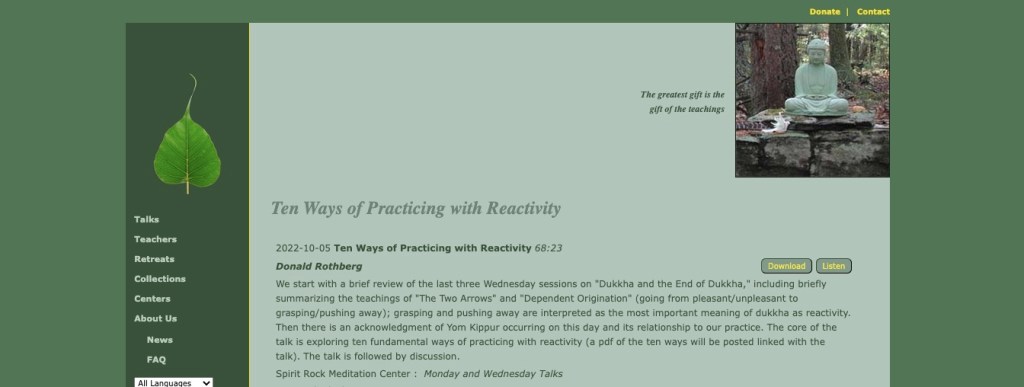
Here is a talk by Donald Rothberg called “Ten Ways of Practicing with Reactivity”, which helped me with something like an insight about a false belief I suffer from. He says that if a child’s parents get divorced, that child may believe it was their fault and because they don’t have the capacity to reframe this false belief, they may experience the cognitive distortion that any future relationship trouble is their fault. I can certainly vouch for this, and I hope I can remember this in future to prevent myself from berating myself endlessly when even the most minor disturbance occurs in my family of choice.

At that link you’ll be able to download a resource listing the ten ways of practising with reactivity, the first of which is to cultivate wisdom. Easier said than done, but Donald provides the teaching of the Two Arrows to help us get started. If someone hurts us, or if we hurt another, that is the First Arrow – if we then begin berating ourselves or ruminating on the hurt, that is the Second Arrow. If we lash out, that’s another Second Arrow, et cetera et cetera, ad nauseum. We may not be able to prevent another from hurting us, and we often are not able to refrain from acting with reactivity, but we can be skillful about how we respond after the fact.

Something we can do after the fact is cultivate the heart practices. I have been starting to do this more recently, and it really helps – if we flood our minds with compassion or forgiveness, there is less room for resentment and anger. I also use this emotional first-aid resource that I developed for myself and have shared here before.

Donald also encourages us to use relatively mundane instances of unpleasantness to practise becoming aware of reactivity. When something vaguely unpleasant happens, something manageable and not too triggering, stay with it. This way we’ll be able to start noticing when reactivity is happening and how it feels – it’s an easy-to-remember way of practising mindfulness throughout the day.

I found it interesting that he talks about reactivity in the context of dukkha, that classically unpleasant experience of suffering or dissatisfaction in the Buddhist conception of our deluded interface with reality – that first one in the Four Noble truths, that suffering exists. He says that reactivity generally manifests as either grasping or aversion, and it seems to hold water for me.

Reactivity is a thing I’ve been trying to understand and move away from, so having it placed in the context of the Four Noble truths helps me feel like the experience is held in a container I trust and have faith in. I understand that grasping and aversion cause suffering because they fuel the wish for reality to be other than it is, and now reactivity is just another way of describing an experience that falls in the attachment basket.

The above are just the bits of Donald’s talk that landed with me – check out the rest of the talk and the accompanying document if you’re interested in learning how to be less reactive and more responsive in life.

mindfulness as an antidote for disappointment

A not insignificant benefit of mindfulness I have noticed: when we are not mindful, our habitual mind seems to be almost-constantly making “micro-plans” … “I’d like to do get time in the garden today”, “I need to put air in the tyres later”, “I really should make sure I blah blah blah”, and because this is happening a mile a minute, soon enough (sometimes within five minutes of waking) our mind has made plans on our behalf and our day is loaded with the dreaded expectation; because we could never achieve the myriad things we imagine every five seconds, this mindless planning is an automated way of setting ourselves up for failure and disappointment, our day resulting in ten thousand micro-dissatisfactions, which accumulate over a lifetime.

One way of defining “dukkah” that isn’t as frightful and extremist as suffering is dissatisfaction, or maybe disappointment: we expected that hedonic pleasure would be satisfying in away that it usually isn’t, and then we are disappointed. Samsara, being characterised by dukkah, is inherently dissatisfying if we aren’t mindful of the way our habituated and conditioned mind creates all these micro-expectations for us.

When we cultivate mindfulness on the cushion, we begin to notice ourselves creating these expectations throughout the day and it becomes easier to keep them in check.

If we have to be dualist and say that nirvana, being the “opposite” of samsara, is a state of being satisfied with what is, then it may not be hyperbole to say that by cultivating mindfulness we place ourselves in more-consistent alignment with a lived experience of nirvana which, after all, is not some other place we need to get to in time or space but more like a way of perceiving correctly where we’re already at.

By enjoying this place without loading ourselves up with expectations, we experience an abiding state of enoughness and are free to do what we can without aspiring to do what we can’t.

slogan one, reminder two: be aware of death; impermanence

Point One The preliminaries, which are the basis for dharma practice

Slogan One First, train in the preliminaries (the Four Reminders or the Four Thoughts)

Reminder Two Be aware of the reality that life ends; death comes for everyone; Impermanence

~~~

*TRIGGER WARNING*

considering the state of our world and minds,
the idea of suicide is bound to come up eventually;

I consider it great consolation that contemplating the inevitability of death
is a powerful antidote for the thought of self-inflicted death

the break in-between

Photo by Pixabay on Pexels.com

I am pleased to report that I have recently dropped the whole work-eat-sleep-and-shit-till-you-die routine. I have taken a financial hit to gain more time affluence, meaning more time for reflection and meditation. The mere acts of writing thoughts and engaging with philosophy and exploring our spiritual nature are things that make my life worthwhile and I hadn’t been doing them enough due to the demands of employment.

It was getting depressing, to say the least – without time for reflection or anything other than work, life’s difficulties were causing a paralysis I could only imagine solving with suicide. I don’t know how people do it for decades in a row. I guess they adjust and reconcile themselves with certain sacrifices. But I don’t want to just adjust. I want to adapt, evolve, and I want to make sure I’m not making sacrifices I will regret on my deathbed.

Regret has always been my biggest fear.

I want to adapt and evolve and accommodate the making of meaning among the demands on my time now that I’m a husband and dad. I want to set the example for my son that there is more to life than just employment, but also for all the people I encounter because we can’t go on like this, depriving ourselves of meaning because material wealth is believed to be all we need for a happy life. Clearly it’s not, because we are all in the West wealthier than ever before and that wealth has been gained through the sacrifice of our collective wellbeing. And to think the word “wealth” was originally derived from weal.

We are less happy despite our relative affluence because increased affluence makes it easier to distract ourselves from facing up to the transformative power of suffering.

A lot of us are running ourselves into the ground for the sake of material security, and in the process neglecting what hopes we can have for psychospiritual security if we gave more time to reflecting on what really makes life worthwhile. And let’s face it, death is the only thing that makes life worthwhile. The word “security” is not quite appropriate in the context of the psychospiritual journey, because on this Path there are no guarantees. I’m not talking about securing a place in Heaven, but a certain few reflections can prepare us for the end of our lives and point us toward a karmic trajectory that is going to be more favourable than if we had neglected spiritual aspirations in favour of, say, yachts!

To help with this aspiration, the second Reminder in the lojong teachings is one of those reflections:

be aware of death; remember that everything is impermanent.

Everything dies, and not just biological organisms – ideas, feelings, thoughts, moods, and situations, are all fleeting. It’s easy to say and know that everything dies, and to think of organisms. But the reality of biological death or mortality is more distant from our immediate experience than emotions are, unless we cultivate a practice of reflecting on impermanence. With our thoughts, feelings and emotions we can see how they are born, dwell for a time, and then fall away. Remembering this helps to let go of attachment – to achievement and ambition, to objects and people, but also to pride and hubris and the over-inflated ego. To illustrate this I like the image of the butterfly.

The self-destruction of the caterpillar is such a perfect metaphor about dissolution of ego attachment. As the caterpillar turns into goo before it somehow morphs into a butterfly, so the ego must dissolve before we can transform into the compassionate beasts we always were.

Reflecting on the impermanence of the ego helps us to learn and grow, because reduced attachment promotes the healthy ego we need to admit we were wrong or don’t know.

Zane and I have butted heads a lot because I have low tolerance for people who can’t admit they were wrong, and Zane lacks the healthy ego development to be gracious about his own ignorance. But when I embrace Butterfly and relinquish my attachment to the value of Socratic ignorance, I am able to swallow my pride and humble myself before his misdemeanours and try to help him understand why some of his behaviours are problematic.

When I feel frustrated with Zane’s transgressions I can try, with sufficient training, to remember that the emotions will pass if I let go of attachment to whatever identity I think has been hurt or disgruntled by the behaviour. When I am able to do this I feel an acute sense of joy because I have dropped my misguided sense of self-righteousness for the purpose of helping a young human learn how to become a well-rounded adult. And we get along better and we smile and we laugh and we don’t scowl so much and I feel good about myself instead of feeling like a goddamn grouch.

To support the renunciation of self-attachment, I have recently introduced a practice of “training in the preliminaries” to my sadhana, because the preliminaries remind me that 1) human life is precious, 2) feelings are fleeting, and 4) attachment to things that are precious but fleeting is foolish and a primary cause of suffering. Of course there are four Reminders in the preliminaries, but the third Reminder about karma has less bearing on the mitigation of suicidal ideation, so I won’t go into that here.

It is enough to say for now that when I feel like ending things because my means for coping are so depleted that I think we’d all be better off without me (which is merely the result of unresolved childhood wounds and has no actual bearing on the nature of present reality), having familiarised myself with these preliminaries helps to mitigate my wish to terminate existence. What a relief!

~ ~ ~

I had a dream after reading about karma the other day and the whole vibe was about the importance of doing the right thing(s) in life so we don’t experience (unfortunate) rebirth and go through a whole other lifetime of suffering. But what about this lifetime? if, like me, we are on the fence about reincarnation. If we could let go of attachment to our thoughts and feelings (if we could stop mis-identifying with our emotions and moods as who we are) then our current lifetime would be so much easier to deal with and there would be fewer causes of wrong thought and action. It’s easy to not accrue negative karma when we’re feeling happy and relaxed, but how often are we in those states? The whole test of our mettle as karmic consequences is the way we think, speak and behave when we are distressed.

I hadn’t really expected that reflecting on impermanence would lead to reflecting on attachment and karma, but (lack of) awareness of non-permanence seems now to obviously underpin our (misguided) notions of identity and how we behave from that identity. When we are attached to a fixed identity, we suffer – when we are more loosely defined by a fluid identity rich with non-attachment, suffering is more easy to bear. When we are suffering less, we karma better.

Also, including these Reminders in my sadhana has helped me to see that they are each complements of the others – it is hard to think of rebirth without thinking of karma, and hard to think of impermanence without thinking about clinging, et cetera.

The reading that informed the above-mentioned dream was about the Buddhist perspective on suicide – tabs I had open from a recent post referencing the monk on the Rage Against the Machine cover – and the author made a very resonant point that suicide is almost always a result of a serious case of mistaken identity.

We mistake our thoughts and feelings for who we are, when what we are is really the vast space wherein that identity manifests temporarily and always in flux. We shoot ourselves in the head because we think that’s where our suffering comes from, tragically unaware that among that very hardware is the toolkit we can train ourselves to use for the mitigation of that suffering. Recognising the non-permanence of our thoughts/feelings is among the first steps in escaping the suffering caused by mistaking our mental/physical body as what we are.

I’m starting to sound like a broken record now.

A first step in recognising the non-permanence of our thoughts/feelings is the cultivation of mindfulness, supported by ethical conduct and leading to the experience of wisdom.

~ ~ ~

I pulled the blood-death card out of a tarot deck the other day, and was pleased because I take death to represent change more than anything else and I need some change – we need something to break and die to bring this period of turmoil to an end. I mean that in a personal or domestic as well as in a global sense. I need a break – we all need to be given a break for a while, but that’s not going to happen. We cannot put life on hold while we repair the damage we have caused.

Meanwhile, suicide is not an option, though my afflicted mind subjects me to considering it anyway.

There is potential for psychotic break, by which I mean a break from illusion, but I want to hold that at bay for now, work on the container I need for that to not spill over into spiritual emergency.

We can’t afford a holiday.

Where to next then? Maybe that break between thoughts – the space in-between, where stillness resides.

How to get there? I’m not sure that question is the purpose of this post.

I know I was pleased when, after pulling the blood-death card, I checked in with this lojong-writing practice and was reminded that Slogan One, Reminder Two is about awareness of death. Death as a meditation object. I’ve been thinking about this lately. I understand or believe it’s a powerful practice – for one, to awaken awareness of Reminder One, the preciousness of human life as an unsurpassed opportunity for liberation, but also as a motivation to be fully alive in the present, fully present in this life.

That’s a golden thing – something to be pleased about, to be sure to be sure.

Yet … I had been avoiding this meditation – as I avoided tonglen, the practice of exchanging oneself for others, a central meditation of the lojong teachings. These are practices that make me feel uncomfortable, just to think about. Perhaps for that reason entirely, they are exactly the practices I should be stepping into. But I have so much discomfort already – it seems like folly to actively seek more … but I sense a paradox here.

The discomfort I am currently experiencing due to tenancy issues outside the bounds of my control, it is base mundane banal … profane is the word I was looking for. The discomfort I would face in these practices has a much-more sacred vibe about it. By embracing existential or psychospiritual discomfort – by turning toward it as the kid in Stranger Things turned toward the monster he faced in the Upside Down – may the discomfort of profane angst evaporate. By confronting the sacred reality that all including life is impermanent, may our afflicted attachment to profane suffering fall away, allowing us to finally live.

So there’s that: confronting the uncomfortable existential truth of death and impermanence may be a root-cause treatment for the discomfort of relative or profane suffering; may we experience equanimity in the face of samsaric daily life by embracing our opportunity to practise enough virtue before an untimely death. This is how McLeod describes the teaching – let’s call it the vinaya argument, the argument from ethics or virtue.

He adds as well the reminder that after death, nothing but the results of virtuous or nonvirtuous actions will remain. As we say (but may not truly know without a death-contemplation practice), no material/profane gains can be taken with us through the grave. The death-scientists of Ancient Egypt may disagree with this, I dunno. They put coins on the eyes of the buried for reasons I don’t understand.

Whatever the result of any potential dissonance between the Buddhist and the Egyptian view, this Reminder buoys me in my recent decision to prioritise wellbeing over traditional employment. The decision was to sacrifice material wealth to gain more time affluence – to have more time for the contemplation of reality, so that I might die poor and happy instead of poor and unhappy, which is where the employment path was leading me. I was told by Nikki just now that when I was quitting my job I said it was partly because I wanted more time to contemplate death. Sounds like something I would say!

I’ll think on this some more over the coming weeks, and maybe I’ll add an edit to this post.

Meanwhile, do you have any guided meditations or other teachings you can recommend for the contemplation of death? And/or the practice of tonglen, of exchanging oneself for others? Absolute bodhicitta sounds very cool, and Shantideva assures us that this is the fastest Path:

They who desire shelter quickly
For themselves and for all others
Should use this sacred mystery,
The exchanging of oneself for others

Imagine how screwed you would be if everyone died!