in praise of pocket protectors

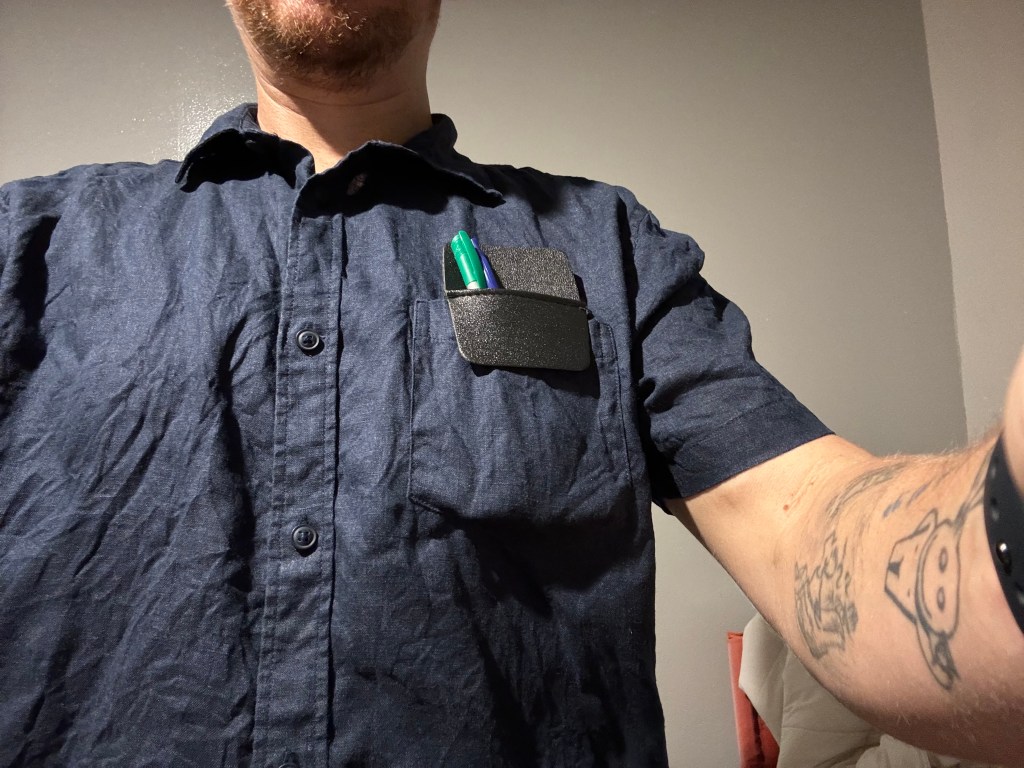
My pocket protector arrived in the mail today, much earlier than expected. I am happy about this for a slew of half-coherent reasons.

It’s Father’s Day, which I know only because my son reminded me, despite the fact I have been working hard on reparenting myself lately ~ so this is a nice and unexpected Father’s Day gift for myself. #

I am a middle-aged man now, and have been a father for sometime, which gives me “permission” to be as daggy as I like. #

It reminds me of a time when a dear and long-term but currently distant friend playfully teased me about the pocket protector I had fashioned out of cardboard, maybe 15 years ago when I was still in my 20s.

One of my pens had burst in the salvaged army-reserve jacket I wore at the time, and this friend, known to me alone as Knobelisque the Great, commended me for being the bogan-cum-mega-nerd I was back then, with my hobo-chic jacket and my cardboard pocket protector.

That was a time when I was earnestly and successfully applying myself to an unexpected publishing career, and some 5 or so years after my first real girlfriend told me, “Because you are a writer, you need to carry a notepad around ~ all writers do that.”

So I started doing that, and I have started doing that again, as well as now embracing the inner mega-nerd that has always just wanted to confidently wear a pocket protector.

Both of these friends are distant now, but I know they would be proud of me for saying, “Fuck it I’m wearing a pocket protector!” #

It fits perfectly in the new linen shirt I bought for myself recently, alongside the above-mentioned spiral notebook, which I am extra-celebrating since I re-read in Zen and the Art of Motorcycle Maintenance, that Robert Pirsig also carried a notepad in his shirt pocket.

I have never really identified as having heroes, but if I did I would say Pirsig is one of them, and I am not ashamed to say that I endeavour to emulate the attitudes he articulated in that singular novel.

Also, he depicts himself as 40 in that story, and I am also currently 40. Every other time I’ve read that book I was, obviously, younger than 40, and each of those times I assumed that Pirsig was maybe 60 and that Phaedrus was maybe 40.

This has been a tendency of mine ~ to always assume that wise folk are more adult than I am.

Reading that Pirsig was 40 at the time of that motorcycle journey with his son has reminded me that wisdom is not a factor of biological age, and on that note I am going to link here to an essay I wrote about the problems associated with typecasting young writers as insufficiently experienced to write about improving the human condition.

I was around 25 when I wrote and published this essay, and may or may not have been wearing a pocket protector, I don’t know.

I do know, thanks to recent personal research, that the reason I can’t remember these details has something to do with trauma-induced dissociative amnesia, which I have previously referred to by saying that “there is a blackhole where the recollection of my history should be”. #

I bought this linen shirt, and a pair of linen trousers, because I have recently moved to a Zen monastery in Brisbane, and am in training to become a monastic. This pocket protector complements that whole-arse lifestyle move in a way that I find incredibly punny:

in some traditions of Buddhism, primarily Tibetan, I believe, there is the practice of seeking refuge from fear in what are called “Dharma Protectors”. My practice being primarily informed by Zen, and with my otherwise-secular background, I don’t really go in for relying on entities that may or may not exist outside myself in some dimension of reality that requires special training or mantras or mandalas to access.

Each to their own.

And with Australian larrikinism deeply embedded in my bones and blood, I consider it funny that I would rather seek protection from a … what smells like faux-leather pocket protector … than from, as Carl Jung apparently said, “Imagining figures of light.”

That said, I do very much believe in and value the power of the imagination to heal both psychological and physical injury, but my current understanding is that the power of imagination stops there, at the personal and therapeutic level.

Imagination may also facilitate transcendence of the personal and support the stabilisation of transpersonal awareness, I don’t know.

What I do know is that my pocket protector will save my shirt from getting soiled by ink. #

That’s pretty much it, I think. On with the show!

releasing attachment trauma through mindfulness of the body

This podcast!

“Top Down and Bottom Up Processing: How Our Mind Creates Our Sense of Self and the World and How to Restart the Process” by Josh Korda, Dharmapunx teacher and Buddhist chaplain

we (unconsciously) attract and are attracted to romantic partners because their loving style is similar
to what we learned to expect in our upbringing ~ mindfulness of the body interrupts that unhealthy cycle … if we want to become conscious, we have to go through the body.

In this podcast, Josh describes the psychological mechanism that causes us to choose partners who replicate the loving style of our caregivers, regardless of course, whether that loving style was healthy or not.

I have wondered for soooooo many years, why do we attract and feel attracted to partners who are just like our parents? This is a whole phenomenon in the psychology world. Some say we are able to heal our attachment traumas in and through these relationships we attract because of this patterning mechanism that Korda describes. But we all know of someone who continues attracting an abusive partner and we’re all standing around watching this train wreck happening yet the person can’t see it coming. That person might be ourself.

Frustrating doesn’t really cut it, to say how it feels to be in or witnessing these cycles.

I was halfway through this episode and couldn’t finish the rest at the time, and was eagerly anticipating the second half because this question of how to restart the process has been on my radar for yonks.

I thought there might be some specialised trick, a hack from the convergence of neuroscience and ancient Buddhism, and it is a hack from that convergence, but it’s just the application of mindfulness ~ in particular, mindfulness of the body.

Mindfulness of the body is the first of the Four Foundations of Mindfulness, followed by mindfulness of feelings, mind and phenomena … mindfulness of kāyā, vedanā, cittā and dhammas.

The body is where bottom-up processing occurs.

Top-down processing is not embodied, and is encoded with our cache of stored memories from the past ~ when we are in top-down we are filtering stimuli through the lens of our past.

When we are embodied we are filtering stimuli only through the present.

Buddha described a causal chain: feelings and impulses (bottom-up) precede thoughts (top-down) in our experience, so we think we are making conscious decisions but our thoughts are actually just following our feelings. This causal chain has been validated by modern neuroscience. (I think this is correct, but I’ve confused myself in writing it, because Buddha also said, “Mind is the forerunner of all states.”) Korda relates the image of the monkey (mind) that thinks it is steering the elephant.

By cultivating awareness of the body, we get ahead of that causal chain and are able to see reality as it is, in the present, without interpreting stimuli through the filter of our conceptual database from the past.

In top-down we unconsciously find ourselves attracted to loving styles that were modelled in our upbringing (even if they were unhealthy) and by cultivating bottom-up processing through mindfulness of the body and feelings, we can let go of the trauma and escape this cycle of continuing to attract partners who trigger our old abandonment and attachment wounds.

If we want to become conscious, we have to go through the body.

It’s not magic, but this insight and its application is key to the work I am doing on myself and imparting to others through posts like this.

Have a listen, apply the practice, let me know what you think.

are you a people-pleaser?

Are you a people-pleaser and would like to reclaim some of the energy you often syphon off to others?

I found this article from Very Well Mind to be helpful, with tips for identifying these traits and how to move away from them if they are a problem for you.

I know for me that I’m not a chronic over-pleaser who gives and gives and gives until I’ve been sucked dry, but I do tend to be hesitant about asserting my needs, in particular for space and solitude.

These are attachment-trauma issues: I worry that if I assert these needs, the other will feel like I don’t want to spend time with them.

Truth is, that as an introvert, I cannot be fully present to share my company and enjoy theirs unless I am re-charged from any extroversion my day has demanded.

I am a much better person to be around (more available, more present, more able to listen without being distracted) once I have met my need to spend time with myself.

Refusing to meet this need in myself might only be a mild form of people-pleasing but it’s people-pleasing nonetheless and I’d like to be rid of it.

The main tips I got from the article are about setting boundaries and understanding my own goals and priorities, so I have a reference point when I’m considering the choice to sacrifice my time for another.

Let me know what you think 🤔

mental-health conditions 

Busting the myth of psychopathology using … semantics!
(The pen is a mighty tool.)
And reflections on understanding what
mental-health recovery means for me. 

An insight that is percolating in me at the moment …  

… after confirming with my therapist and the work of Gabor Maté that my condition is relatively normal and healthy (‘understandable’ is Maté’s term1) and our family dysfunction within the range of healthy …  

… and while studying and practising peer work …  

… is that “recovery” (from mental-health conditions or substance misuse or whatever) does not necessarily mean the absence of symptoms.  

👆🏼That right there is a powerful insight for me! 

The insight started with some unexpected reflection on my attachment style (disorganised) and the recognition that I don’t need assurance that my attachment with Nikki (or any significant other) is secure. In that mood I can safely practise the health-giving practice of authenticity. 

a digression about boundaries 

It is about authenticity: not needing that assurance that our survival depends on attachment.  

A disorganised attachment style is a symptom, and “recovery” doesn’t necessarily mean living symptom free but means living in harmony (in good relationship) with the manifestation of the best response we know for these unnatural circumstances2.   

An instance that illustrates this is the tussle between anxious and avoidant attachment styles (that tussle being called the disorganised attachment style): by knowing my symptoms as they manifest in certain traits and tendencies and reactive patterns, I can live with them and not worry that their occurrence means I have some problem. And without living in fear that if I’m triggered these maladaptive habits will over-run me before I can regulate. Which generally prevents me from engaging with certain important relationships because I’m anxious that I’ll fuck it up and further exacerbates symptoms.

They (the patterns) were how I adapted and they don’t need to dominate my interpretation and/or be maladaptive. I can see them for what they are, the same as when I know the types of cognitive distortions that tend to emerge when I am triggered.

I can see them as trauma responses and let them go, thereby exhausting the negative karma that caused them, reducing suffering and pointing me toward wholeness.  

These models (such as attachment styles) help develop emotional and psychological granularity and vocabulary, enabling us to imagine and articulate a more nuanced inner landscape, helping us to navigate the experience of living with and thriving from/through the mental-health conditions that are an understandable response to the culture and world we live in today.  

I like that phrase as it comes out now, and that’s where the insight really landed for me: mental-health conditions is good terminology because it clearly connotes illness but literally just means (denotes) the condition of health.  

It puts our mental condition on a health spectrum, meaning it’s just varying degrees of health we’re talking about – eliminating and preculding the very concept of psychopathology.  

I have a mental-health condition – I am in a condition of mental health.  

It doesn’t sound like much, but it means something to me right now.  

the Buddhist connection 

Reflecting on this again after another shift at work, I really do like this phrase mental-health condition, and the acceptance that I live with symptoms, because mental-health symptoms are a natural consequence of the human condition, the human condition being characterised by suffering, delusion. 

The Buddhist view puts mental health in an interesting context and on a spectrum (of illness), saying the human condition itself is a form (the ultimate form!) of mental illness. This sits nicely for me because it says all human experience is a spectrum of illness and the phrase ‘mental-health condition’ offsets this with its opposite: that all human experience is on a spectrum of health.  

The one precludes all psychopathology altogether, the other precludes the hope for health (bleak!) by precluding health altogether! And as a paradox they collapse duality and leave me with an acceptant contentment that the symptoms I live with are understandable, manageable and meaningful, I can live a happy and constructive and meaningful life in their presence.  

I do not need these symptoms to be absent for me to feel healthy.  

That’s recovery for me. 

For me (with attachment/relational trauma) much of the work of staying healthy among these symptoms involves understanding my attachment style.  

So there you have it! A solution to all the world’s mental illness in one short blog post 🤣 

I’d love to know what you think — drop me a comment or write me a DM.  

footnotes

  1. meaning, ‘a natural consequence of our toxic culture’ as well as ‘able to be comprehended’  ↩︎
  2. those circumstances being our toxic culture (Maté, 2020)  ↩︎

political ideology + trauma

I just realised that being politically conservative might actually be a prolonged trauma response, and maybe that being politically progressive is too. A person’s whole political worldview might be determined in the period of our childhood prior to the emergence of conscious awareness, and during other traumatic experiences later in life. Just like any other coping mechanism that may or may not be maladaptive.

Therefore, helping people recover from trauma becomes political activism by helping people become less extremist on the dualist political spectrum.

the construction of happiness

Happiness does not come automatically. It is not a gift that good fortune bestows upon us and a reversal of fortune takes back. It depends on us alone. One does not become happy overnight, but with patient labour, day after day. Happiness is constructed, and that requires effort and time. In order to become happy, we have to learn how to change ourselves.

Luca and Francesco Cavalli-Sforza

achievement + self-worth

There is a balance to be struck between achieving to gain a sense of self-worth and achieving from a place of already existing self-worth: our worth is inherent because we have buddha-nature and is therefore not dependent upon achievement, but we also need to achieve to put our worth to good use.

The same as we practise radical acceptance of things at the same time as exerting influence to make change as long as we are not attached to outcomes, so we can make effort to accomplish achievements and try to remain mindful that our happiness doesn’t become attached to the outcome (the achievement).

But if we rely on achievement to be happy we will always want more achievement even after we have achieved: it is not a source of lasting satisfaction. Contact with our sense of inner worth is the only lasting source of genuine satisfaction.

holistic mindset approach

To change our mindset we need to do more than just cognitive affirmations. We need to work on the subconscious level as well, and on an embodied level, if only because neural pathways are a physical part of our body that’s as relevant as the cognitive parts of our mind.

equanimity + anger & emotional fluidity + self-compassion for flight response

#

I generally think of how equanimity will help me be graceful among suffering or misfortune that is not my fault ~ a sort of forbearance that’s easy to imagine compared to equanimity among suffering I perceive to be caused by my own mistakes and inadequacies, if I think I’ve done something wrong or fallen short, such as feeling insecure as a parent. But these are the times we need equanimity the most, when we are the most hard on ourselves. 

#

I wish I had a healthier relationship with anger. I wish we all did and our culture wasn’t so anger-averse. It is on the one hand celebrated (in movies and the aggrandisment of war) and on the other hand repressed (in our children). That’s a mixed message!

I lost my temper recently, yelled at my stepson for abusing his mother while she was trying to help him, threw a tube of hydrolytes across the room, slammed a few doors.

Nothing major ~ and it’s normal, you might say: teenagers are impossible and their moods and bullshit are acutely triggering. Maybe so, but is it normal for a situation like this to cause such an acute sense of shame and self-loathing and a powerful flight response in the form of suicidal ideation!? I guess nervous-system dysregulation is the new normal.

I need this to change. Nervous system balance and emotional fluidity needs to be the new black. Trauma-informed, transpersonal and holistic self-recovery from the damage we’ve done to ourselves and others with our moralistic view of the human-emotion spectrum: anger is bad; joy is good; surprise is neutral until cognitions force our reaction into duality.

Emotions evolved to keep us safe by motivating us to act without needing to rationalise. The social disgust that became anger this morning has a healthy evolutionary and social function if we can just let it be without casting judgement upon it.

To that end, a good place to learn about such emotional fluidity is Filipe Rocha’s Cultivating Emotional Balance (CEB) training and for nervous system mastery, see Jonny Miller.

#

I was talking to Nikki about the acute cognitive distortions I experience when I’m triggered about my capacity to be a good dad, which I wrote about recently. My wounded parts tell me I can’t participate in the family anymore because I need to keep my distance for the sake of harm-minimisation. If I lose my temper, I might cause trauma.

Between my own trauma and the toxic culture pitted against parents, I don’t feel I can do any good (certainly not with the perfectionism my personality subconsciously demands) and the result is that I just want to opt out or tap out. I don’t want to do it anymore. I’m not being a good dad anyway. I have so little to do with Zane, am I being a dad at all?

I did manage to call myself out on that language, remembering that I am being the only dad I know how to be, and that has to be good enough because I didn’t have a good model to start with.

And there would be some neuroscientific understanding about what my upbringing did to the development of my brain that has left me deficient in chemical pathways or something. Here I am trying to live values such as kindness and compassion

when perhaps my brain doesn’t actually know the pathway or the pathway may never have been laid down. I’m talking about how certain experiences in childhood leave a person with the right brain-plumbing. I may be fighting to cognitively apply values my brain physiology literally does not recognise.

When I was still triggered, Nikki tried to suggest a way things could be done differently next time and pointed out connection before correction. I could not entertain a way I would do things differently next time,

and the suggestion is predicated on the assumption I am capable of making connection in the first place. If I am not capable of maintaining that connection, I also lose capacity to assert boundaries and this leads to major anger-spectrum stuff.

I don’t know how to do connection safely in the context of the trauma I live with ~ I am afraid of rejection, so I don’t take the risk. And I find so many things triggering about Zane, I guess because of repressed shadow and disconnection from self.

My desire to flee from the family and no longer participate as a father may be a flee response and/or it may be a reasonable and logical conclusion of me being neither fit nor willing. It’s hard to tell among whirling thoughts.

I never wanted to have kids and there was a reason for that. Now I’m a stepdad and it simply may not be a good idea. I don’t believe in nuclear families anyway. The pressure between trauma and a toxic culture makes it extremely difficult to parent well. I have other things I could do well if I weren’t trying to live up to an illusory idea and paly roles I may not want to play and which don’t meet the other’s needs anyway.

I catch myself again, and remember we are progressive adults and can imagine new dynamics ~ we don’t need to play by the rules of a culture that has fucked us up, and in fact doing so would be cruel insanity.

The only way to respond to these kinds of cognitive distortions is by prioritising self-compassion. The same approach I was moving toward anyway: privacy, solitude, time alone to make connection with self; cultivating the heart qualities and dropping the identification with roles like ‘parent’ and ‘husband’; authenticity though it jeopardises attachment.

I would rather have the authenticity from connection with self than any attachment relationship that requires the sacrifice of authenticity.

an open letter to men who think they are shit dads

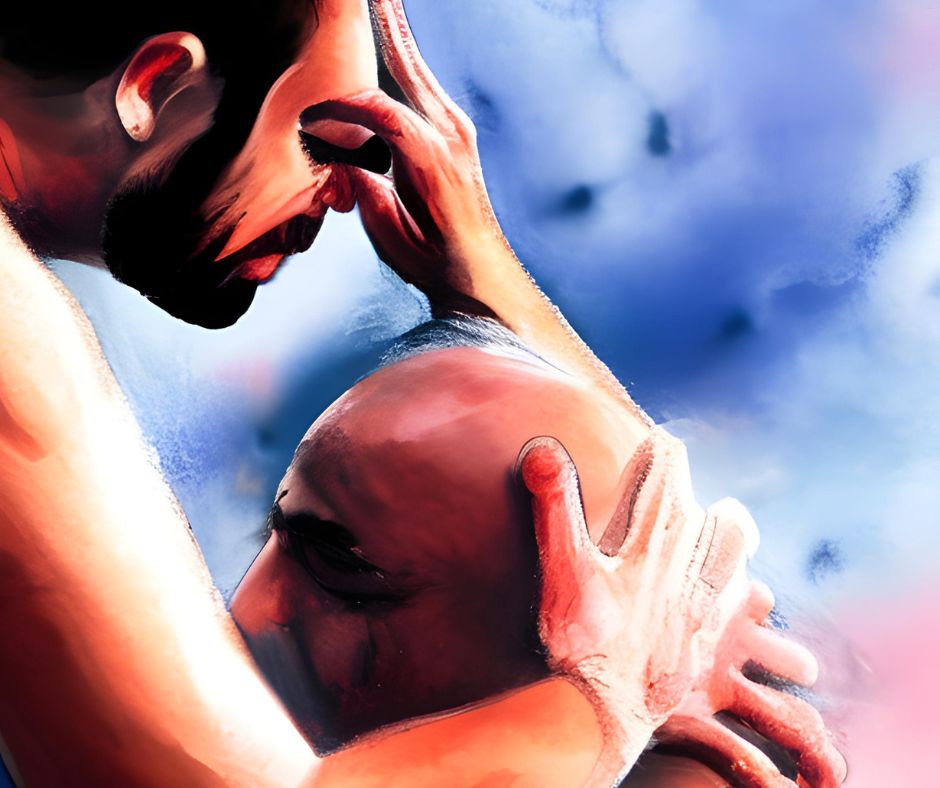
Canva generated AI art depicting “dad feeling self-compassion and trying to pull himself together so he can be there for others on father’s day trauma recovery reintegration” looks uncannily like myself embracing my wounded inner child

To all the men today who think they are a shit dad, I see you through me. 

I see what constraints you are living with, between your childhood trauma and the toxic culture that has relegated us to the dustbin of the heartless-provider1. It’s very fucking hard to be compassionate and kind and patient with our kids today when generations behind us were not these things: we didn’t have the role models. 

I understand, as you do, that not having the role models doesn’t excuse us from the responsibility to be the good-hearted men we know our kids need. We understand it’s not our fault that our parents didn’t love us the way we needed, but we also understand it’s our responsibility to find the love we need to give ourselves and our kids. 

That though, is so fucking hard, especially in our culture, alone, divided, “the village” now a legend we hear about from traditional societies and pre-industrial Europe. It’s really really hard to act and live from our higher true self (where compassion and kindness are the default reactions) when our conditioning and ego and trauma is running the show most of the time because our nervous systems are fried and our default reactions are non-constructive, damaging, traumatising. 

It’s very fucking hard to be aware enough, awake enough, and self-compasionate enough to not pass on the trauma we are carrying from generations past. It takes work to reconnect with our true self enough that our default reactions transform out of destructive habitual maladaptions into constructive and compassionate active responses.

On the journey of trauma recovery and conscious evolution, we are gradually ascending in a spiral that brings us inexorably closer to reacting with compassion as a default because that’s all our true self knows. But it’s a journey and a spiral, meaning we have to go through the same tests and lessons over and over again, learning something new each time, and evolving if we are aware of where we tripped up last time. 

If you’re doing this, then you’re on the right track and you’re a much-better dad than you are probably giving yourself credit for.

Taking responsibility for your own love and healing and evolution is the absolute best fathering a man can do, because without that our kids are just getting some performance of what we think a father should be and that’s only ever going to be disingenuous, dishonest, not real. 

Be your flaws and do the work of overcoming them, of recovering from and transforming trauma and becoming whole again, and know that you’re setting an example of a man who takes genuine happiness seriously and will not settle for some performance of happiness we copied from a fucking beer ad or something.

.

.

.

I made a video of this post because I know that some folk out there just can’t do reading sometimes and I wanted this compassion missive to reach as many as possible 👇🏼

  1. What I mean by this is that we have been conditioned to provide materially for our families, at the expense of our own hearts and we are now expected to be loving and compassionate fathers despite having those parts of us conditioned out of us by culture. We were made into worker drones to serve the industrial economy and now we are trying to find our hearts again. ↩︎

EP re-connecting with Self to avoid being an existential suckhole

This is the EP version of this idea that if we don’t have connection with self (which is the definition and consequence of trauma), there is a tendency to seek that connection with other, either other people or other stuff, things external to the self, and wind up sucking the other dry.

Insights are emerging out of some tension that has been plaguing the family for the last week or so1, and a very valuable lesson:

when we don’t have connection with self (which is the definition and consequence of trauma) there is a tendency to seek that connection with other, either other people or other stuff, things external to the self;

knowing our needs is a function of connection with self, meaning that we meet our psychological needs by connecting with self and to connect with self we need to be meeting our needs; 

when we give to, serve, or try to help others (without connection with self), we often end up doing the opposite of giving, which is sucking, taking, draining …

We end up sucking from others when we are trying to give, or when we think we love them, because instead of giving we are taking, sucking, a natural metaphysical consequence of there being a void or vacuum where our connection with self once was ~ we become a psychological blackhole, syphoning from others what we can only truly get from connection with self.

The formal term for this is “being an existential suckhole”.

I don’t mean to sound so obtuse ~ I’m just trying to work this out. 

We reconnect with self by recovering from or releasing trauma, and through contemplative transpersonal practices (because by ‘self’ I actually mean ‘the part of us that transcends personal identification’).

How do we release trauma and integrate the parts of ourselves that we exiled during events we found traumatising? I cannot articulate that right now but it’s a central aspect of the Heartwards modularity

I’m sure there’s literature around this and it sounds very much like something Buddha would say (I’m thinking of the “wrong objects” here) and I am interested in seeing that documentation but for right now the insight feels real enough to not need validation. 

I drafted a lot more for this post and have hacked it back to the above so I can get something up here for the day. More to come.

Photo by Andrea Piacquadio on Pexels.com
  1.  truth is it’s been plaguing us for years, generations, but this week it has come to a head again, as it does, crying to be seen ↩︎

a modularity for transpersonal development

I got around to uploading the bones of what I’ve started calling “a modularity”, describing the framework that is developing around me for helping others recover from small-t trauma and experience sustainable genuine happiness.

If you’re interested in transcending the inherently limited personal/human ego and experiencing a much-expanded perspective of our true place in and relationship to reality, check it out.

If you value being happy, check it out!

imagination + trauma release

Working with a Somatic Experiencing therapist yesterday, I realised we have this incredible interface between the mind and the body and it’s called the imagination ~ shaman’s know this, and we too can learn the language of the body by tuning in to the imagery that comes up during emotional episodes.

When I allowed it, mine was a snake uncoiling from a clay-lump of anxiety to eat up the meat-confetti of shame that was underneath an immense well of sadness. The trauma release that followed was blessedly story-free.

The body really does know the score … and … because I love mincing metaphors … the music is light and sweet.