I’ve just added a Study page to this portfolio site, where I’ve uploaded an exegetical essay I wrote for a uni subject called Swords & Spaceships: Writing Genre. I also included the chapter I wrote for that exegesis. I like saying the word ‘exegesis’.
I’ve also added a page to the Other section of the Writing page, where I’ve published a rumination called “How To Eat Cereal“, which was published in Glass, the QUT student magazine, earlier the year.
And I’ve added a review of Dave Eggers’ What is the What, which was broadcast on ABC Radio National’s The Book Show, yonks ago.
I finished my final end-of-year assessments a few weeks ago, and the results are in ~ I did pretty well! It feels great to have made it through a year of university study again ~ next year is an open book at this stage, but if I don’t defer to focus on freelancing I hope to make it through more than three weeks of the second year.
In 2002 I started a bachelor of English and philosophy at Adelaide Uni, straight outta high school, and I left three weeks in to the second year because … for a number of reasons. I ended up working in publishing for nearly ten years after that, and had my first full-time in-house job by the time I would have graduated, so it was no great loss, but this time going to uni has a different … vibe about it: I’m really keen to not let my literary skills be spent entirely on editorial and advocacy work, as had happened by the end of my ‘first’ career in publishing.
I say ‘first’ because it feels like the first iteration ~ this time I hope to maintain stronger focus on having my own work published, instead of focusing on the facilitation of others’ ideas, which was and is a joy, but I like to write more than I like to edit, so here’s to hoping for the next iteration.
I’ve got some nag champa burning and some Carbon Based Lifeforms playing, which is nothing unusual for a morning of study, but it feels more ceremonial this morning ~ and instead of working on assignments I’ve been using my morning writing time to work on chapters for a novel I’m writing. For the next three months or so I will be waking up at 6 am to pour myself into crafting words on a page that won’t be assessed according to a university rubric, which feels liberating and exciting.
I like the rubrics ~ they help direct the energies I give to writing, and I think they are set up to reflect a nuanced (albeit arbitrated) judgement of what constitutes good writing, which is mostly considered a subjective question. Learning some objective notions of what constitutes good writing has been interesting and helpful, but sometimes such objectivity gets in the way of just letting loose on the page to see what happens.
The other benefit of a university writing course is that you’ve got deadlines imposed on you that force you to produce material. Of course I’m excited about maintaining a writing practice over the summer, but there’s something daunting about maintaining a writing schedule without the deadlines enforced by a faculty.
I was pleasantly surprised when I received an envelope from the uni recently, and inside was a certificate notifying me that I had been admitted to the Creative Industries Faculty Dean’s List, ‘in recognition of [my] exceptional academic performance in Semester 1, 2019’. I achieved a GPA of 6.75, which kind of surprised me ~ I understand that I’m a halfway-decent writer, but one of the reasons I left uni in the early noughties is that I struggled to get my head around the academic expectations of the assessors, so even after all my experience in publishing I was still a bit daunted by meeting these expectations in 2019.
But I did it, and it feels really empowering.
I was talking to my neighbour recently about the freelancing work I do, and how it’s pretty easy money once I do the leg work of soliciting clients. He reminded me of the Dunning-Kruger Effect, which, according to Very Well Mind, is ‘a type of cognitive bias in which people believe they are smarter and more capable than they really are’. It works in the other direction too: people who are good at what they do often diminutise the skills and experience required to do it.
Editing has always come naturally to me ~ I was annotating the books I was reading in late high school. And writing is something I’ve also always had a natural affinity for … with? 🙂
I was thinking about it this morning, and about how I would be likely to say to someone if they asked: ‘Oh, it’s just a creative-writing degree ~ it’s not rocket science or anything.’ But the things I’ve learned this year about the craft of writing have reminded me (thankfully) that, in fact, there is a kind of science to writing ~ you have to experiment with methods, and if they don’t work you need to amend the material you’ve crafted until it does work. It requires a great degree of lateral thinking, and also the ability to observe things as they are and wonder about what will happen if you put them together.
That’s a definition of creativity I encountered in a Netflix documentary: creativity is the ability to take two or more existing things and put them together until you’ve created something new. A nice and simple definition.
Doing this with, say, two different chemicals in a lab to make polystyrene (to use an example from the doco) is one thing, but doing this with concepts requires a whole other level of creative ingenuity. And the results I’ve been getting at uni this year seem to suggest that I possess this ingenuity, which is definitely affirming. After struggling to overcome intellectual insecurities in my late teens and early adulthood, I slowly began to realise that yes, I was in the possession of intelligence and creativity, but it’s still been something I’ve struggled to accept as valuable in a culture dominated by ideologies that seem to prioritise material creativity and productivity ~ in the form of, say, medical or engineering innovation.
But this year I’ve formulated the beginning of a thesis for a New Weird novel that I genuinely hope will ‘create room in our collective psyche for new and innovative institutional ideals’ (to quote from the exegesis), and I live now with the confidence that such work is both imminently and immanently necessary.
I’ve learned (or, rather, been officially reminded) this year that there is great power in the written word to change the way we think and act in the world. I’ve never been one for direct action in the form of, say, protest activism, but I certainly share the sensibilities and values that inform such dissidence. But I think I’ve always suspected that something needs to change at a level deeper than just the streets. I have deep admiration for the people who protest at the coal-face of our culture’s iniquities, but I’m also convinced now more than ever that the real protest has to happen in the structures of our minds, which are informed (maybe even just straight-up formed) by the language and neurological structures we use to tell ourselves stories about the world and our experience in it.
I never really expected a first-year BFA in creative writing to have this kind of deep ideological impact on me ~ I really only expected to learn some neat skills about how to improve the craft of writing. So I guess I need to send props to the profs at QUT for the way they’ve handled the material this year. It’s been really inspiring, and I’m super proud of myself for being able to respond to that material in a way that I hope has done it justice.
It’s been a hell of a year ~ super busy because I’ve also been adjusting to living in a full-time relationship with someone I adore, plus I’m a sudden-dad of an eleven year old now, who has a huge heart even though he’s troublesome now and then (but what kid isn’t ~ and we want him to be troublesome, because we need young people to speak and act out against injustice, so we try to encourage that when he does it at home 🙂
I’ve got a few short pieces of writing that I have started shopping around, so hopefully over the next few months I’ll have a few announcements to make about those. And I’m thinking about throwing up my exegesis here, because I’m proud of it and it constitutes the begin of the first major work I’ll try to produce. (Well, second — but the first one kind of flopped, though I’ve noticed that many of the ideas are beginning to leech into this one.)
Meanwhile, I’ve got a novel manuscript to edit for Paul Mitchell, a guy I worked with at Wakefield Press yonks ago. And compost to turn! And bikes to ride. And books to read slowly …
I am very pleased to announce that my short story, “Prank Me”, was shortlisted for the Allen & Unwin Undergraduate Writers Prize. It’s a story about a couple of friends who almost bump into each other after one of them has been overseas for a long time. I wrote it many moons ago, and back then it was broadcast on Cath Kenneally’s breakfast radio show in Adelaide. The shortlisting has inspired me to get onto the task of shopping it around to magazines, because it still hasn’t been published in print yet. Here’s a sample from the opening:
Here they are on the streets of old suburbia on the wrong side of town, alone. The streetlights are weak, as though the council doesn’t expect people out this way this late. These are capillaries clogged with darkness and stillness, thick with silence except for the sound of the nearby main road, a constant whoosh, but no discernible engine sound, just displaced air and rolling rubber.
She’s a silhouette he can identify by the way her ponytail still seems ready to spring a leak. She stands in front of her mother’s house, anxiety patterning her hunched back, her fingers fiddling with an envelope.
Beyond her, the procession on the main road is an awkward dance, choreographed by people used to fumbling with the sun in their eyes between work and home, whose children, due to there not being much to look at, develop wonky imaginations about wonders like the old one-block factory, out of action since these two can remember sneaking out of church, the other main attraction.
wherein Bodhi does not write a review ~ just a blogspurt
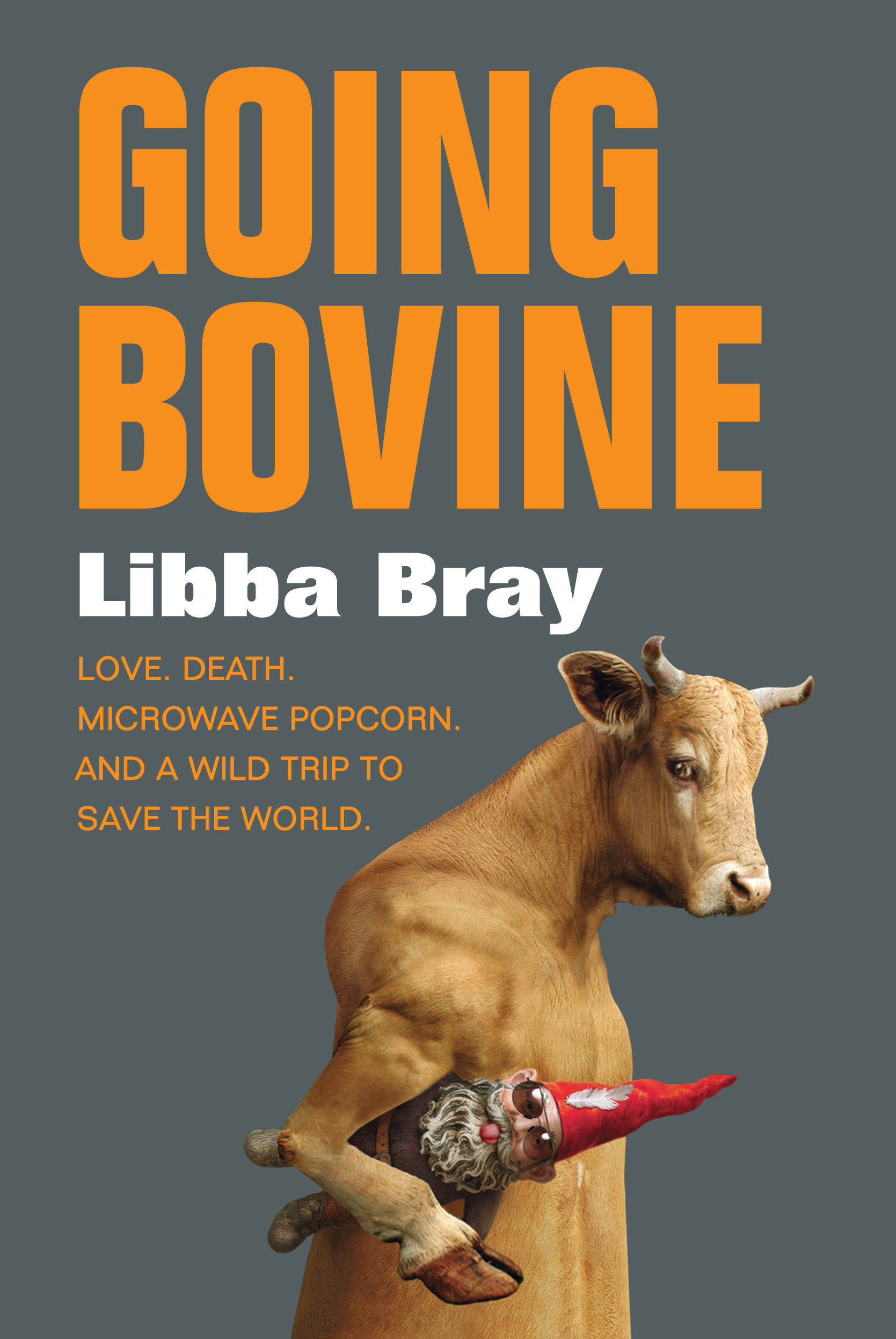
In my current search for books in the new-weird genre, I came across Going Bovine by Libba Bray, which depicts a wild, hallucinatory road trip across America in search of a mad-cow-disease cure for high-school-stoner Cameron Smith. It was okay ~ I’m glad I read it, and I’m doing my best to appreciate it for what it is ~ but these events-driven narratives are just not really my bag.
I say ‘events-driven’ narrative because I can’t really say the book was plot-driven, and it definitely wasn’t character-driven: the plot is deliberately implausible, and the characters are a bit two-dimensional, except for Cameron, although his surname is the bog-standard Smith, which suggests that Bray didn’t think too much into whether this character would have any nuances to distinguish him from any other high-school-stoner stereotype. He’s a smart kid, but a lot of the time his elaborate reflections on the nature of life, love and the universe make him feel more like a vehicle for Bray’s ideas than a character in his own right. The events he has to go through to arrive at places where such reflections might feel plausible are the driving force in this story, and if you’re okay with that, you’ll enjoy it.
I recently read China Miéville’s novel Un Lun Dun, which employs a similar approach to narrative, and these types of books continue a long and esteemed tradition including Hitch-hiker’s Guide (which is referenced in blurb quotes on the edition I read) and the Discworld novels of Terry Pratchett. I’m sure we could include the Arabian Nights in this tradition as well, and even the Bible in all of its radical implausibility. Going Bovine also fits into what I would characterise as the ‘ideas novel’, where ideas are more important than plot or character. But unfortunately this novel just doesn’t live up to the standards of these traditions.
It’s too long, for starters. I love a good long novel, but I don’t go in for length resulting from sloppy plotting, and at almost 500 pages, it wasn’t until around chapter ten that the first real premise of the story was mentioned: Cameron has mad cow disease, and is informed by a punk-angel called Dulcie that he must find Dr X, the parallel-dimension-hopping physicist who accidentally created a wormhole and released the prions that are causing the disease and jeopardising the fabric of reality. (Yep, he’s called Dr X, and this is just one of the many instances where Bray seems to have used placeholder names in a novel-writing template, then forgot to come back and edit the fields with something more unique. Drs A, T, O, and M are pretty cool though.)
Cameron then convinces Gonzo, a Little Person of Mexican descent, to come with him for the journey ~ Gonzo repeatedly complains that it’s a stupid idea, but goes along anyway, threatening to phone his mum and call the whole thing off, but then never actually doing it, to the point where I began to understand that this was just a flawed device for creating character tension, which immediately dissipated once I realised that no amount of complaining was actually going to be met with follow-through: if the character acted on his feelings, Bray wouldn’t have a sidekick for Cameron.
And the prion-actions that are causing Cameron’s debilitating disease, which would otherwise prevent him from going to the toilet on his own, let alone trek across America … these are held at bay by a too-convenient wristband. So the book starts (after too many preliminary chapters) with a deus ex machina, which was a red flag I chose to ignore because I was hoping the shonky plotting and characterisation would be worth it for the ideas.
Alas, the hijinks they go through are funny (they rescue a kidnapped garden gnome who believes he is the Norse god Balder, destroy a chain restaurant trying to escape the fire giants who got through the wormhole and are trying to kill them, and sabotage a happiness cult by unwittingly causing a ‘reality revolution’), but I just didn’t care because the characters are templates and their story is nothing more than a vehicle for Bray’s surface-level ruminations on the many-world’s interpretation of quantum physics, which I so desperately wanted to enjoy because it’s one of my favourite subjects, and something I’d like to … *ahem* … enfold in the novel manuscript I’m working on. So I was bummed that I didn’t enjoy this novel as much as I was hoping I would.
So yeah, I read this as research as much as for leisure, and it’s going on the inspiration pile because it’s New Weird (part quantum-sci-fi, part urban-mythological-fantasy, part bildungsroman, part tragi-comedy, part YA, all roadtrip), but it’s going on the how-not-to-write pile, simply because this is just not my kind of book. It’s not the sort of book I want to write, because it’s not the sort of book I enjoy reading very much. I enjoyed it, on some levels, but not on enough levels that I would aspire to even read it again, let alone write something like it. I don’t mean to sound harsh ~ it’s just not for me. It’s not a terrible book, but it’s not a great book either.
That said, the conclusion is surprisingly well-constructed and effective. The ending is described on All the Tropes as being a ‘gainax ending’, meaning an ending that doesn’t make sense, but it does make sense in the context of Cameron’s/Bray’s appropriately-half-formed ideas about life after death. So I enjoyed the ending a lot, because it’s not neatly resolved and it’s not exactly a happy ending. The book didn’t need to spend 500 pages getting there, but I’m glad it go there in the end. If you’re into easy-reading pan-genre New Weird strangeness and you like watching high-school stoners do implausible things and learn a few basic insights along the way, check it out.
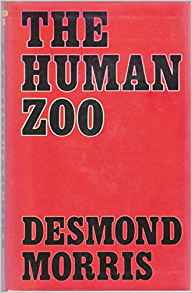
I’ve just finished reading The Human Zoo by Desmond Morris, which, in reprints, bears the subtitle, ‘A Zoologist’s Classic Study of the Urban Animal’. It reads and feels like a classic, and I was glad to find an old (1971) edition at the Lifeline Book Fair last year. The dustjacket is haggard, bearing a meagre black typeface on a red background, barely covering a cloth-bound hardback with yellowed pages I was originally reluctant to mark with a pen or even subject to dog-earing.
I was also not compelled to mark the text because, frankly, the insights and ideas in the book are not exactly thrilling or groundbreaking ~ I didn’t find that much to remark upon, at least in the early chapters. By the end, especially in the chapter, ‘The Childlike Adult’, I was feeling somewhat more moved.
The book does open with a compelling notion to challenge the criticism of modernity as a ‘concrete jungle’: Morris goes one further, saying it’s worse than a jungle ~ it’s a human zoo, where captive human animals murder each other, waste their energy on the pursuit of unnecessary status symbols, and masturbate furiously to kill time and get a dopamine hit, which are things that wild animals apparently do not do. One of my favourite t-shirts reads ‘concrete jungle’, so now I feel like a bit of a chump when I wear that.
He also touches on something raised by Alvin Toffler in his book Future Shock, which is the basic idea that humans have not evolved biologically to keep up with the pace of evolution we see in technology and industry: we’re simply not designed to live in the sorts of environments that now surround us. He talks about this in terms of ‘tribes and super-tribes’, which is the title of his first chapter:
there was a time in our evolutionary history where every one of the 120-or-so members of the tribe/village knew everyone else, and there were very few stressors beyond the demands of hunting and gathering, maybe tending a few crops after we invented farming; now that we’re living in super-tribes, where anonymity is the default, we are beginning to suffer from problems like fixation with ‘super-status’ (chapter two), and addictions to ‘super-sex’ (chapter three).
(I say ‘beginning to’, but remember Morris’s observations were being made in the late 60s early 70s, so we’re 50-odd-years down the path he pointed out for us way back then.)m
It was a vaguely entertaining light-read, but many of Morris’s observations are limited by the catch-all ‘super’ qualifier, and many are super-reductive and over-simplistic. In Chapter 5, ‘Imprinting and Mal-imprinting’, he claims that homosexuality is an aberration resulting from problematic upbringing. In Chapter 6, ‘The Stimulus Struggle’, he reduces the history of human art to nothing more than a pursuit of stimulus ~ we are so under-stimulated because we don’t have to hunt or gather anymore, that we make art for the sake of trinkets. And he attributes all guitar-playing to a phallic fixation.
These ideas are patently ridiculous, and were difficult to read without vomiting scorn into my mouth. He has a tendency to make such claims, provide some evidence that could (at a stretch) be interpreted as support for that claim, completely ignore the possibility of other interpretations, and then say, ‘See, I proved that all guitarists are repressed wankers.’
He introduces a nice idea at the end: that if adults can retain their childlike qualities as they age, we can hope to find creative and explorative ways out of the situation we’ve created for ourselves. It was an interesting book to read, even if it was a bit glib and mostly bland ~ maybe these were profound insights 50 years ago, but I think anyone reading this with even a vague sense of awareness about the world today would not be surprised or freshly enlightened to read them. It’s a classic text that I was excited to find and read, and I’ll probably check out his Naked Ape if I find it in the two-dollar pile at next year’s book fair, but I don’t think I’ll deliberately hunt it down.
And despite my reflex to dismiss the whole thing as the rambling half-thoughts of a drunken uncle at Christmas, the book still falls into my category of paradigm-expanding texts: reading it has reminded me, again, that living in the modern world comes with consequences extending their roots all the way back to the dawn of humanity. After reading such a book, when I stress about uni or finances or getting another cold sore after three sleepless nights in a row, I don’t beat up on myself so much for having trouble coping. It’s a veritable zoo out there ~ the conditions we have created for ourselves are not exactly conducive to that wild sort of happiness we tend to expect from life. So if I’m happy some of the time, and not depressed most of the time, I think I’m doing alright.
I am very pleased to announce that The Good Men Project have published one of my essays, ‘Telling It How It Is: How (kitsch-free) literature has helped me be a better dad’. You can read it here. It’s an essay about how reading Paul Mitchell’s novel-in-stories, We. Are. Family, helped me to understand the culture that informed my dad’s way of being – and how to avoid the foibles of his parenting style.
I published once about my relationship with Dad on GMP before: ‘An Open Letter to my Dad the Bandit’, which you can read here.
The Good Men Project have a great brief, ‘the conversation no one else is having’ about what it means to be a good man in the 21st century, which I love to support.
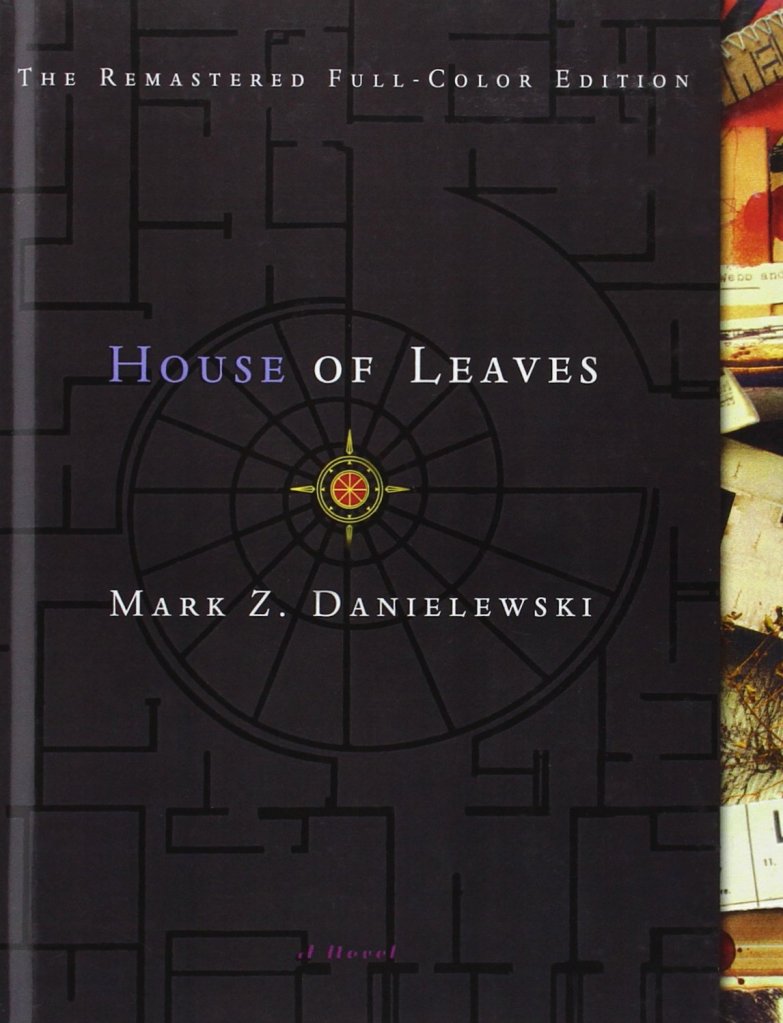
I’ve just finished reading House of Leaves by Mark Z. Danielewski, and I found it fascinating (of course). Reading this combined with the intro to literary and cultural theory subject I’m taking at uni (plus the intro to genre subject I’m taking), has left me feeling all sorts of dizzy and awestruck by the power of narrative/signs to have bizzare and illuminating effects on the mind, while also leaving me baffled and certain that certainty is a lie.
I was fascinated, of course, because the book is a mystery wrapped in a riddle wrapped in a rasher of bacon thrown down a bottomless stairwell, but also I was fascinated, I think, because the book contains many and varied clues about WTF it might actually be on about, and I have immensely enjoyed dwelling in that strange liminal place between understanding and confusion. But I have a certain disposition ~ I quite like ambiguity, and I’m generally okay with accepting that mostly I don’t understand things, and when I do feel like I understand them I am always/usually prepared for this understanding to come crashing down among paroxysms of fear and uncertainty about the meaning of anything, not just life.
My first impression of the book (riddled as it is with footnotes in footnotes in footnotes, and the whole thing about exploring an unknown space with the intention to define it, understand it, make it known, and how this is ultimately futile because knowing is a ruse, a construct, a decision that must necessarily preclude other types of knowing) is that it’s one great big lumbering comment on the nature of academic enquiry, especially things like literary and cultural studies. The invented academic commentary about a non-existent film about a house that theoretically should not exist, left me with the early impression that the book is a comment on the stupidity of trying to categorise things, and the tendency of academics to shroud their feelings of stupidity/inferiority with obfuscating language and irrelevant tangents, lest they be discovered pretending they know things they cannot possibly know.
I should say, I mean, that my first impression was that the book is a protracted comment on the idea that we cannot know, and therefore our search for meaning is futile because meaning is a construct that can change or collapse at any moment, especially if we try to maintain a liberal mindset, and by ‘liberal’ here I mean ‘flexible’, based on a quote I like from Bertrand Russell:
The essence of the Liberal outlook lies not in what opinions are held, but in how they are held: instead of being held dogmatically, they are held tentatively, and with a consciousness that new evidence may at any moment lead to their abandonment.
Whether he said this or not, I don’t know, and I don’t know the context in which he said it ~ knowing the unreliability of the internet, though, which is where I found this idea in the first place, I have my doubts. Nonetheless, I cherish the idea ~ and will cherish it until new evidence may convince me that I should change my mind and become (wholly) conservative (I do have some views that might be considered conservative, such as a preference for diversity over equality if I had to put these two values in a hierarchy, which may not be a conservative value: I just know arguing against equality among liberals causes people to wince).
Anyway, my first impression was that the whole book is a comment on postmodernism and how it’s fucked up everyone’s chances of every being able to say they understand anything without being called out as a reductionist, and a semantic chauvinist/jingo to boot. We haven’t got around to actually learning about postmodernism yet, so I’m feeling a bit presumptious about reducing this book to just a comment on the presumptions of postmodernism, though it is fair to say, as did Steven Poole in the Guardian, that the novel is ‘a delightful and often very funny satire of academic criticism’. So it’s that ~ category number one: satire. Tick. (Hypocrisy witnessed, stupidity accepted.)
But it’s also something else, and this reading of the novel has been formulating in a weird way around things I’ve been learning at uni as well. The whole thing is a metaphor for American colonisation, which is explained in such a way that I don’t need to attempt it here. The first clue for me was when I started to learn (in the book) that Virginia is the site of America’s earliest colony, and in the book a journal is found that details a hunting expedition where the colonists found a set of stairs descending into the earth out of nowhere. So the staircase at the centre of the house has been there since long before the house was actually built, since the dawn of American colonisation, at least. Perhaps the darkness at the heart of the house is the horror, shame and guilt at the heart of all who participate in the colonial endeavour (which continues, BTW, no matter who tells you we live in a postcolonial age). I think so.
The cool thing about this act of interpretation, in the context of what I’m learning about semiotics and literary theory and postmodernism and the like, is that if I interpret these words to be a metaphor for one thing or another, I can say, ‘I think [so and so]’, and it’s pretty much always going to be correct, as long as I can back it up with something approaching logic, as long as I can point to things that make my conclusion seem at least half reasonable. So for me, House of Leaves will always mean something specific, which is both right and wrong (right to me, and wrong to you, unless you agree, but also wrong to me because it will always mean something else as well, simultaneously). And with this I reveal the other aspect of a predisposition: as much as I’m okay with ambiguity and uncertainty, I do like to feel a sense of understanding/knowing after I’ve been confused for over 700 pages.
For this reason, I would also say the book is a metaphor for how narcissism and egotism get in the way of healthy human relationships: to me (and other, fictional, analysts in the book) the house represents the psyche, as in so many dreams (cf. Jung), and the ‘Navidson house’ in House of Leaves frequently behaves in such a way that it’s impossible not to wonder if the house represents/reflects each of the fears/hopes of the people who enter its dark spaces, especially Will and Karen, and also Holloway.
The other and final note I want to make about the book, is that as far as I can tell the whole thing was nothing more and nothing less than a wild and comprehensive hallucination of Johnny’s. There are clues for this in the text, but they are buried in such a way that I don’t especially care to dig them out (also, somewhat, I’d rather hold this reading close for now, because it references my interest in psychosis and what the experience of psychosis does to a person’s lasting impressions of what constitutes reality).
And it left me with this fictional quote, which I love because even though I’m passionate about reading, writing and literature, sometimes I feel like a fraud when sitting down at the desk to actually do the creating feels like the last thing I actually want to do:
Passion has little to do with euphoria and everything to do with patience. It is not about feeling good. It is about endurance. Like patience, passion comes from the same Latin root: pati. It does not mean to flow with exuberance. It means to suffer.
(Not that I identify at all with the idea of ‘the suffering artist’. I never really did, which is perhaps why I so easily sold out my literary ambitions to become an editor in my early career. Now that I’ve got that out of my system I look forward to a rich and balanced life of literary creation, in which I eat food instead of mi goreng for breakfast lunch and dinner. I just resonate with the idea that if you’re passionate about something, especially creativity, it’s important to remember that sometimes you have to just plough through the work, even, and perhaps especially, when you’re not really feelin it.)
All told it was one of the most painfully enjoyable literary experiences of my life, and I know it’s one of those books that will … *ahem* … haunt me for a very long time, yielding new meanings as I encounter new theories / ideas / texts and as I begin to meet others who have read it. So drop a comment below if you feel like it ~ I’d love to join the conversation
I recently finished reading Digital Vertigo, a book by Andrew Keen with the subtitle, ‘How Today’s Online Social Revolution Is Dividing, Diminishing, and Disorienting Us’. I’ve been trying to write a few notes at least when I finish reading a book, so that I’m not just reading book after book after book without really integrating what I’ve read. To do so for Digital Vertigo in anything approaching a comprehensive way would take waaaaaaay too long – it’s pretty jam-packed with references and metaphors and ideas supporting the main thesis from various pop-cultural angles.
So instead of trying to write anything comprehensive about the book I’m just going to summarise what I understand to be its core thesis, which happens to be a subject dear to my heart: the online social media revolution is turning our culture into one great big panopticon of suck. I picked up the book because I’m interested in internet critiques, but had no idea Keen would take his critique into the realm of the panopticon, which I love because it’s easy to hate and because it’s just a cool-sounding word.
bleak AF
This image of the Presidio Modelo prison complex in Cuba is often used to illustrate the notion of panopticon, I suppose because (apart from it being a literal instance of a panopticon-style prison) it evokes the feeling of a creepy stable for domestic beasts of burden and because it looks about as bleak as the best dystopian fiction can make us feel.
To directly quote the wonderful Wikipedia, ‘ The panopticon is a type of institutional building and a system of control designed by the English philosopher and social theorist Jeremy Bentham in the 18th century’. The building in the above image has a central tower from which every one of those cells can be observed. It doesn’t really matter whether there’s a guard in that tower or not: the idea was that if prisoners merely believed they were being observed, they would begin to self-enforce the rules imposed by the institution.
That’s a simplified interpretation of Bentham’s theory, and in Keen’s book this idea is expanded upon as an analogy for the ever-broadcasting mode of social media: by constantly revealing intimate details of ourselves, the state no longer has to engage in covert surveillance to access our data, personalities and identities – we give it away for free, in exchange for advertising-sponsered ‘free’ services.
The result is a culture where everyone feels observed all the time. One result of this culture is a tendency to self-censor and to err on the side of political correctness, which really worries me – the importance of free speech and free thought cannot be emphasized enough, of course, and when we inhibit this freedom ourselves because we’re unconsciously worried that our icky-shadow thoughts might reveal us to be horrible people to the audience we’re trying to impress with our selfies and travel photos, there is no longer any need to fear state-side suppression, because we repress all that nasty shit ourselves.
I rarely use social media these days, largely because I had begun to feel something suss about it. So perhaps I was the perfect audience for a book like this – because I’m a malcontent and latent dissenter, this book took me to the heart of fears about the internet I hadn’t even really unpacked.
It’s a decent read, even if the writing starts to feel a bit dry and journalistic at times (when he’s not throwing in annoying scene descriptions to make the writing more warm but which just feel forced and over-written), and there are loads of tendrils into the internet in the form of reference links if you want to pursue the subject into the rabbit hole.
I got a response from Meanjin about my essay pitch, which is pretty exciting. I emailed the manuscript and am happy to have just piqued their interest.
#.
I finished reading the manuscript of the novel I’m editing for a friend I made while working at Wakefield Press. It’s a really good manuscript and I’m enjoying finding the places where I can make suggestions to really make it shine, thematically and stylistically. (Such as deleting adverbs 😉
#.
I registered for next semester’s classes and my timetable looks like a sieve. It seems that a prerequisite for getting ideal tute times is the ability to warp timespace. But the subjects are cool:
Introduction to Literary and Cultural Studies
Writing the Short Story
Swords and Spaceships: Writing Genre
I dropped my fourth subject because I need more time for paid employment and the professiona-creative-practice subject for this semester would be better suited for when I’m getting nearer the end of the degree.
It is blog-worthy to note that I just figured out that as a QUT student I have a free subscription to the Macquarie Dictionary online.
#.
I still haven’t figured out how to get the post-preview function working on WordPress though, despite repeated attempts with different browsers. Super annoying, because I have to publish the post so I can preview it.
#.
I’ve been editing a novel manuscript for a guy I worked with years back at Wakefield Press, and it’s really great to be digging into the nitty gritty of a gutsy Australian story again.
#.
I got my booklist for Semester 2, which includes Cormac McCarthy’s The Road for the genre subject I’m taking (called Swords and Spaceships). The list also includes the 2700-page The Norton Anthology of Theory and Criticism, which I once started summarising in tweets! Because I’m a nerd.



 Kokoro 心 Heart