satisfaction + career = sustainability


career = satisfaction ≠ sustainability

Tuesday 7 November 2023

I am starting with Neami at Safe Space tomorrow and have some time today to relax a bit, make some space for it. I’ll be working as a Peer Support Worker, responding to people presenting at the service in varying degrees of psychological distress. It’s not counselling or even directly therapeutic ~ peer support roles are explicitly non-clinical. I will be sitting with people as a person with lived experience of recovery from acute and chronic mental-health challenges, to give them hope for recovery and support them as they see fit. 

Thankfully, I am ahead with TAFE assignments and would like to get ahead with some course reading but that doesn’t feel like a priority compared to preparing for tomorrow, which includes looking at some of the documents and research I have found and would like to study. 

I’m starting a folder for these documents because: 1.) I am interested and curious and taking this seriously and I consider it an investment because I’d like to work in this area as a lifelong career; and 2.) it is a peer worker’s role to be aware of these documents and current research, to support the purpose of advocating for systemic change in the mental-health system. No small bikkies round here eh! 

The gist of the following reflection if it’s a bit TL;DR is that I have a deeply satisfying spiritual practice now, which I didn’t have during my first career, in publishing. The Zen practice I have now is the central and only source of true satisfaction, and on this foundation of extant satisfaction I can build a successful career in a helping profession and not be dependent upon that success for satisfaction. I will not be dependent upon thanks and accolades to feel satisfaction or success, and therefore will be less susceptible to burnout when sufficient thanks are inevitably not forthcoming. It will be inherently unsustainable to work in this profession being dependent on thanks to keep going, so I feel very grateful that I have found the Zen practice because it makes it more likely I can ‘stay the distance’ in what is bound to be a career that is as exponentially rewarding as it is challenging.

1. careerism + contentment

Josh Korda from Dharma Punx says in his book Unsubscribe that the dharma can liberate us from addictions like consumerism and what he calls ‘careerism’, and I’ve been thinking about this today. 

I understand that addictions tend to be the result of habitual tendencies to escape from reality or modify our consciousness so that reality seems more bearable. And since I came back from retreat recently I have been considerably more aware of the contents of the monkey mind and I’m grateful for that because the sooner I notice I have wandered away from the present (imagining the future or recalling the past), which is a habitual escapist tendency we all share, the sooner I can come back to reality. The more time I spend in reality (in touch with the present moment), the better I am able to learn how to cope with reality. 

Without frequent contact with reality, how can we learn to cope with and adapt to it?

And I noticed during the retreat that unless something immediately stressful was going on that needs attention (which there wasn’t, for seven days, it being a retreat), the present is the best place to be. I noticed that I would feel anxiety or discomfort or dissatisfaction immediately upon wandering into monkey mind and then when I caught myself and came back to MU in the present (in the tradition I practise in, the mantra MU is our object of meditation ~ similar to the breath in other traditions), the anxiety would dissipate because I had gone back to the reality of the moment, from where I could do nothing and didn’t need to do anything about the situation I had remembered or imagined. The situation was both geographically and temporarily distant and therefore beyond the range of my influence and therefore not worth my time and energy, compared with what was happening right there in that moment.

It doesn’t mean I don’t plan for the future or learn from the past. It just means I can do these things more consciously and intentionally, rather than habitually and compulsively as a maladaptive tendency that formed as a way of escaping the boring/painful present. 

Another way to say it is that MU is a refuge from anxiety or worry and regret or nostalgia. This is a ‘negative image’ of the same idea that I would feel anxiety or discomfort or dissatisfaction immediately upon wandering into monkey mind. In MU there is no anxiety ~ it is a totally neutral object of meditation.

Since the retreat I notice more frequently that I have drifted from the present into story and can bring myself back sooner. The result is a deeper and more-frequent sense of contentment because I am just present without adding commentary to a reality that doesn’t need anything added or subtracted. 

Folks have asked me what I got from the retreat and I haven’t been able to answer easily because the benefits are subtle and metaphysical or psychological, hard to describe. Our landlord asked me today and it came to mind that the benefit is a deeper and more-consistent sense of contentment (not to be confused with complacency) and even a sense of acceptant satisfaction in the sense of dukkha, the OG of Buddhism translated as either ‘suffering’ or ‘dissatisfaction’. Not quite liberation from samsara, but a growing sense of equanimity about being here whether I like it or not. 

***

I say all this 👆🏼 because it was appreciated timing to go on the retreat almost immediately before starting this new job. I feel renewed and refreshed in a mundane sense. At a deeper more-spiritual level, I have realised or remembered this morning that the contentment resulting from dedicated practice is worth more than any job satisfaction or career kudos I might get from working in the mental-health space.

I didn’t have contact with the source of this satisfaction when I was working on my former career in publishing, and as a result I sought abiding satisfaction in work, where abiding satisfaction does not reside (outside the self). 

I’m glad to have this practice now because it is the central and only source of true satisfaction, and on this foundation of extant satisfaction I can build a successful career in a helping profession and not be dependent upon that success for satisfaction, without falling into the trap of seeking satisfaction where it does not exist (in external things and activities like work or even relationships)

***

I didn’t know I would end up journalling about this today, but I’m glad I did. To say my practice and study of Zen meditation is a resource that will keep me grounded and resourced as I embark on the journey of professionally helping those in psychological distress is a bit too glib (consider Zen is a genuine transpersonal practice and not just a means for reducing stress), but it’s also true: getting my satisfaction from the self (through meditation) will mean I don’t expect satisfaction (or thanks or accolades) from my work, clients or colleagues, and will mean my work as a peer practitioner will be more sustainable. I will be more likely to ‘stay the distance’, making an impact through meaningful work without a high risk of burnout and dissatisfaction.

So that’s what I came to write about today. 

I am starting in peer work tomorrow because for many years I have been wanting to learn about and help others learn about how to be happy and healthy in our challenging modern world. Truth is I have been doing peer work for most of my life and tomorrow is just a start on the journey to ‘professionalise a lifestyle’, as I put it to a colleague recently. 

There are few things truly worth doing with our time here, and cultivating genuine happiness (sukkha in the Buddhist parlance) is certainly among those few things, if not the only thing. We need to do other things while we are here, such as accommodate the inescapable reality of our current conditions (read: pay the bills, etc.) and I am grateful I might be able to ‘pay the bills’ doing something as meaningful as supporting others’ genuine subjective wellbeing.

2. research + advocacy

One of the documents I mentioned above is the Charter of Peer Support published by The Centre of Excellence in Peer Support (CEPS) in Victoria, Australia. It describes in detail what peer work actually is, and an understanding of this document (combined with work experience) will help me refine an elevator pitch I can use on the typical look confusion I encounter in others when I say I’m a peer worker. Even in some areas of the mental-health space it is still not quite understood what a peer worker brings to the table, but that’s a post for another time.

Some research I want to look at is about “dual diagnosis” of mental illness with addiction. This is interesting to me, because a first report from ​​the Senate Select Committee on Mental Health has shown that dual diagnoses are “The expectation not the exception”, which seems like a no-brainer for me (with lived experience) but may not be for others (perhaps those without lived experience of either, which surely is the exception not the rule, these days). It’s going to be interesting, as I start working in this sector, to see what sort of no-brainers from the lived experience perspective need to be explicitly supported by research for the service commissioners to take them seriously.

ad-hoc offering: guided yoga nidra

I am feeling very blessed and proud to have guided a yoga-nidra session today for our TAFE class ~ we’re training to be mental-health peer-support workers, and part of that is learning self-care practices, which I have been studying and trialing for yonks now:

yoga nidra has helped me self-regulate so much over the years, I am really glad to have introduced some folk to it. One of the students had a gentle emotional release when I guided them to imagine their safe place, and my heart expands a bit each time I think I had that influence on another <<<333

I was going to bring my speaker and just hit play on a recording by someone else, but decided: I didn’t want to lug a speaker about; I could wing it, trust myself, back myself, and that paid off. I did really well, and folks were grateful, another student experienced the hypnagogic state and of course someone fell asleep, hopefully getting exactly the deep rest their body needed but their mind might not have otherwise allowed.

It’s a beautiful and profound practice, yoga nidra ~ popularised by Huberman as NSDR (non-sleep deep rest) if you want to do the version that’s a bit more science-y.

I should say “modern Western” science-y because really yoga is among the original sciences, a true science of the spirit and I’m really glad and profoundly grateful to be joining the ranks of folk who pass that on through culture, which I learnt today has been described as “collective conditioning of the mind”, but that’s another story.

(Briefly: we can undo that conditioning and re-condition our minds and hearts to be more spontaneously compassionate ~ the theme of today.)

May your rest be deep and only vaguely sleepy 🙂 Reach out if you’re curious about yoga nidra, I’d love to chat about it more and trial this meditation-facilitation thing a bit more. Get in touch via Heartwards’ Get Support page.

reporting on recovery, and offering support

I’m really proud of myself and very excited because I feel I can say I am in recovery from mental illness, which is no small deal.

Trigger warning though:

I have been debilitatingly depressed for months at a time in the last 10 years or so. I have experienced heart-breaking bouts of acute suicidal ideation and a deep sense of alienation from my self and my worth. (This is a trauma response I have learnt about and am able to see for what it is: no more and no less than fight-or-flight, my nervous system trying to protect me from acute and sometimes chronic emotional pain and suffering.) I have been through 2.5 episodes of spiritual emergenc(y) and about .5 episodes of full-blown acute episodic stress-induced psychosis. I have been dependent on drugs and alcohol and various behavioural addictions since my early teens. I am now 39! Apart from a bit of mild binge-eating or a dose of half-mindless entertainment, I am now nearly addiction free. (The final addiction to drop is our attachment to false ideas about reality.)

I no longer get floored by depression ~ I have learnt and am teaching myself how to respond to life in way that doesn’t result in debilitating overwhelm. I am able to see when my nervous system has been triggered and know that any thoughts (say, of worthlessness) are cognitive distortions. Most days I experience micro-mystical states of deep peace and contentedness that are dependent on no external source ~ due to the self-work I am doing, these moments of genuine happiness are the result of being in relationship with my true self and with reality as it is, compared with wishing reality were how I think it should be.

I am reporting this after an exchange with Zane tonight that previously would have totally derailled me. A minor (but vaguely problematic) exchange that remained minor because I saw what was happening: we were triggered = responding half-consciously from dysregulated nervous systems that believed we were in the past, not the now. I saw what was happening, and exited the situation instead of trying to make Zane see reason (read: instead of trying to make reality or Zane behave as I think they should). Earlier in the evening I had self-regulated after Zane had been pushy and rude. Then we had the exchange where we were triggered and I co-regulated with Nikki. And I have been at baseline ever since, whereas a year and a half ago I would have still been fuming.

In fact I now need to regulate joy because I am so excited about other positive things going on!

Previously I wouldn’t have been able to enjoy these positive things because once I was triggered it would sometimes take me days to come back to baseline. I would let triggering situations hijack my happiness and I would feel so trapped in suffering that suicide felt like the only option.

I didn’t know how to respond to or cope with life in a healthier way, but now I do and am learning more all the time.

So I’ve come a long way!

Nikki is doing really well too and we were able to report to our relationship counsellor today that we each feel we are genuinely healthy ~ at least, as healthy as we can expect. (I’ve since re-encountered Gabor Mate’s idea that a lot of our mental and physical symptoms today are the reasonable responses of our whole organism to the toxic culture we are growing in.) Sometimes we are distressed and suffering acutely, but this does not mean we are unwell. It means we are human. It seems really obvious now, but it’s been a huge paradigm shift to feel that.

The cool thing is … the really fucking cool thing: this sense of wellness among suffering has not resulted from some miracle or fluke; it is the result of some 15+ years of (self-) inquiry, application, research, therapy, meditation, a bit more inquiry, some giving up, a lot of starting again, despair, triumphs, bum steers and mistakes and lessons and gradually a very solid deepening of self- and other-love.

It’s been a fucken journey! It still is. I’m finding my way. Makes my heart swell inside to think of it and report this here.

And like all before me who travelled the Path, I carry a torch that lights not just my way but others’ as well, and apart from being excited about my own increasingly consistent wellbeing I am excited about beginning to support others more on the Path.

I’m starting to offer dana-based coaching, so if you’re curious about that, get in touch at that link. I am starting to offer this in in the most ad-hoc fashion, making it up as I go along ~ join me if you’re ready to explore the Path together.

My enrolment at TAFE Qld was finalised today so it’s now official. I am going to study Mental Health (Peer Work) and I feel ready ~ ready to use my lived experience of recovery to help others move toward recovery and health and wholeness as well.

Did you know the word “wealth” is derived from weal, meaning good health? I find that weally intewesting.

I bought Gabor Mate’s book The Myth of Normal to celebrate enrolment, because we got an advance payment from cLink and I bought myself a 5-subject lecture pad as well because hey, nerds like to live a little as well!

On that note (book), go well and godspeed 🙂

👆🏽 This on the back of the following report that I may be the world’s newest card-carrying member of the mad pride movement. I am proud that I “went mad” at least 2.5 times and came back from the brink alive and well, bearing insights for the village.

And I repeat:

like all before me who travel the Path, I carry a torch that lights not just my way but others’ as well, and apart from being excited about my own increasingly consistent wellbeing I am excited about beginning to support others more on the Path.

I am starting to offer dana-based coaching so if you’re curious about that, get in touch at that link and we’ll arrange a time to catch up.

toward Heartwards

I’m starting a venture called Heartwards, a small business offering personal training for integrative health and wellness.

This is the first time I’ve mentioned it here. I’ve mentioned it to a few friends and others in my networks, but otherwise it’s a very nascent thing.

Now I can mention it elsewhere on the socials and Kokoro 心 Heart and feel like it’s been mentioned before. It won’t be weird if you hear me refer to ‘Heartwards’.

I’m definitely not yet at the stage where I’m doing anything like formal marketing, but it definitely won’t fly if I don’t tell anyone about it. So here’s a banner, which is already out-dated as I develop and re-develop content trying to explain exactly the service I want to provide:

It feels weird, to be honest – starting something like this. I’m doubting myself, wondering why I think I should or could be someone to offer these kinds of services to others. I’m not the healthiest Jimbo on the block. I mean, I’m pretty healthy – much healthier than I was 20 years ago. I’m healthier than many, and less healthy than many others.

The answer(s) I always come back to are:

  • by supporting others to step into ownership of their wellness, I will strengthen the sense of accountability for my own wellness;
  • by teaching others, we deepen our own learning;
  • to be of service doing something I feel passionate about
  • by developing holistic-lifestyle training plans for others, I will be able to develop one for myself

Another reason for doing this is that I’m developing the sort of service I wish I could find and afford. Kind of like an author writing the book they want to read. I haven’t been able to find or afford a service like this, so I’m developing it myself – it’s easier to justify developing it for others than it is to justify developing it solely for myself.

There’s a lot more to it than that, but this is just my first public mention of the idea. I won’t go into much more detail here-now, because a) I’m giving up nicotine today and therefore am feeling super vague and fuzzy and weirdly noncommittal and b) I don’t intend to publish a lot about this until it’s more developed. I will publish here if doing so motivates me or helps to justify developing the content, structure, ideas – because publishing here will mean I feel less like I’m operating in a vacuum.

Otherwise, I’m really just mentioning it here so it doesn’t feel weird for me when I reference it in future posts.

I can share a bit of the content I’ve been developing for the business plan.

Vision

Our vision at Heartwards is a healthy and sustainable world, where every individual, group and institution is able to cultivate and promote genuine happiness and wellbeing, no matter the challenges we face. We believe a healthy world arises out of healthy minds, and that everyone can reduce suffering and increase happiness.

Mission

Our mission at Heartwards is to help facilitate this healthy and sustainable world by equipping individuals, groups and institutions with the resources, knowledge, means and support to cultivate the holistic/integrative health and wellness we need to cope in a world that seems increasingly difficult to navigate. Based on the Pillars of Wellness, we do this by providing one-on-one coaching and accountability support, workshops for groups, in-person and online courses, and resource packages for groups and individuals wanting to develop and maintain lifestyle practices that support their holistic/integrative health and wellness. We help our clients consistently and sustainably prioritise eudaimonic wellness (flourishing) rather than continuing to pursue hedonic pleasure even though we know it leads to suffering rather than happiness.

Our “unique selling proposition” is that Heartwards takes the cliche, happiness comes from within, and turns it into applied eudaimonics. That means we provide clients with the tools and skills they need to actually connect with this elusive treasure that is already within us. By meeting clients where they are at in their busy lifestyles, we help them to become sustainably accountable for their most-important priorities.

Our work is underpinned by the belief that spiritual awareness and health is the foundation of all other experiences of health and wellbeing. Bodhi’s background is Buddhist, but there doesn’t need to be a label from Eastern theological philosophy for us to understand that every individual shares the same deepest aspiration:

to be free from suffering and meet with the causes of genuine (inner) happiness

It is our goal at Heartwards to support others in the spiritual journey that facilitates the sort of wellbeing upon which all other wellbeing is founded – and this is our USP: we don’t mince around and try to leverage the wish for riches or professional success or to live your full potential to entice clients to our products and services; we go straight to the source and help individuals to activate a yearning they already know is there but cannot quite yet identify … the wish the be happy and free from suffering.

a PDF worksheet for emotional first-aid

Photo by Roger Brown on Pexels.com

On the Resources page here I have published a worksheet I use to process emotional episodes in a healthy, supported and guided way. It’s a practice of self-soothing and -regulation. Here are the .odt and .docx files if you want to modify the worksheet for your personal use.

The worksheet guides you through asking, What sort of things did you think, feel and do before, during and after the emotional episode?

Then there are some prompts for self-care and emotional first-aid you can try, and some reflection questions about things like, What are you grateful to have learnt from this experience.

I’m proud of this resource because it has helped me a number of times already when I needed to change the narrative around some event that was emotionally distressing. The worksheet is inspired by the work of Guy Winch, which was my introduction to this practice.

There are more resources on that page, such as Dr Kristin Neff’s website about compassion, and a compassion meditation guided by Sharon Salzberg.

enoughness

My affirmation for today is that I am enough.

That should be enough said, but we all know I like to get a bit long-winded.

It is enough to just be a kind and present observer in and of the world, a being that brings laughter and lightness and other authentic qualities to their experience and to that of those around them. Or to be a kind and present observer who is grouchy. We don’t need to add or subtract anything from ourselves to be worthy of joy, happiness and love.

This doesn’t mean that we don’t do. Just being is not enough.

Is that a paradox? I don’t think so.

It just means that from our place of being enough, everything else we do comes with ease, is additional, expectation free.

It means that whatever I do today it’s because I choose to add this to my already-enoughness. It also means that if something gets in the way of what I want it doesn’t matter because I am already enough without getting to the thing I wanted.

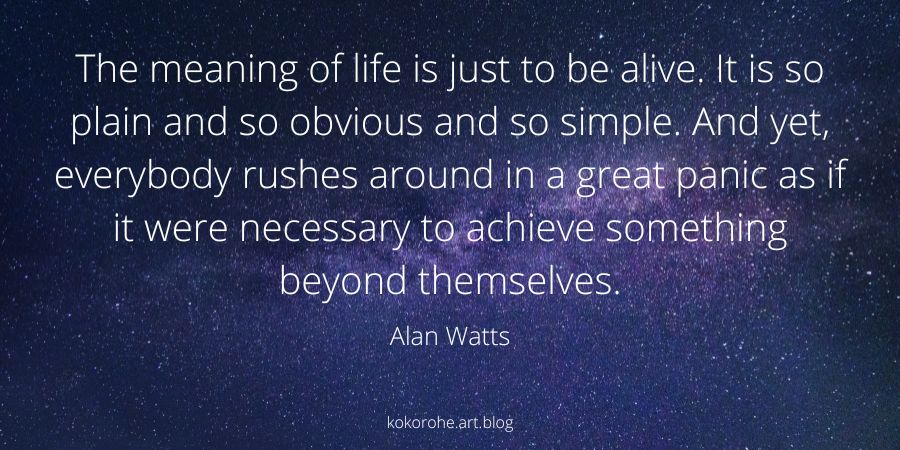
Alan Watts has a nice quote about this:

photo by Felix Mittermeier

psychological first-aid

I have added a video to the Resources page on Kokoro 心 Heart, about psychological first-aid.

The practice of psychological first-aid falls somewhere between acute and long-term self-care. It baffles me that I was nearly 40 before I had it pointed out to me that we need to treat psychological wounds as they happen, the same as we treat physical wounds.

Here is the video by Guy Winch, which was my introduction to this practice.

may we become conscious of the unconscious

Ironbark Gully
getting back on the horse

Down at the Gully today, doing some writing work and thinking about getting back on the pogram … I’ll explain that word in a minute.

It’s been too long that we’ve allowed the situation with our tenant to derail us. I’ve been in damage-control mode and now it’s time to get back into live grow and build mode.

We bumped into Irish Ryan yesterday and he reminded us that we can choose how we feel about the situation. Remember Frankl (paraphrased):

man’s final freedom is the freedom to choose how he feels.

I choose to feel like I can resume my daily life and go back to cultivating contentment and wellbeing and happiness. I choose to use my time in the house as though This Person being is not a problem. (Such is the extent that I have been overwhelmed by their ongoing presence, that I hand-wrote their whole being as the problem. It’s time to take my mind and heart back from the person I have been allowing to occupy it for too long.) The advice columnist Ann Landers said,

Hanging onto resentment is letting someone you despise live rent-free in your head.

I choose to reclaim the right to my mental and emotional space. This space is priceless, and my experience of it is a choice.

I’ve been meaning to start a document, something I can fold into a pocket somewhere, with the values and reminders I’d like to keep in the fore of my mind. This exercise helps me feel anchored to something, less dependent on retaining all my intentions in the brain. I’m getting on to this today and will share it here as some kind of practical resource when I’m able to get to that.

When I’m getting back on the horse like this, I talk about getting back on my pogram, which is a combination of program and pogrom, a program of personal re-education, of expelling that which holds me back and re-learning what makes me soar.

This idea of keeping a document on hand as a reminder has … reminded me that a key project of my pogram and the work at Kokoro 心 Heart is making the subconscious more conscious. By bringing my values and beliefs and positive “talk” to the fore of my conscious, I reclaim the ability and freedom to choose how I feel.

If 95% of our behaviour is motivated by the subconscious, then we need to become aware of the subconscious so we can be more intentional, less reactive, less likely to crumble when struck by unchartered adversity.

So that’s the theme set for the day and days to come. My battery is about to die, so I’m going to hit send on this missive.

The Book Vouch

I’ve started a page on Kokoro 心 Heart called The Book Vouch, a list of books I can vouch for. Imagine a TV show where people sit on a couch and talk about their favourite books, except there’s no couch, no video, and no talking.

This is part of my first crack at affiliate marketing, so you can buy books through this page and I’ll get some money for a coffee, at no extra cost to you.

update: meditation and employment

I’ve restarted my formal meditation practice today. It was nice to sit still on the cushion and give some time to just enjoying the breath and allowing thought to fall away before it takes hold.

I’ve been taking a break from maintaining all such habits since I quit my job a while back. I let myself go a bit because I just wanted to relax and go easy on myself with the routine and discipline. I’d been planning to get back to a more regular practice a few weeks ago, but then things blew up with our housemate and that destabilised us for a while.

That’s okay.

It’s all okay.

It has to be, or else despair sets in and there’s nothing more paralysing for me than despair. It’s worse than fear for me, which at least has a kind of energising power.

The work I’m doing now, since I quit my complicity in traditional exploitative employment, is here on this blog and internal, intrapersonal, work. I’m fortunate to live in a country that has welfare benefits, and I’m choosing to redirect that benefit to the investigation of our culture and the internal environment that creates that culture. I consider it a form of tithing.

What better service can I offer the community than investigating the true nature of reality? By sharing any insights I come across I hope to contribute to the work of changing the narrative around what we consider valuable at the heart of our culture: the acquisition and hoarding of material wealth, which divides us into haves and havenots, creates discord and harms the habitat of our planet; or the realisation of wisdom that unites us in the common journey toward equality, harmony and sustainability.

Of course we all need a degree of material wealth to survive long enough to conduct these investigations, and we can’t all depend on the welfare system forever. To that end, I am beginning to monetise this blog a bit, with affiliate links to things like books I can wholeheartedly recommend. Here’s one, in the spirit of trying this on for size — a fiction-ish memoir account of the ancient search for what the author calls Quality: Zen and the Art of Motorcycle Maintenance by Robert Pirsig.

I’ve always felt a bit suss about marketing and advertising, but I’ll try to make sure the way I do it here is not grubby. All recommendations will be as much on theme as possible, and nothing I wouldn’t buy myself. Zen and the Art of Motorcycle Maintenance is a classic of philosophical ficto-memoir that has inspired my own metaphysical adventures endlessly, and is one of the few books I’ve read more than once.

I’ve got other income streams in mind, such as meme-coasters and other “merch”, as well as social enterprise ideas that will take a bit more time to materialise. I also want to produce a little chapbook of my published and unpublished writing, so stay tuned.

If this sounds like something you’d like to follow and get involved with and support, there are some links below.

Meanwhile, may your psychospiritual wellness be complete and your contribution valued. I’m looking forward to a bright future, and I’m excited and happy to be stepping into my purpose of compassionate communication about metaphysical adventure.

Nikki put this on the stereo as I was finishing the draft of this post (it’s Ben Harper’s “With My Own Two Hands”, in case the embed doesn’t work):

Very appropriate, and from an album I can highly recommend: Diamonds on the Inside by Ben Harper [link].

~ ~ ~

If you enjoyed this post, please feel free to comment here or wherever you found the link, and share if you think others will be interested. I write here for love and sanity (and coffee money!), any engagement from readers such as your fine self is immensely encouraging.

For more post updates, find me on Twitter, on WordPress at the follow link below, or sign up for my little mailing-list newsletter here. I’m also on LinkedIn and Unifyd.