
equanimity + anger & emotional fluidity + self-compassion for flight response

#

I generally think of how equanimity will help me be graceful among suffering or misfortune that is not my fault ~ a sort of forbearance that’s easy to imagine compared to equanimity among suffering I perceive to be caused by my own mistakes and inadequacies, if I think I’ve done something wrong or fallen short, such as feeling insecure as a parent. But these are the times we need equanimity the most, when we are the most hard on ourselves. 

#

I wish I had a healthier relationship with anger. I wish we all did and our culture wasn’t so anger-averse. It is on the one hand celebrated (in movies and the aggrandisment of war) and on the other hand repressed (in our children). That’s a mixed message!

I lost my temper recently, yelled at my stepson for abusing his mother while she was trying to help him, threw a tube of hydrolytes across the room, slammed a few doors.

Nothing major ~ and it’s normal, you might say: teenagers are impossible and their moods and bullshit are acutely triggering. Maybe so, but is it normal for a situation like this to cause such an acute sense of shame and self-loathing and a powerful flight response in the form of suicidal ideation!? I guess nervous-system dysregulation is the new normal.

I need this to change. Nervous system balance and emotional fluidity needs to be the new black. Trauma-informed, transpersonal and holistic self-recovery from the damage we’ve done to ourselves and others with our moralistic view of the human-emotion spectrum: anger is bad; joy is good; surprise is neutral until cognitions force our reaction into duality.

Emotions evolved to keep us safe by motivating us to act without needing to rationalise. The social disgust that became anger this morning has a healthy evolutionary and social function if we can just let it be without casting judgement upon it.

To that end, a good place to learn about such emotional fluidity is Filipe Rocha’s Cultivating Emotional Balance (CEB) training and for nervous system mastery, see Jonny Miller.

#

I was talking to Nikki about the acute cognitive distortions I experience when I’m triggered about my capacity to be a good dad, which I wrote about recently. My wounded parts tell me I can’t participate in the family anymore because I need to keep my distance for the sake of harm-minimisation. If I lose my temper, I might cause trauma.

Between my own trauma and the toxic culture pitted against parents, I don’t feel I can do any good (certainly not with the perfectionism my personality subconsciously demands) and the result is that I just want to opt out or tap out. I don’t want to do it anymore. I’m not being a good dad anyway. I have so little to do with Zane, am I being a dad at all?

I did manage to call myself out on that language, remembering that I am being the only dad I know how to be, and that has to be good enough because I didn’t have a good model to start with.

And there would be some neuroscientific understanding about what my upbringing did to the development of my brain that has left me deficient in chemical pathways or something. Here I am trying to live values such as kindness and compassion

when perhaps my brain doesn’t actually know the pathway or the pathway may never have been laid down. I’m talking about how certain experiences in childhood leave a person with the right brain-plumbing. I may be fighting to cognitively apply values my brain physiology literally does not recognise.

When I was still triggered, Nikki tried to suggest a way things could be done differently next time and pointed out connection before correction. I could not entertain a way I would do things differently next time,

and the suggestion is predicated on the assumption I am capable of making connection in the first place. If I am not capable of maintaining that connection, I also lose capacity to assert boundaries and this leads to major anger-spectrum stuff.

I don’t know how to do connection safely in the context of the trauma I live with ~ I am afraid of rejection, so I don’t take the risk. And I find so many things triggering about Zane, I guess because of repressed shadow and disconnection from self.

My desire to flee from the family and no longer participate as a father may be a flee response and/or it may be a reasonable and logical conclusion of me being neither fit nor willing. It’s hard to tell among whirling thoughts.

I never wanted to have kids and there was a reason for that. Now I’m a stepdad and it simply may not be a good idea. I don’t believe in nuclear families anyway. The pressure between trauma and a toxic culture makes it extremely difficult to parent well. I have other things I could do well if I weren’t trying to live up to an illusory idea and paly roles I may not want to play and which don’t meet the other’s needs anyway.

I catch myself again, and remember we are progressive adults and can imagine new dynamics ~ we don’t need to play by the rules of a culture that has fucked us up, and in fact doing so would be cruel insanity.

The only way to respond to these kinds of cognitive distortions is by prioritising self-compassion. The same approach I was moving toward anyway: privacy, solitude, time alone to make connection with self; cultivating the heart qualities and dropping the identification with roles like ‘parent’ and ‘husband’; authenticity though it jeopardises attachment.

I would rather have the authenticity from connection with self than any attachment relationship that requires the sacrifice of authenticity.
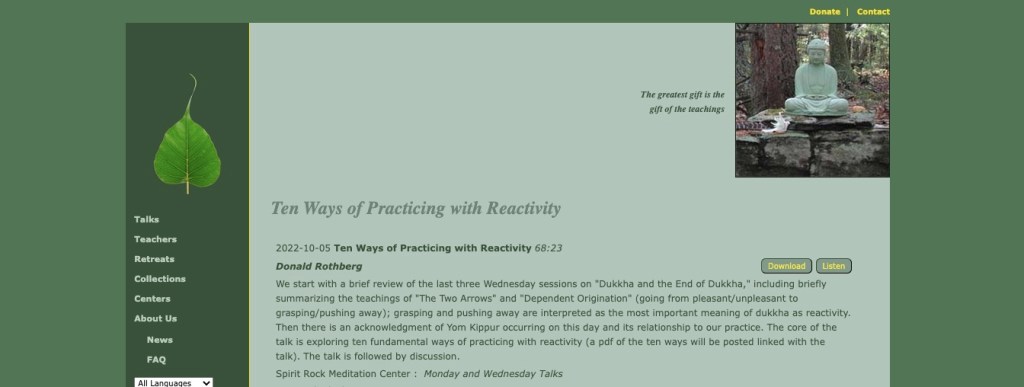

working with reactivity to reduce suffering

Here is a talk by Donald Rothberg called “Ten Ways of Practicing with Reactivity”, which helped me with something like an insight about a false belief I suffer from. He says that if a child’s parents get divorced, that child may believe it was their fault and because they don’t have the capacity to reframe this false belief, they may experience the cognitive distortion that any future relationship trouble is their fault. I can certainly vouch for this, and I hope I can remember this in future to prevent myself from berating myself endlessly when even the most minor disturbance occurs in my family of choice.

At that link you’ll be able to download a resource listing the ten ways of practising with reactivity, the first of which is to cultivate wisdom. Easier said than done, but Donald provides the teaching of the Two Arrows to help us get started. If someone hurts us, or if we hurt another, that is the First Arrow – if we then begin berating ourselves or ruminating on the hurt, that is the Second Arrow. If we lash out, that’s another Second Arrow, et cetera et cetera, ad nauseum. We may not be able to prevent another from hurting us, and we often are not able to refrain from acting with reactivity, but we can be skillful about how we respond after the fact.

Something we can do after the fact is cultivate the heart practices. I have been starting to do this more recently, and it really helps – if we flood our minds with compassion or forgiveness, there is less room for resentment and anger. I also use this emotional first-aid resource that I developed for myself and have shared here before.

Donald also encourages us to use relatively mundane instances of unpleasantness to practise becoming aware of reactivity. When something vaguely unpleasant happens, something manageable and not too triggering, stay with it. This way we’ll be able to start noticing when reactivity is happening and how it feels – it’s an easy-to-remember way of practising mindfulness throughout the day.

I found it interesting that he talks about reactivity in the context of dukkha, that classically unpleasant experience of suffering or dissatisfaction in the Buddhist conception of our deluded interface with reality – that first one in the Four Noble truths, that suffering exists. He says that reactivity generally manifests as either grasping or aversion, and it seems to hold water for me.

Reactivity is a thing I’ve been trying to understand and move away from, so having it placed in the context of the Four Noble truths helps me feel like the experience is held in a container I trust and have faith in. I understand that grasping and aversion cause suffering because they fuel the wish for reality to be other than it is, and now reactivity is just another way of describing an experience that falls in the attachment basket.

The above are just the bits of Donald’s talk that landed with me – check out the rest of the talk and the accompanying document if you’re interested in learning how to be less reactive and more responsive in life.

updated emotional first-aid worksheet [PDF]

Photo by Roger Brown on Pexels.com

I have updated the PDF worksheet for emotional first-aid that I first posted about here, which I have designed mostly for my own use but am sharing here because it might be helpful for others. You can download the worksheet directly here, and see the Resources page for other tools that can be used for emotional self-care and balance. I have added there some resources for cultivating emotional balance:

we can start developing our emotional vocabulary with reference to the Ekmans’ Atlas of Emotions, which is associated with the Cultivating Emotional Balance training that was commissioned by the Dalai Lama. Using the Atlas can help us to “map” an emotional episode so that when it happens again we are better able to navigate it.

I use the emotional first-aid worksheet to process emotional episodes in a healthy, supported and self-guided way, as a practice of self-soothing and -regulation. Here are the .odt and .docx files if you want to modify the worksheet for your personal use. It is an ever-evolving worksheet – I have never used it the same way twice, and as I learn more about emotional balance I am adding new ideas to the document.

In this version I have added a section for reflecting on whether the emotional experience was balanced or imbalanced, using a model I have learnt through the Cultivating Emotional Balance training program, according to which, emotional balance is:

  • the appropriate emotion,
  • felt with appropriate intensity
  • and appropriate expression,
  • at the appropriate moment.

To make an obvious example, it would not be emotionally balanced to laugh manically and start peeling potatoes at the scene of a horrendous car accident.

I have also elaborated on the RAIN meditation in the Self-care section of the worksheet. This meditation helps us to:

Recognise
the emotions we have experienced

Accept or Allow
that we have experienced them, rather than suppressing them

Investigate
the experience of these emotions, to see for example whether they have triggered cognitive distortions or whether they were balanced

Nurture
ourselves, because probably we are coming to RAIN because we have experienced some affliction and if so it’s time for some compassion and forgiveness

Tara Brach has a very good guided RAIN meditation that you can find on Insight Timer here. If you don’t have Insight Timer, here is a link to where you can download an mp3.

The worksheet guides you through asking, What sort of things did you think, feel and do before, during and after the emotional episode?

Then there are some prompts for self-care and emotional first-aid you can try, and some reflection questions about things like, What are you grateful to have learnt from this experience?

I’m proud of this resource because it has helped me a number of times already when I needed to change the narrative around some event that was emotionally distressing. The worksheet is inspired by the work of Guy Winch, which was my introduction to this practice.

.