a Burgeoning of Authenticity

may enthusiasm reign superior

In my living experience of recovery from complex trauma, I being … lol, a relevant typo there … I begin to feel enlivened and enthusiastic again about the things and activities I have been passionate about all my life, but which I learnt to hide from a world/culture that considers them foolish or idealistic, such as reading, studying, applying and writing about the New Psychology, meaning books like Transcend and the Tao De Ching.

This work has always been my purpose, and I have known this on some level since I was a child. The culture I was raised in did not value this at all, so I harboured these passions in secret except from a few trusted friends. Otherwise it was repressed, hidden from the world, and the psychological force required to maintain this secrecy and to project a false-image was profoundly injurious, but also created a kind of counter-pressure, such that when my authenticity comes punching through again I experience it as almost overwhelming. (The Incubus song “New Skin” comes to mind.)

(Curiously, the first stanza, not the one about fallacious cognitions that has always been a kind of mantra for me.)

And I experience shame when I “indulge” this passion to wake-and-write, when I spend hours at a time writing page after page of longhand that over the years has become boxes and boxes of journals and scraps of notes that are now gathered around me like … not like … as a cache of half-written books.

The experience of wanting to bound out of bed and resume this life’s work is characterised by a burgeoning of authenticity that makes me happy. It may be a relative happiness compared to the genuine happiness of sukkha, but I’ll take it, because the energy of this motivates me to do the training of letting that relative happiness go so I can continue moving toward the deep contentment I know is my and everyone’s birthright.

I’ve been getting about 5 hours of sleep a night because I often wake up bursting with enthusiasm to be awake answering my calling, and weirdly I feel a mild shame around this as well, that I am not getting the amount of sleep that the “establishment” dictates is what an adult needs. (Jonah Takalua comes to mind.)

That shame says, If I am not getting the sleep an adult needs, then I must be an immature adolescent, like reading by torchlight under the quilt until stupid o’clock in the morning is some kind of heinous sin.

I understand that shame is an egoic attachment to one’s sense of inferiority, and I am grateful to be letting go of this as well.

I don’t actually read until stupid o’clock in the morning anymore, because I have sleep-hygiene skills I have taught myself on the journey of re-parenting, but I do often wake up before my alarm feeling energised and ready to seize the day (Dead Poets Society comes to mind), which is a feeling that has been far-too-infrequent in my adult life because our culture is not conducive to this kind of bounding-puppy enthusiasm.

Well, I plan to … not plan to … I am changing the culture of my own life, one morning leap out of bed at a time.


equanimity + anger & emotional fluidity + self-compassion for flight response

#

I generally think of how equanimity will help me be graceful among suffering or misfortune that is not my fault ~ a sort of forbearance that’s easy to imagine compared to equanimity among suffering I perceive to be caused by my own mistakes and inadequacies, if I think I’ve done something wrong or fallen short, such as feeling insecure as a parent. But these are the times we need equanimity the most, when we are the most hard on ourselves. 

#

I wish I had a healthier relationship with anger. I wish we all did and our culture wasn’t so anger-averse. It is on the one hand celebrated (in movies and the aggrandisment of war) and on the other hand repressed (in our children). That’s a mixed message!

I lost my temper recently, yelled at my stepson for abusing his mother while she was trying to help him, threw a tube of hydrolytes across the room, slammed a few doors.

Nothing major ~ and it’s normal, you might say: teenagers are impossible and their moods and bullshit are acutely triggering. Maybe so, but is it normal for a situation like this to cause such an acute sense of shame and self-loathing and a powerful flight response in the form of suicidal ideation!? I guess nervous-system dysregulation is the new normal.

I need this to change. Nervous system balance and emotional fluidity needs to be the new black. Trauma-informed, transpersonal and holistic self-recovery from the damage we’ve done to ourselves and others with our moralistic view of the human-emotion spectrum: anger is bad; joy is good; surprise is neutral until cognitions force our reaction into duality.

Emotions evolved to keep us safe by motivating us to act without needing to rationalise. The social disgust that became anger this morning has a healthy evolutionary and social function if we can just let it be without casting judgement upon it.

To that end, a good place to learn about such emotional fluidity is Filipe Rocha’s Cultivating Emotional Balance (CEB) training and for nervous system mastery, see Jonny Miller.

#

I was talking to Nikki about the acute cognitive distortions I experience when I’m triggered about my capacity to be a good dad, which I wrote about recently. My wounded parts tell me I can’t participate in the family anymore because I need to keep my distance for the sake of harm-minimisation. If I lose my temper, I might cause trauma.

Between my own trauma and the toxic culture pitted against parents, I don’t feel I can do any good (certainly not with the perfectionism my personality subconsciously demands) and the result is that I just want to opt out or tap out. I don’t want to do it anymore. I’m not being a good dad anyway. I have so little to do with Zane, am I being a dad at all?

I did manage to call myself out on that language, remembering that I am being the only dad I know how to be, and that has to be good enough because I didn’t have a good model to start with.

And there would be some neuroscientific understanding about what my upbringing did to the development of my brain that has left me deficient in chemical pathways or something. Here I am trying to live values such as kindness and compassion

when perhaps my brain doesn’t actually know the pathway or the pathway may never have been laid down. I’m talking about how certain experiences in childhood leave a person with the right brain-plumbing. I may be fighting to cognitively apply values my brain physiology literally does not recognise.

When I was still triggered, Nikki tried to suggest a way things could be done differently next time and pointed out connection before correction. I could not entertain a way I would do things differently next time,

and the suggestion is predicated on the assumption I am capable of making connection in the first place. If I am not capable of maintaining that connection, I also lose capacity to assert boundaries and this leads to major anger-spectrum stuff.

I don’t know how to do connection safely in the context of the trauma I live with ~ I am afraid of rejection, so I don’t take the risk. And I find so many things triggering about Zane, I guess because of repressed shadow and disconnection from self.

My desire to flee from the family and no longer participate as a father may be a flee response and/or it may be a reasonable and logical conclusion of me being neither fit nor willing. It’s hard to tell among whirling thoughts.

I never wanted to have kids and there was a reason for that. Now I’m a stepdad and it simply may not be a good idea. I don’t believe in nuclear families anyway. The pressure between trauma and a toxic culture makes it extremely difficult to parent well. I have other things I could do well if I weren’t trying to live up to an illusory idea and paly roles I may not want to play and which don’t meet the other’s needs anyway.

I catch myself again, and remember we are progressive adults and can imagine new dynamics ~ we don’t need to play by the rules of a culture that has fucked us up, and in fact doing so would be cruel insanity.

The only way to respond to these kinds of cognitive distortions is by prioritising self-compassion. The same approach I was moving toward anyway: privacy, solitude, time alone to make connection with self; cultivating the heart qualities and dropping the identification with roles like ‘parent’ and ‘husband’; authenticity though it jeopardises attachment.

I would rather have the authenticity from connection with self than any attachment relationship that requires the sacrifice of authenticity.

September dharma circle

Photo by Sagui Andrea on Pexels.com

We enjoyed another beautiful dharma circle on Saturday, our second. I am so grateful for Mónica and Natalie who arranged the whole thing using the running order / model we are beginning to co-create for a decentralised, non-hierarchical spiritual-practice group that operates in community. So exciting!

I’ve been so stretched this month and could not have pulled this together on my own. Mónica’s guided journey was deeply restorative for me and it was great to see some circlers from last month, plus a new circler Lo, welcome. And thank you Nat for holding the circle.

I feel very inspired about October and would like to cohost with someone at Brisbane Theosophical Society in Spring Hill (if we can arrange access in time). Does anyone want to share some thoughts and/or guide a journey with me for us? I can hold the container while someone takes the whole session, or share a mixture of short practices together.

There is a beautiful collaborative vibe around the place and I’m very happy to be a part of this.

If you are interested and happen to be in Brisbane, get in touch to chat about the circle and see if you’d like to get involved.

Brisvedas Dharma Circle

A disparate and spiritually secular sangha meeting locally around Brisbane to discuss the dharma and practice meditation together.

Not just a Buddhist group, but a group of anyone who seeks the truth through experiential means and is interested in being guided by an understanding of the ancient spiritual literatures.

We are hoping that anyone from any spiritual tradition will feel welcome to participate, events are co-facilitated by anyone who feels comfortable doing so.

the emotional cost of our material security

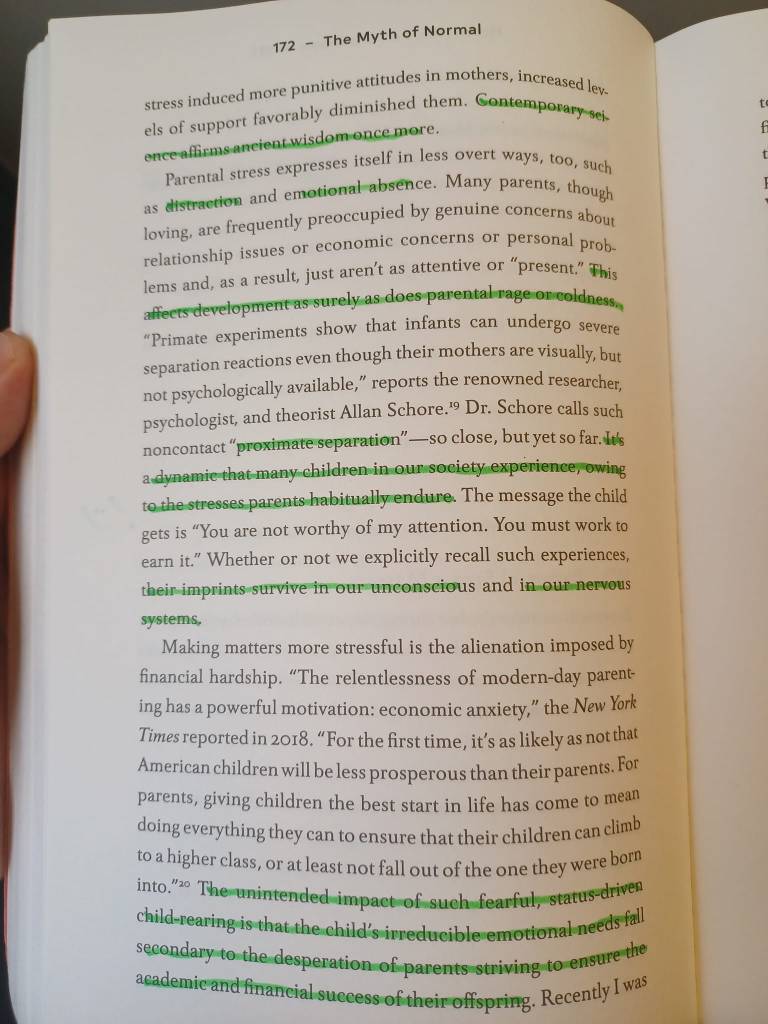
Honestly, this book by Gabor Maté is such a banger! Every second page is like this, riddled with salient points and wobbly highlights from reading on the train.

Here in the bottom highlight he puts into words what many of us have been saying to each other for decades: our parents’ good intentions to improve our material security has come at the cost of our emotional and psychological stability.

It’s no one’s fault, just an ideological glitch in the culture, but yes it’s our responsibility to change the culture.

More and more I am starting to take an active role in this cultural responsibility, participating in men’s health circles, starting the Brisvedas Dharma Circle, studying peer work at TAFE and offering experimental coaching in psychological-fitness training …

… because we can recondition our minds and hearts to turn these habits around and create a healthier and more-sustainable culture, one individual, one family, one community at a time.

And as Mate says, there is much to learn about this from the ways of being that are still modelled by traditional societies alive today.

Get in touch if this resonates with you ~ I’d love to hear from you and see how we can put our energy together toward this imperative call to adventure into our ancient future.

We don’t have to continue fumbling along on our own, struggling and wondering what to do in this weird alienating culture of ours.

We can heal our trauma and step into flourishing, and we can do it in this lifetime!

Answer the call! ☎️🌍🤯📚🤓🙏🏻🦋💚

#commutingwithmaté #culture #healing #trauma #ancientfutures #psychology #wellness #community

how to contribute to the worth economy

upon reflection during this post, it turns out there was a reason I have always eaten the cupcake first
~ photo by Chanhee Lee on Unsplash ~

I’ve been prioritising what I call “happiness habits” lately and it’s doing me well. I have a routine of rituals I do each morning, and a few other must-do’s each day, but otherwise I’m trying to refrain from having expectations other than this in my day. The situation with our co-tenant persists, which makes it hard to do much each day. Sometimes if all I can manage to maintain is my meditation practice I am happy.

I was talking to Nikki the other day about how much a regular practice of compassion meditation is helping me cope with our situation, and we talked about how such foundations must be built before anything else, and I really appreciate that.

I’m proud of having got myself to a place where I’m actually feeling pretty good among the pretty shitty situation we’re in with our co-tenant. I made the affirmation this morning that

I will keep up with observing the basics and not have majorly high expectations of myself to do a lot more

because I understand that’s where we start to go wrong in our culture: we try to achieve all this stuff because we think we need to prove ourselves, but in doing so we neglect the practices of being that would have us feeling worth without having to prove ourselves;

all motivation/intention must come from a place where we already recognise our inherent worth, otherwise that motivation will become tainted by the wish to be validated by others and we’ll be chasing this forever without satisfaction because no amount of external validation can fill the void where our self-worth should be;

anything we achieve to supplement our self-worth is going to suck worth out of the worth-economy, whereas anything we achieve from a sense of inherent self-worth is going to contribute worth.

I wrote about something similar recently, in a post called “on self-esteem as a precursor for achievement …” where I mentioned how societal expectations drive a lot of us to be always achieving, never satisfied to just exist and accept ourselves for our inherent worth.

I didn’t go into how we might cultivate that sense of inherent self-worth, but I’d like to drop a few thoughts here because a big part of the narrative shift I’m contributing to with Kokoro 心 Heart is about internal self-talk, which is where our sense of worth (or lack thereof) begins.

I believe the path to a sustainable and harmonious future on this planet is paved by creating a culture of individuals who are internally sustainable and harmonious. Because individuals create culture as much, if not more, than they are influenced by culture. We are culture, and the future is determined by the state of our present.

One way we can begin to create that culture of internally healthy individuals is by looking at our own self-talk. For me, there are some essential meditation and contemplation practices that are indispensable in healing my negative self-talk, and they are:

  • mindfulness
  • (self-)compassion
  • (self-)forgiveness
  • gratitude

I spend some time each day reflecting on and practising these, and sometimes I find it hard to justify the time because I feel like I should be achieving something else … anything else, just not wellbeing.

But that’s absurd, and there’s a logic to be understood here: no amount of external achievement can satisfactorily supplement the sense of worth that comes from laying the foundation of these practices first; so the foundational practices need to come first, and are justified on these grounds.

Anything extra I can do, after I have done these exercises, is just the cream on top. If I have a really productive day, that’s just a cherry on top of the cream. Please excuse the shonky metaphor, but without that foundational cupcake we’re left with just a handful of whipped cream and a slimy glacé cherry.

The understanding we live by is arse-about in Western culture: we live for the external, and neglect the internal. But the internal is all that exists. This is a fundamental aspect of the narratives we need to change in ourselves and thereby our culture.

Does this make sense?

What does this mean for you?

on self-esteem as a precursor for achievement …

… rather than achievement as a prerequisite for self-esteem

Photo by Pawel Czerwinski on Unsplash

I’ve been taking stock today — taking it slow and allowing myself to get back in the groove of being a bit more organised than I have been lately. I’ve been posting a lot more here recently, but a few other things like life-admin and chores have gone by the wayside a bit.

This is okay — I’ve been riding the enthusiasm I feel for this blog and the community we can build here. It’s been making me happy. I will find the balance between running this blog and running the rest of my life, as the pendulum swings to and fro.

When I’m taking stock I like to go through my various browsers, closing tabs I’ve had open for yonks. It helps me feel a bit more organised by cutting out some of the mental noise I feel at some kind of subconscious level when I know I’ve been opening tabs like they’re going out of fashion.

Something I stopped on today was this article about how some overachievers turn to drugs for escape because no achievement is ever sufficiently satisfying. It’s published by an addiction-recovery and mental-health clinic, and covers a lot of ground (in three short sections) about how societal expectations drive a lot of us to be always achieving, never satisfied to just exist and accept ourselves for our inherent worth.

I understand this compulsion intimately, though I’m not sure I had quite made the connection between the constant need for achievement and the temptation of drugs that promise a reprieve from this pressure.

I am pleased to be able to say, though, that since I’ve been working more full-time on Kokoro 心 Heart and the business around it, I can relate more to this statement from the article:

Our attempts to achieve and succeed should have their roots in a healthy, already-existent sense of self-esteem, rather than being motivated by its absence.

I can honestly say that I wake up each morning feeling committed to doing this work that fulfils my purpose. Not because I need to supplement a low self-esteem, but because doing this work feels as natural and necessary as breathing, or making nutritious food, or walking in the bush. It’s an act of self-care, this work, and feels like something I am just meant to do — no one else expects me to do it.

I value the work I am doing here, and I do it because I believe it has worth — I wouldn’t be able to do that without others’ expectations if I didn’t have a higher sense of self-esteem than I had previously recognised.

So that’s a nice thing to have realised, and was well worth taking stock for. I am grateful, and very fortunate.

Check out the article, and let me know what you think. I think it’s essential we question the narratives telling us we need to achieve more — always more, never enough.

What is your enough?

If societal expectations drive a lot of us to be always achieving, never satisfied to just exist and accept ourselves for our inherent worth, but also no achievement is ever sufficiently satisfying, what to do?

books made of human skin

Books made of human skin, Da Vinci’s Codex Leicester selling for US$30,802,500, and Fran Lebowitz being outraged at someone putting a cup down on a book …

The Booksellers, a charming documentary about the endearingly whacko people who trade in rare and iconic books.

We watched it the other night and it was lovely to just wander through these people’s lives, through their enthusiasm for hunting and protecting these books for posterity.

If you’re looking for a light documentary about the simple cultural pleasure of physical books, check out The Booksellers by D W Young.*

*That’s an affiliate link, so if you buy something through that link I’ll get some money for a coffee, at no extra cost to you.

my review of The Enlightenment of the Greengage Tree by Shokoofeh Azar

I’ve published my review of The Enlightenment of the Greengage Tree by Shokoofeh Azar.

I’m a huge fan of this book and I recommend it to anyone looking for a literary novel that’s easy to read, but illuminating and enjoyable. It is one of those rare books that yields high value and meaning without being too much like hard work.

The reader can expect a magic-realist dirge about injustice, grief, repressed spirituality, the futility of revenge, and the importance of survivors’ struggle to move forward into life, after death – an engaging contribution to the humanisation of the victims of
large-scale fundamentalist violence.

reaching out ~ what to do with a truant teen

Zane buggered off again today ~ skipped school and bailed on meeting us to drop his uniform to him. We found him, but boy has it brought up a lot of stuff!

My conditioning dictates that I should be angry, but I’m trying to be positive and bring a compassionate perspective.

This is all in the context of me trying to rediscover my place in the dynamics of the family, so I’m feeling very unsure about what my part should be in responding to this truancy again.

I’m a step-dad who has minimal-to-no relationship with Zane, and therefore limited agency for either discipline or influence. The only part I know is supporting Nikki, but she insisted I stay at the library while she drove around looking for him.

At least if I’m not there for the potential confrontation when Zane decides to show up and face the consequences of breaking our trust again, maybe I’ll have the chance to calm down a bit and play the part of compassionate supporter ~ I do want to understand why he’s making these decisions, but in which parallel universe is a 13-year-old boy going to share this with his step-dad?

In which parallel universe does a 13-year-old boy know himself why he behaves one way or another?

We need the skills of introspection and emotional intelligence to know the nuances of our internal motivations ~ skills that are not taught in our sausage-factory schools.

This gap in our education culture is a huge part of why I’m doing Kokoro 心 Heart: we need to learn how to manage our own psychospiritual wellbeing enough to stop perpetuating a culture that results in 13-year-old kids wagging class to smoke bongs down the creek. (That’s just one specific symptom of the cultural malaise I hope to address in the posts here and in the work I’m doing in the business around Kokoro 心 Heart.)

I spent my whole high-school career smoking bongs down the creek, and my decades-long drug and alcohol dependency left me in my late 20s with the emotional development of the teenager I was when I started using drugs, because I didn’t have the mentors to help me learn how to deal with my emotions any other way.

We are letting down our children and our future by allowing these gaps to remain in the upbringing of the emerging generations.

Nikki and I are doing all that we can to access services that will make up for the deficits in our own and Zane’s development.

If you’re going through or have been through this, let me know in the comments. We need all the guidance we can get, lest our son become like Trent from Punchy.

~ ~ ~

For more post updates, find me on Twitter, on WordPress at the follow link below, or sign up for my little mailing-list newsletter here. I’m also on LinkedIn and Unifyd.

update: meditation and employment

I’ve restarted my formal meditation practice today. It was nice to sit still on the cushion and give some time to just enjoying the breath and allowing thought to fall away before it takes hold.

I’ve been taking a break from maintaining all such habits since I quit my job a while back. I let myself go a bit because I just wanted to relax and go easy on myself with the routine and discipline. I’d been planning to get back to a more regular practice a few weeks ago, but then things blew up with our housemate and that destabilised us for a while.

That’s okay.

It’s all okay.

It has to be, or else despair sets in and there’s nothing more paralysing for me than despair. It’s worse than fear for me, which at least has a kind of energising power.

The work I’m doing now, since I quit my complicity in traditional exploitative employment, is here on this blog and internal, intrapersonal, work. I’m fortunate to live in a country that has welfare benefits, and I’m choosing to redirect that benefit to the investigation of our culture and the internal environment that creates that culture. I consider it a form of tithing.

What better service can I offer the community than investigating the true nature of reality? By sharing any insights I come across I hope to contribute to the work of changing the narrative around what we consider valuable at the heart of our culture: the acquisition and hoarding of material wealth, which divides us into haves and havenots, creates discord and harms the habitat of our planet; or the realisation of wisdom that unites us in the common journey toward equality, harmony and sustainability.

Of course we all need a degree of material wealth to survive long enough to conduct these investigations, and we can’t all depend on the welfare system forever. To that end, I am beginning to monetise this blog a bit, with affiliate links to things like books I can wholeheartedly recommend. Here’s one, in the spirit of trying this on for size — a fiction-ish memoir account of the ancient search for what the author calls Quality: Zen and the Art of Motorcycle Maintenance by Robert Pirsig.

I’ve always felt a bit suss about marketing and advertising, but I’ll try to make sure the way I do it here is not grubby. All recommendations will be as much on theme as possible, and nothing I wouldn’t buy myself. Zen and the Art of Motorcycle Maintenance is a classic of philosophical ficto-memoir that has inspired my own metaphysical adventures endlessly, and is one of the few books I’ve read more than once.

I’ve got other income streams in mind, such as meme-coasters and other “merch”, as well as social enterprise ideas that will take a bit more time to materialise. I also want to produce a little chapbook of my published and unpublished writing, so stay tuned.

If this sounds like something you’d like to follow and get involved with and support, there are some links below.

Meanwhile, may your psychospiritual wellness be complete and your contribution valued. I’m looking forward to a bright future, and I’m excited and happy to be stepping into my purpose of compassionate communication about metaphysical adventure.

Nikki put this on the stereo as I was finishing the draft of this post (it’s Ben Harper’s “With My Own Two Hands”, in case the embed doesn’t work):

Very appropriate, and from an album I can highly recommend: Diamonds on the Inside by Ben Harper [link].

~ ~ ~

If you enjoyed this post, please feel free to comment here or wherever you found the link, and share if you think others will be interested. I write here for love and sanity (and coffee money!), any engagement from readers such as your fine self is immensely encouraging.

For more post updates, find me on Twitter, on WordPress at the follow link below, or sign up for my little mailing-list newsletter here. I’m also on LinkedIn and Unifyd.