forgiveness dispels victim mentality

a journal entry about how forgiveness is
loosening my attachment to a victim mentality

I have been doing a near-daily forgiveness training in my sadhana lately, and as I near the end of a 30-day rotation I was pleased to realise that a forgiveness practice can release us from the victim mentality. I had read about this in my research about this elusive heart quality, but I hadn’t yet really felt it. Now I have!

After nearly 30 days of this practice, having exhausted the people I could think of who I needed to forgive, I found myself moving on to the culture as a whole.

Now that’s a nebulous beast, the whole culture, and because I didn’t have one person or institution I could hang on to as the sole thing requiring forgiveness, the one distinct entity I felt resentful about, I found that I started moving into states of … let’s call it “resentment Teflon”!

In this state I recall once thinking of myself as a duck in the waters of resentment.

Point is, the resentment had nowhere to stick.

When I realised I could let go of all the resentment I hold for our culture and society being generally deficient (especially, for example, for being spiritually bankrupt) I found that a whole new sense of empowerment and personal responsibility + agency filled the void where resentment had been.

I was no longer the victim of a culture that didn’t meet my spiritual needs and was now an agent who could serve the spiritual needs of that culture.

This phrase comes to mind from a guy I met through men’s work: it’s not our fault, but it’s our responsibility.

This usually applies to the victims of trauma, abuse, neglect, meaning it’s not our fault we were traumatised, but it’s our responsibility to do the healing. No one else is going to do it. I feel the same now about the lack in our culture. I no longer feel let down by our culture because it doesn’t immediately meet my spiritual needs, and instead feel agency to meet my own, and empowered to help others meet theirs.

It’s not like there was ever a Golden Age of Spirituality. Maybe there were (and still are) traditional societies whose culture is based on spirituality. But these are not the cultures or times I live in. And generally speaking these pursuits were always marginalised, initiated and led and maintained by the few who decided it was their duty and honour, their way of serving humanity.

I had no idea this would emerge out of a sustained practice of cultivating forgiveness, but I’m grateful it has.

working with reactivity to reduce suffering

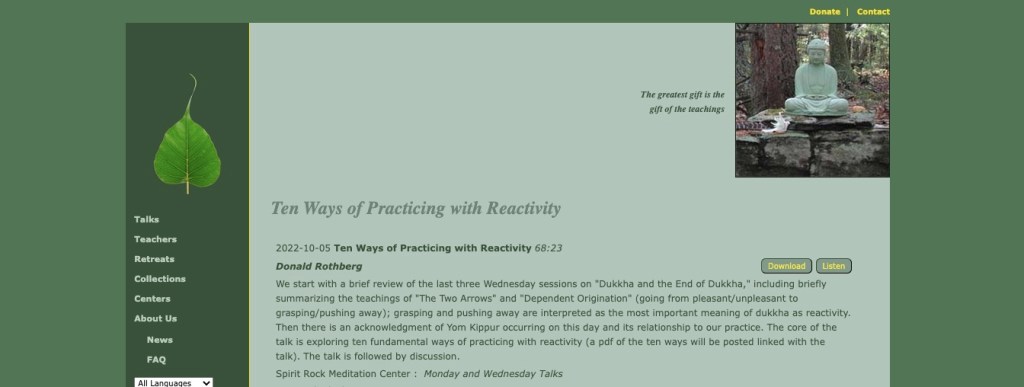
Here is a talk by Donald Rothberg called “Ten Ways of Practicing with Reactivity”, which helped me with something like an insight about a false belief I suffer from. He says that if a child’s parents get divorced, that child may believe it was their fault and because they don’t have the capacity to reframe this false belief, they may experience the cognitive distortion that any future relationship trouble is their fault. I can certainly vouch for this, and I hope I can remember this in future to prevent myself from berating myself endlessly when even the most minor disturbance occurs in my family of choice.

At that link you’ll be able to download a resource listing the ten ways of practising with reactivity, the first of which is to cultivate wisdom. Easier said than done, but Donald provides the teaching of the Two Arrows to help us get started. If someone hurts us, or if we hurt another, that is the First Arrow – if we then begin berating ourselves or ruminating on the hurt, that is the Second Arrow. If we lash out, that’s another Second Arrow, et cetera et cetera, ad nauseum. We may not be able to prevent another from hurting us, and we often are not able to refrain from acting with reactivity, but we can be skillful about how we respond after the fact.

Something we can do after the fact is cultivate the heart practices. I have been starting to do this more recently, and it really helps – if we flood our minds with compassion or forgiveness, there is less room for resentment and anger. I also use this emotional first-aid resource that I developed for myself and have shared here before.

Donald also encourages us to use relatively mundane instances of unpleasantness to practise becoming aware of reactivity. When something vaguely unpleasant happens, something manageable and not too triggering, stay with it. This way we’ll be able to start noticing when reactivity is happening and how it feels – it’s an easy-to-remember way of practising mindfulness throughout the day.

I found it interesting that he talks about reactivity in the context of dukkha, that classically unpleasant experience of suffering or dissatisfaction in the Buddhist conception of our deluded interface with reality – that first one in the Four Noble truths, that suffering exists. He says that reactivity generally manifests as either grasping or aversion, and it seems to hold water for me.

Reactivity is a thing I’ve been trying to understand and move away from, so having it placed in the context of the Four Noble truths helps me feel like the experience is held in a container I trust and have faith in. I understand that grasping and aversion cause suffering because they fuel the wish for reality to be other than it is, and now reactivity is just another way of describing an experience that falls in the attachment basket.

The above are just the bits of Donald’s talk that landed with me – check out the rest of the talk and the accompanying document if you’re interested in learning how to be less reactive and more responsive in life.

how to contribute to the worth economy

upon reflection during this post, it turns out there was a reason I have always eaten the cupcake first
~ photo by Chanhee Lee on Unsplash ~

I’ve been prioritising what I call “happiness habits” lately and it’s doing me well. I have a routine of rituals I do each morning, and a few other must-do’s each day, but otherwise I’m trying to refrain from having expectations other than this in my day. The situation with our co-tenant persists, which makes it hard to do much each day. Sometimes if all I can manage to maintain is my meditation practice I am happy.

I was talking to Nikki the other day about how much a regular practice of compassion meditation is helping me cope with our situation, and we talked about how such foundations must be built before anything else, and I really appreciate that.

I’m proud of having got myself to a place where I’m actually feeling pretty good among the pretty shitty situation we’re in with our co-tenant. I made the affirmation this morning that

I will keep up with observing the basics and not have majorly high expectations of myself to do a lot more

because I understand that’s where we start to go wrong in our culture: we try to achieve all this stuff because we think we need to prove ourselves, but in doing so we neglect the practices of being that would have us feeling worth without having to prove ourselves;

all motivation/intention must come from a place where we already recognise our inherent worth, otherwise that motivation will become tainted by the wish to be validated by others and we’ll be chasing this forever without satisfaction because no amount of external validation can fill the void where our self-worth should be;

anything we achieve to supplement our self-worth is going to suck worth out of the worth-economy, whereas anything we achieve from a sense of inherent self-worth is going to contribute worth.

I wrote about something similar recently, in a post called “on self-esteem as a precursor for achievement …” where I mentioned how societal expectations drive a lot of us to be always achieving, never satisfied to just exist and accept ourselves for our inherent worth.

I didn’t go into how we might cultivate that sense of inherent self-worth, but I’d like to drop a few thoughts here because a big part of the narrative shift I’m contributing to with Kokoro 心 Heart is about internal self-talk, which is where our sense of worth (or lack thereof) begins.

I believe the path to a sustainable and harmonious future on this planet is paved by creating a culture of individuals who are internally sustainable and harmonious. Because individuals create culture as much, if not more, than they are influenced by culture. We are culture, and the future is determined by the state of our present.

One way we can begin to create that culture of internally healthy individuals is by looking at our own self-talk. For me, there are some essential meditation and contemplation practices that are indispensable in healing my negative self-talk, and they are:

  • mindfulness
  • (self-)compassion
  • (self-)forgiveness
  • gratitude

I spend some time each day reflecting on and practising these, and sometimes I find it hard to justify the time because I feel like I should be achieving something else … anything else, just not wellbeing.

But that’s absurd, and there’s a logic to be understood here: no amount of external achievement can satisfactorily supplement the sense of worth that comes from laying the foundation of these practices first; so the foundational practices need to come first, and are justified on these grounds.

Anything extra I can do, after I have done these exercises, is just the cream on top. If I have a really productive day, that’s just a cherry on top of the cream. Please excuse the shonky metaphor, but without that foundational cupcake we’re left with just a handful of whipped cream and a slimy glacé cherry.

The understanding we live by is arse-about in Western culture: we live for the external, and neglect the internal. But the internal is all that exists. This is a fundamental aspect of the narratives we need to change in ourselves and thereby our culture.

Does this make sense?

What does this mean for you?

a PDF worksheet for emotional first-aid

Photo by Roger Brown on Pexels.com

On the Resources page here I have published a worksheet I use to process emotional episodes in a healthy, supported and guided way. It’s a practice of self-soothing and -regulation. Here are the .odt and .docx files if you want to modify the worksheet for your personal use.

The worksheet guides you through asking, What sort of things did you think, feel and do before, during and after the emotional episode?

Then there are some prompts for self-care and emotional first-aid you can try, and some reflection questions about things like, What are you grateful to have learnt from this experience.

I’m proud of this resource because it has helped me a number of times already when I needed to change the narrative around some event that was emotionally distressing. The worksheet is inspired by the work of Guy Winch, which was my introduction to this practice.

There are more resources on that page, such as Dr Kristin Neff’s website about compassion, and a compassion meditation guided by Sharon Salzberg.

through which the motes fleet

(The title of this post should be sung to the tune of “For Whom The Bell Tolls” while imagining James Hetfield doing the splits.)

We’ve got a situation here. This last week our domestic environment exploded in fits of verbal violence that leave my family and I mostly displaced from the dwelling that was intended as a shared home. We’ve been spending the days in our car or with family, coming back to sleep fitfully at night. Our son has thankfully avoided a lot of the fallout, though not for any positive reason – his friend is missing, so Zane and his mates have been roaming Brisbane to find him. Things are calming down now – the main aggressor is talking about moving out, which is a huge relief.

These events are the symptoms of a maligned culture in demise – they are the cracks that result from collective ways of being that are unsuitable for our nature. I say this not to exonerate myself from my part in the verbal violence – I made the mistake of retaliating, yelling, have accepted my responsibility for the maladaptive reaction I contributed to the escalation of a situation that could have been avoided if I and others had been more skillful, and I resolve to learn from this how to do differently next time. There’s more of that at the end of this draft.

Continue reading “through which the motes fleet”