an open letter to men who think they are shit dads

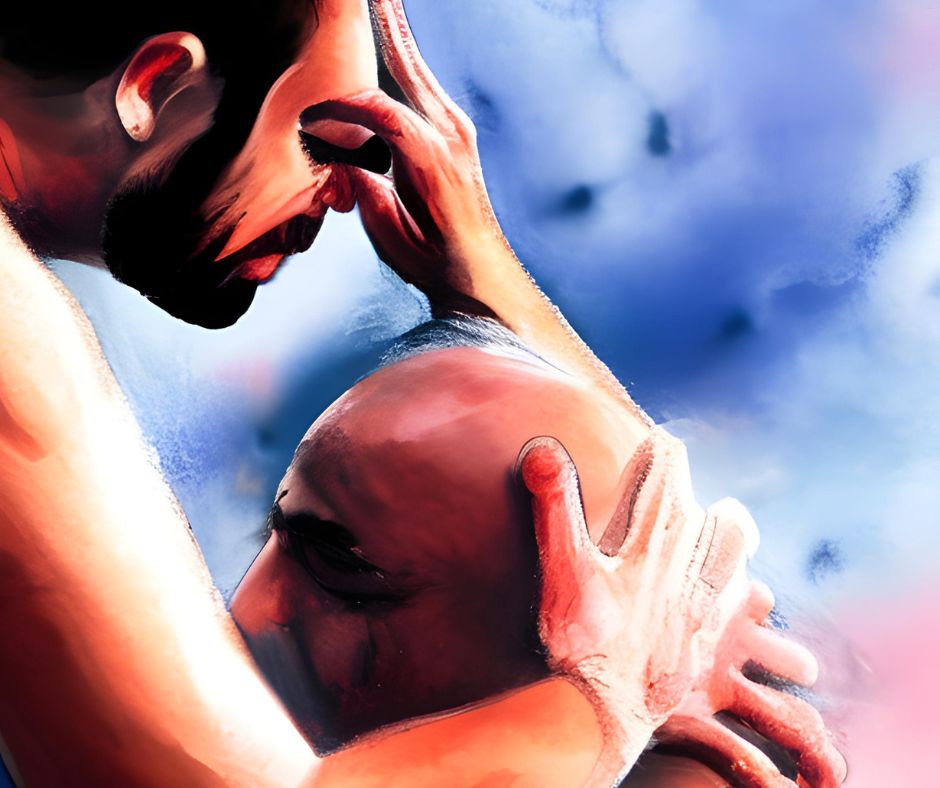
Canva generated AI art depicting “dad feeling self-compassion and trying to pull himself together so he can be there for others on father’s day trauma recovery reintegration” looks uncannily like myself embracing my wounded inner child

To all the men today who think they are a shit dad, I see you through me. 

I see what constraints you are living with, between your childhood trauma and the toxic culture that has relegated us to the dustbin of the heartless-provider1. It’s very fucking hard to be compassionate and kind and patient with our kids today when generations behind us were not these things: we didn’t have the role models. 

I understand, as you do, that not having the role models doesn’t excuse us from the responsibility to be the good-hearted men we know our kids need. We understand it’s not our fault that our parents didn’t love us the way we needed, but we also understand it’s our responsibility to find the love we need to give ourselves and our kids. 

That though, is so fucking hard, especially in our culture, alone, divided, “the village” now a legend we hear about from traditional societies and pre-industrial Europe. It’s really really hard to act and live from our higher true self (where compassion and kindness are the default reactions) when our conditioning and ego and trauma is running the show most of the time because our nervous systems are fried and our default reactions are non-constructive, damaging, traumatising. 

It’s very fucking hard to be aware enough, awake enough, and self-compasionate enough to not pass on the trauma we are carrying from generations past. It takes work to reconnect with our true self enough that our default reactions transform out of destructive habitual maladaptions into constructive and compassionate active responses.

On the journey of trauma recovery and conscious evolution, we are gradually ascending in a spiral that brings us inexorably closer to reacting with compassion as a default because that’s all our true self knows. But it’s a journey and a spiral, meaning we have to go through the same tests and lessons over and over again, learning something new each time, and evolving if we are aware of where we tripped up last time. 

If you’re doing this, then you’re on the right track and you’re a much-better dad than you are probably giving yourself credit for.

Taking responsibility for your own love and healing and evolution is the absolute best fathering a man can do, because without that our kids are just getting some performance of what we think a father should be and that’s only ever going to be disingenuous, dishonest, not real. 

Be your flaws and do the work of overcoming them, of recovering from and transforming trauma and becoming whole again, and know that you’re setting an example of a man who takes genuine happiness seriously and will not settle for some performance of happiness we copied from a fucking beer ad or something.

.

.

.

I made a video of this post because I know that some folk out there just can’t do reading sometimes and I wanted this compassion missive to reach as many as possible 👇🏼

  1. What I mean by this is that we have been conditioned to provide materially for our families, at the expense of our own hearts and we are now expected to be loving and compassionate fathers despite having those parts of us conditioned out of us by culture. We were made into worker drones to serve the industrial economy and now we are trying to find our hearts again. ↩︎

forgiveness dispels victim mentality

a journal entry about how forgiveness is
loosening my attachment to a victim mentality

I have been doing a near-daily forgiveness training in my sadhana lately, and as I near the end of a 30-day rotation I was pleased to realise that a forgiveness practice can release us from the victim mentality. I had read about this in my research about this elusive heart quality, but I hadn’t yet really felt it. Now I have!

After nearly 30 days of this practice, having exhausted the people I could think of who I needed to forgive, I found myself moving on to the culture as a whole.

Now that’s a nebulous beast, the whole culture, and because I didn’t have one person or institution I could hang on to as the sole thing requiring forgiveness, the one distinct entity I felt resentful about, I found that I started moving into states of … let’s call it “resentment Teflon”!

In this state I recall once thinking of myself as a duck in the waters of resentment.

Point is, the resentment had nowhere to stick.

When I realised I could let go of all the resentment I hold for our culture and society being generally deficient (especially, for example, for being spiritually bankrupt) I found that a whole new sense of empowerment and personal responsibility + agency filled the void where resentment had been.

I was no longer the victim of a culture that didn’t meet my spiritual needs and was now an agent who could serve the spiritual needs of that culture.

This phrase comes to mind from a guy I met through men’s work: it’s not our fault, but it’s our responsibility.

This usually applies to the victims of trauma, abuse, neglect, meaning it’s not our fault we were traumatised, but it’s our responsibility to do the healing. No one else is going to do it. I feel the same now about the lack in our culture. I no longer feel let down by our culture because it doesn’t immediately meet my spiritual needs, and instead feel agency to meet my own, and empowered to help others meet theirs.

It’s not like there was ever a Golden Age of Spirituality. Maybe there were (and still are) traditional societies whose culture is based on spirituality. But these are not the cultures or times I live in. And generally speaking these pursuits were always marginalised, initiated and led and maintained by the few who decided it was their duty and honour, their way of serving humanity.

I had no idea this would emerge out of a sustained practice of cultivating forgiveness, but I’m grateful it has.

affirmations for going with the flow

Photo by Ian Turnell on Pexels.com

I allow myself to go gently back into the practice of discipline, structure, ritual. My self-expectations are realistic. I enjoy coming back to the world after an extended period of avoidance. I accept that I haven’t been coping, and I step back into responsiveness and responsibility, moving again toward thrival.

I move through my tasks and actions with awareness, relishing each moment I come back to the reality of now through my senses. I come back to my senses.

The world is benevolent, and we are put through trials by a loving energy that knows we are able to learn what we need for life to be more and more like a flow.

I relinquish attachment to what I like, and I allow aversion to move through me without causing stuckness.

I remain committed to conscious evolution.

“Goldilocks’ Grieving” published [short fiction]

I am pleased to announce that I have had a new short story published, called “Goldilocks’ Grieving”, the first in quite some time. You can read it here. Based on a true story, it’s about a guy’s reaction to witnessing another guy idling his car in the carpark.

I’m really proud of this story. It emerged almost fully formed in a single sitting, immediately after the events that inspired it. I used the draft for a uni assignment and then submitted it to a competition run by QUT, who published it in the inaugural issue of a new student-run mag called Scratch That.

Let me know what you think!