
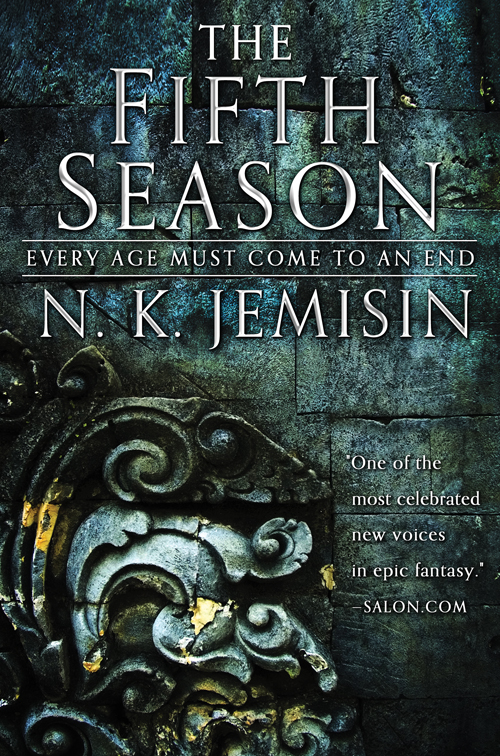
To say that I’m immensely enjoying The Fifth Season would not be quite enough to cover how I’m feeling about it. It is eminently readable despite the shifting perspectives (I love the second person) and the language and style feels unique and original, artful. I knew it was never going to be just a bit of genre trash.
Others have noted the skill and immensity of Jemisin’s worldbuilding, and I’m enjoying this too. She has a way of skillfully referring to world-specific information in context that means we may not know exactly what she’s talking about, but we know that we’ll soon find out. (Unlike William Gibson — I never figured out a word of what he was on about.) I’m being taken on a tour of the Stillness with a very competent guide, who happens to know what happens and yet seems invested in an outcome or a certain reading of events. Not an unreliable narrator exactly, but one who is savvy to the way stories can get twisted if they’re not careful.
One thing I sense strongly is that the orogenes are the hero’s here — a feared and hated powerful other that hold the fate of the world in their ability to wield energy for good or ill.
The Fulcrum would like to harness that power, and seem to be doing their best to leverage the public’s ill-opinion of the orogene to serve that purpose. By creating (or at least encouraging) fear of the other, the leadership have a divided people, which is much easier to manage for nefarious purposes than a united people. By creating a problem, the leadership can swan in and be seen to solve it.
I’m not exactly sure if that’s what we’re getting at with The Fifth Season (it’s probably just conspiracy-theory theory that’s colouring my reading here, though I’m sure there’s a genuine political theory around this problem-creation approach to creating malleable citizens) but there’s definitely something suss about the way the Stillness leadership are containing the orogenes at the Fulcrum.
The orogenes are feared and hated all over the Stillness, but they are needed because they are the only ones who can wield the power of Father Earth, who is felt to be a malevolent force in the Stillness.
So the themes are on point for the kind of literary genre fiction I love to read.
In the plot, Essun has picked up with the boy Hoa, who I assume is the one who emerged from the molten geode. She was a bit suss at first because she needs to find Jija and their daughter and doesn’t need a naked refugee kid tagging alone, but he seems to have a supernatural sense of where Nassun might be. The world around her on the road is falling into a dystopia of the displaced — towns and comms everywhere have been flattened by the shake. Hoa seems to be some kind of “sentient non-human”, even more other than the orogene.
Damaya has been broken into line after she tried challenging the authority of her Guardian Schaffa. And a comment of his has alluded to the idea that the underclass rural “midlatters” are educated only enough to enable their contribution to the economy through food production. This is a theme I appreciate, considering my understanding that our industrial education system does little more than churn out workers for our sausage factories. By explaining to Damaya, Schaffa has helped us understand the Yumenes policy that orogenes and their power must be contained and regulated by the Fulcrum, seemingly for the benefit of the state. It is Schaffa’s duty that Damaya “remain helpful, not harmful”.
Helpful to who?
This information comes on the back of the story about the ~deranged~ orogene Misalem, who tried to usurp the Emperor back in the day but was killed by the Emp’s bodyguard. The Guardians and the Fulcrum were created after this, I guess like the UN after the Wars. There is something about the whole Stillness needing protection from the angered Father Earth, but this part of the worldbuilding is being judiciously released. The protection premise for the coercive force of Yumenes policy appears to be shrouded in the mysts of myth — the incomplete record of stonelore is manipulated by those who have the power to gain ascendency for their interpretation of history. Sounds familiar, reminiscent of the ideology that the people are unable to manage themselves and therefore need government.
In the Syenite narrative we learn the seismic stability enabling Yumenes to stand for so long is the result of having contained and strategically deployed the power of the orogenes. The brutal inhumanity of this coercion is revealed — that orogene child in the wire chair at the node station

It was said by Feldspare that Syenite was being deployed to clear some coral out of a commercial harbour at Allia, but Alabaster seems to have other plans. The extent of his training, power and agency as a ten-ringer is such that he can just decide he needs to deal with the supervolcano more than the coral at Allia. He has his own beefs with Yumenes, which might be motivating a bit of spontaneous dissidence if he hasn’t already secretly gone rogue. He’s made contact, during his circuits, with heretics who seem to have their own agenda for the way reality is narrated in the Stillness. He wants to cover up what they find at the node station. And he wants to try “letting orogenes run things”. He definitely knows something about the broader schemes at play in the Stillness and is a character I’m watching closely. The scene where he quells the supervolcano is epic and engrossing.
This whole book is a page-turner! and the only thing stopping me from ripping through the lot of it in a few late-night sessions is my desire to parse the themes in these update posts.
After the supervolcano when they’re at the heinous node-maintainer station, I lost my way following the implications about how the orogene child either triggered or was caused to trigger the seismic activity that Alabaster had to quell. Something about a wealthy helplessness fetishist molesting (say that three times really fast!) the kid. I understand enough to know the orogene are plied into servicing the state and that the perversions of an over-inflated state are what cause the throes of imperial decline. The state in its hubris is catalysing its own collapse, and I love this.
I love the metaphor, and the awareness of what such metaphors catalyse in the subconscious of readers. IRL we know that the age of Western industrial capitalism cannot sustain itself indefinitely — that the greed engendered by its ideologies will eventually cause civilisation to eat itself unless a true civilisation emerges through the cracks in the same way so-called weeds emerge through the cracks of dystopian pavement. The orogene are the “weeds” in this case.
If there’s any question about what I mean by “weeds”, there might be a post about that somewhere. (There is, about “nativeness” in ecological restoration.) Short version of how that idea applies here: I love weeds, and there’s no place, in our globalised economy that was always a global ecology, for denouncing one plant over another because we humans believe we know better than Earth about where plants should or shouldn’t be.
That’s a good place to segue toward the end of this update. Father Earth knows better than the Fulcrum why the orogene have the power that they do, and the antagonist we most need to fear in my reading of the metaphor so far is our own ignorance of holistic planetary systems that we so blithely fuck with in our hubristic anthropocentric way. And Father Earth is angry!
Do we live on “a planet that wants nothing more than to destroy the life infesting its once-pristine surface”, or does it just seem that way because our meddling is causing the planet to react in the same way a human body would react to an organ gone cancerous? Or the way an orogene reacts instinctively when threatened! Either way, I appreciate the reminder in this book that “human beings are ephemeral things in the planetary scale”.
These are the kinds of themes that lead us to the shift in narrative we need around our culture if we’re to survive the collapse we’re going through as a civilisation.
~ ~ ~
If you enjoyed this post, please feel free to comment here or wherever you found the link, and share if you think others will be interested. I write here for love and sanity (and coffee money!), any engagement from readers such as your fine self is immensely encouraging.
For more post updates, find me on Twitter, on WordPress at the follow link below, or sign up for my little mailing-list newsletter here. I’m also on LinkedIn and Unifyd.
I wasn’t going to drop an affiliate link until I had finished it and could confidently vouch for it, but I’m going to take a punt: [The Fifth Season by N K Jemisin].
 Kokoro 心 Heart