In my living experience of recovery from complex trauma, I being … lol, a relevant typo there … I begin to feel enlivened and enthusiastic again about the things and activities I have been passionate about all my life, but which I learnt to hide from a world/culture that considers them foolish or idealistic, such as reading, studying, applying and writing about the New Psychology, meaning books like Transcend and the Tao De Ching.
This work has always been my purpose, and I have known this on some level since I was a child. The culture I was raised in did not value this at all, so I harboured these passions in secret except from a few trusted friends. Otherwise it was repressed, hidden from the world, and the psychological force required to maintain this secrecy and to project a false-image was profoundly injurious, but also created a kind of counter-pressure, such that when my authenticity comes punching through again I experience it as almost overwhelming. (The Incubus song “New Skin” comes to mind.)
(Curiously, the first stanza, not the one about fallacious cognitions that has always been a kind of mantra for me.)
And I experience shame when I “indulge” this passion to wake-and-write, when I spend hours at a time writing page after page of longhand that over the years has become boxes and boxes of journals and scraps of notes that are now gathered around me like … not like … as a cache of half-written books.
The experience of wanting to bound out of bed and resume this life’s work is characterised by a burgeoning of authenticity that makes me happy. It may be a relative happiness compared to the genuine happiness of sukkha, but I’ll take it, because the energy of this motivates me to do the training of letting that relative happiness go so I can continue moving toward the deep contentment I know is my and everyone’s birthright.
I’ve been getting about 5 hours of sleep a night because I often wake up bursting with enthusiasm to be awake answering my calling, and weirdly I feel a mild shame around this as well, that I am not getting the amount of sleep that the “establishment” dictates is what an adult needs. (Jonah Takalua comes to mind.)
That shame says, If I am not getting the sleep an adult needs, then I must be an immature adolescent, like reading by torchlight under the quilt until stupid o’clock in the morning is some kind of heinous sin.
I understand that shame is an egoic attachment to one’s sense of inferiority, and I am grateful to be letting go of this as well.
I don’t actually read until stupid o’clock in the morning anymore, because I have sleep-hygiene skills I have taught myself on the journey of re-parenting, but I do often wake up before my alarm feeling energised and ready to seize the day (Dead Poets Society comes to mind), which is a feeling that has been far-too-infrequent in my adult life because our culture is not conducive to this kind of bounding-puppy enthusiasm.
Well, I plan to … not plan to … I am changing the culture of my own life, one morning leap out of bed at a time.
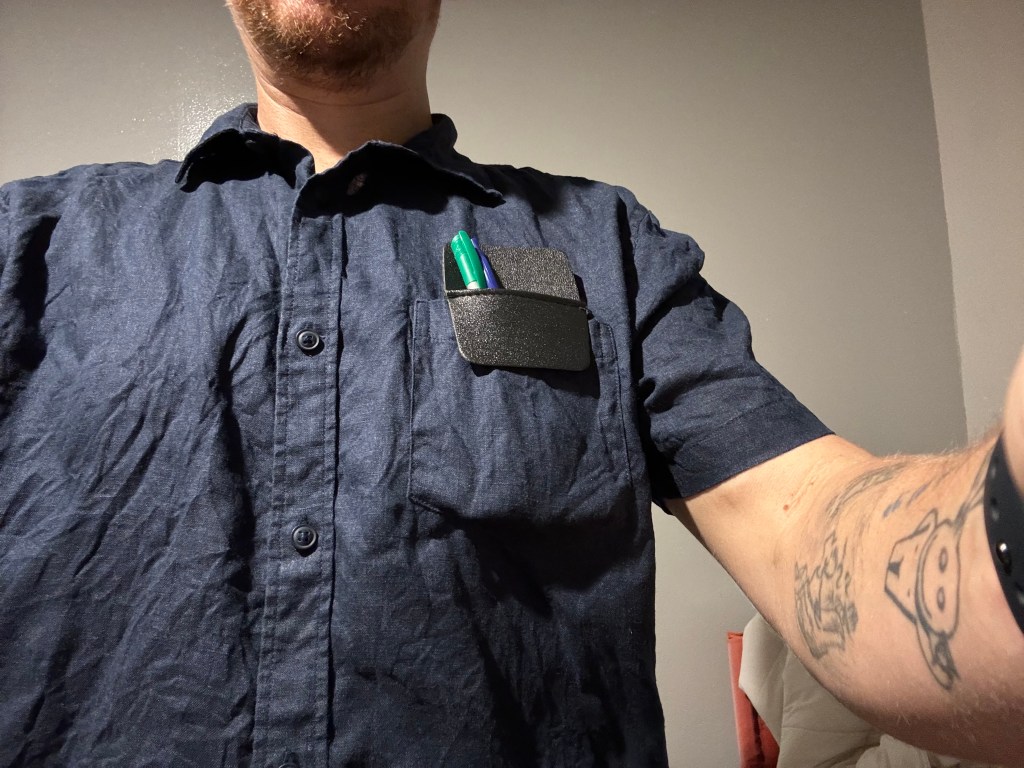
My pocket protector arrived in the mail today, much earlier than expected. I am happy about this for a slew of half-coherent reasons.
It’s Father’s Day, which I know only because my son reminded me, despite the fact I have been working hard on reparenting myself lately ~ so this is a nice and unexpected Father’s Day gift for myself. #
I am a middle-aged man now, and have been a father for sometime, which gives me “permission” to be as daggy as I like. #
It reminds me of a time when a dear and long-term but currently distant friend playfully teased me about the pocket protector I had fashioned out of cardboard, maybe 15 years ago when I was still in my 20s.
One of my pens had burst in the salvaged army-reserve jacket I wore at the time, and this friend, known to me alone as Knobelisque the Great, commended me for being the bogan-cum-mega-nerd I was back then, with my hobo-chic jacket and my cardboard pocket protector.
That was a time when I was earnestly and successfully applying myself to an unexpected publishing career, and some 5 or so years after my first real girlfriend told me, “Because you are a writer, you need to carry a notepad around ~ all writers do that.”
So I started doing that, and I have started doing that again, as well as now embracing the inner mega-nerd that has always just wanted to confidently wear a pocket protector.
Both of these friends are distant now, but I know they would be proud of me for saying, “Fuck it I’m wearing a pocket protector!” #
It fits perfectly in the new linen shirt I bought for myself recently, alongside the above-mentioned spiral notebook, which I am extra-celebrating since I re-read in Zen and the Art of Motorcycle Maintenance, that Robert Pirsig also carried a notepad in his shirt pocket.
I have never really identified as having heroes, but if I did I would say Pirsig is one of them, and I am not ashamed to say that I endeavour to emulate the attitudes he articulated in that singular novel.
Also, he depicts himself as 40 in that story, and I am also currently 40. Every other time I’ve read that book I was, obviously, younger than 40, and each of those times I assumed that Pirsig was maybe 60 and that Phaedrus was maybe 40.
This has been a tendency of mine ~ to always assume that wise folk are more adult than I am.
Reading that Pirsig was 40 at the time of that motorcycle journey with his son has reminded me that wisdom is not a factor of biological age, and on that note I am going to link here to an essay I wrote about the problems associated with typecasting young writers as insufficiently experienced to write about improving the human condition.
I was around 25 when I wrote and published this essay, and may or may not have been wearing a pocket protector, I don’t know.
I do know, thanks to recent personal research, that the reason I can’t remember these details has something to do with trauma-induced dissociative amnesia, which I have previously referred to by saying that “there is a blackhole where the recollection of my history should be”. #
I bought this linen shirt, and a pair of linen trousers, because I have recently moved to a Zen monastery in Brisbane, and am in training to become a monastic. This pocket protector complements that whole-arse lifestyle move in a way that I find incredibly punny:
in some traditions of Buddhism, primarily Tibetan, I believe, there is the practice of seeking refuge from fear in what are called “Dharma Protectors”. My practice being primarily informed by Zen, and with my otherwise-secular background, I don’t really go in for relying on entities that may or may not exist outside myself in some dimension of reality that requires special training or mantras or mandalas to access.
Each to their own.
And with Australian larrikinism deeply embedded in my bones and blood, I consider it funny that I would rather seek protection from a … what smells like faux-leather pocket protector … than from, as Carl Jung apparently said, “Imagining figures of light.”
That said, I do very much believe in and value the power of the imagination to heal both psychological and physical injury, but my current understanding is that the power of imagination stops there, at the personal and therapeutic level.
Imagination may also facilitate transcendence of the personal and support the stabilisation of transpersonal awareness, I don’t know.
What I do know is that my pocket protector will save my shirt from getting soiled by ink. #
I am adrift again after 7-odd years, remembering Robert Pirsig’s idea of drifting ~ I have choices in this river of change and I choose to go with the flow as I bump from shore to shore. I choose to go full-vagrant, wandering-sannyasin style … neither grasping for comfort nor shunning despair and fear. There’s a freedom in that, I trust. I’ve got this. I was a part-time-reluctant vagrant for 10 years in my 20s and 30s. I gained a lot of skills in those years and I am resourcing from those now. I choose to accept because resisting change is a guaranteed way to suffer and I choose non-suffering. Aho
~
I am staying with a friend on the southside of Brisbane, a new place for me, and stepping onto the path of homelessness again. I am hosting a cleansing ceremony with some of the men from the circles around here, and organising ways to strengthen and deepen my commitment to the path. The Zen group I sit with are taking refuge this year (we will get a little vest 😍) and I am seeking the counsel of a teacher at another group in Brisbane that ordains. I said to the men:
Brethren, I am ritualising a cleanse I have imagined many times while my marriage was getting wobblier and wobblier: I am going to shave my dreads and beard, and I’d love for you to hold my hand while I do so because who knows what sort of catastrophic emotional release it might catalyse
Two of my marriage vows were to never cut my dreads or beard. Now that the marriage is over, the hair needs to go.
Will you join me to celebrate? The marriage was magic and transformative in many beautiful ways. The sadness needs to be honoured as well.
Think of it like a birthday, a celebration of life, death, decay and growth. Maybe we’ll get on the turps and blow some herb if you’re partial to that. Bring a share plate and a chin-beanie cos it’s going to be fucken weird having no insulation!
Oh, the ordination part! In the last 15 years or so I have sporadically indulged the fantasy of running away to the Himalayas. I tried this in Thailand but ended up getting drunk for 18 months and writing before I finally got my arse to a monastery for 5 gruelling days. Since then I have deferred the urge to ordain for no less than 2 women, joined a sex cult on the Isle of Lesbians for 3 months and walked three quarters of the Lycian Way as pilgrimage.
My commitment to the spiritual path is real and alive and valid and urgent. I want to celebrate that and step into it, no more shirking!
A dharma sister has referred me to a Zen group that ordains monks here in Brisbane. I’m pursuing that, starting with going to sit with them. They were the first Zen group I sat with before the covid struck, so there’s a return of a circle there.
It’s honestly not as radical as it sounds!
At the shaving ceremony I’ll give a short talk about Buddhism and some of my motivations to ordain, then we shall break the fifth precept and get moderately intoxicated. Should be a laugh
I am starting with Neami at Safe Space tomorrow and have some time today to relax a bit, make some space for it. I’ll be working as a Peer Support Worker, responding to people presenting at the service in varying degrees of psychological distress. It’s not counselling or even directly therapeutic ~ peer support roles are explicitly non-clinical. I will be sitting with people as a person with lived experience of recovery from acute and chronic mental-health challenges, to give them hope for recovery and support them as they see fit.
Thankfully, I am ahead with TAFE assignments and would like to get ahead with some course reading but that doesn’t feel like a priority compared to preparing for tomorrow, which includes looking at some of the documents and research I have found and would like to study.
I’m starting a folder for these documents because: 1.) I am interested and curious and taking this seriously and I consider it an investment because I’d like to work in this area as a lifelong career; and 2.) it is a peer worker’s role to be aware of these documents and current research, to support the purpose of advocating for systemic change in the mental-health system. No small bikkies round here eh!
The gist of the following reflection if it’s a bit TL;DR is that I have a deeply satisfying spiritual practice now, which I didn’t have during my first career, in publishing. The Zen practice I have now is the central and only source of true satisfaction, and on this foundation of extant satisfaction I can build a successful career in a helping profession and not be dependent upon that success for satisfaction. I will not be dependent upon thanks and accolades to feel satisfaction or success, and therefore will be less susceptible to burnout when sufficient thanks are inevitably not forthcoming. It will be inherently unsustainable to work in this profession being dependent on thanks to keep going, so I feel very grateful that I have found the Zen practice because it makes it more likely I can ‘stay the distance’ in what is bound to be a career that is as exponentially rewarding as it is challenging.
1. careerism + contentment
Josh Korda from Dharma Punx says in his book Unsubscribe that the dharma can liberate us from addictions like consumerism and what he calls ‘careerism’, and I’ve been thinking about this today.
I understand that addictions tend to be the result of habitual tendencies to escape from reality or modify our consciousness so that reality seems more bearable. And since I came back from retreat recently I have been considerably more aware of the contents of the monkey mind and I’m grateful for that because the sooner I notice I have wandered away from the present (imagining the future or recalling the past), which is a habitual escapist tendency we all share, the sooner I can come back to reality. The more time I spend in reality (in touch with the present moment), the better I am able to learn how to cope with reality.
Without frequent contact with reality, how can we learn to cope with and adapt to it?
And I noticed during the retreat that unless something immediately stressful was going on that needs attention (which there wasn’t, for seven days, it being a retreat), the present is the best place to be. I noticed that I would feel anxiety or discomfort or dissatisfaction immediately upon wandering into monkey mind and then when I caught myself and came back to MU in the present (in the tradition I practise in, the mantra MU is our object of meditation ~ similar to the breath in other traditions), the anxiety would dissipate because I had gone back to the reality of the moment, from where I could do nothing and didn’t need to do anything about the situation I had remembered or imagined. The situation was both geographically and temporarily distant and therefore beyond the range of my influence and therefore not worth my time and energy, compared with what was happening right there in that moment.
It doesn’t mean I don’t plan for the future or learn from the past. It just means I can do these things more consciously and intentionally, rather than habitually and compulsively as a maladaptive tendency that formed as a way of escaping the boring/painful present.
Another way to say it is that MU is a refuge from anxiety or worry and regret or nostalgia. This is a ‘negative image’ of the same idea that I would feel anxiety or discomfort or dissatisfaction immediately upon wandering into monkey mind. In MU there is no anxiety ~ it is a totally neutral object of meditation.
Since the retreat I notice more frequently that I have drifted from the present into story and can bring myself back sooner. The result is a deeper and more-frequent sense of contentment because I am just present without adding commentary to a reality that doesn’t need anything added or subtracted.
Folks have asked me what I got from the retreat and I haven’t been able to answer easily because the benefits are subtle and metaphysical or psychological, hard to describe. Our landlord asked me today and it came to mind that the benefit is a deeper and more-consistent sense of contentment (not to be confused with complacency) and even a sense of acceptant satisfaction in the sense of dukkha, the OG of Buddhism translated as either ‘suffering’ or ‘dissatisfaction’. Not quite liberation from samsara, but a growing sense of equanimity about being here whether I like it or not.
***
I say all this 👆🏼 because it was appreciated timing to go on the retreat almost immediately before starting this new job. I feel renewed and refreshed in a mundane sense. At a deeper more-spiritual level, I have realised or remembered this morning that the contentment resulting from dedicated practice is worth more than any job satisfaction or career kudos I might get from working in the mental-health space.
I didn’t have contact with the source of this satisfaction when I was working on my former career in publishing, and as a result I sought abiding satisfaction in work, where abiding satisfaction does not reside (outside the self).
I’m glad to have this practice now because it is the central and only source of true satisfaction, and on this foundation of extant satisfaction I can build a successful career in a helping profession and not be dependent upon that success for satisfaction, without falling into the trap of seeking satisfaction where it does not exist (in external things and activities like work or even relationships)
***
I didn’t know I would end up journalling about this today, but I’m glad I did. To say my practice and study of Zen meditation is a resource that will keep me grounded and resourced as I embark on the journey of professionally helping those in psychological distress is a bit too glib (consider Zen is a genuine transpersonal practice and not just a means for reducing stress), but it’s also true: getting my satisfaction from the self (through meditation) will mean I don’t expect satisfaction (or thanks or accolades) from my work, clients or colleagues, and will mean my work as a peer practitioner will be more sustainable. I will be more likely to ‘stay the distance’, making an impact through meaningful work without a high risk of burnout and dissatisfaction.
So that’s what I came to write about today.
I am starting in peer work tomorrow because for many years I have been wanting to learn about and help others learn about how to be happy and healthy in our challenging modern world. Truth is I have been doing peer work for most of my life and tomorrow is just a start on the journey to ‘professionalise a lifestyle’, as I put it to a colleague recently.
There are few things truly worth doing with our time here, and cultivating genuine happiness (sukkha in the Buddhist parlance) is certainly among those few things, if not the only thing. We need to do other things while we are here, such as accommodate the inescapable reality of our current conditions (read: pay the bills, etc.) and I am grateful I might be able to ‘pay the bills’ doing something as meaningful as supporting others’ genuine subjective wellbeing.
2. research + advocacy
One of the documents I mentioned above is the Charter of Peer Support published by The Centre of Excellence in Peer Support (CEPS) in Victoria, Australia. It describes in detail what peer work actually is, and an understanding of this document (combined with work experience) will help me refine an elevator pitch I can use on the typical look confusion I encounter in others when I say I’m a peer worker. Even in some areas of the mental-health space it is still not quite understood what a peer worker brings to the table, but that’s a post for another time.
Some research I want to look at is about “dual diagnosis” of mental illness with addiction. This is interesting to me, because a first report from the Senate Select Committee on Mental Health has shown that dual diagnoses are “The expectation not the exception”, which seems like a no-brainer for me (with lived experience) but may not be for others (perhaps those without lived experience of either, which surely is the exception not the rule, these days). It’s going to be interesting, as I start working in this sector, to see what sort of no-brainers from the lived experience perspective need to be explicitly supported by research for the service commissioners to take them seriously.
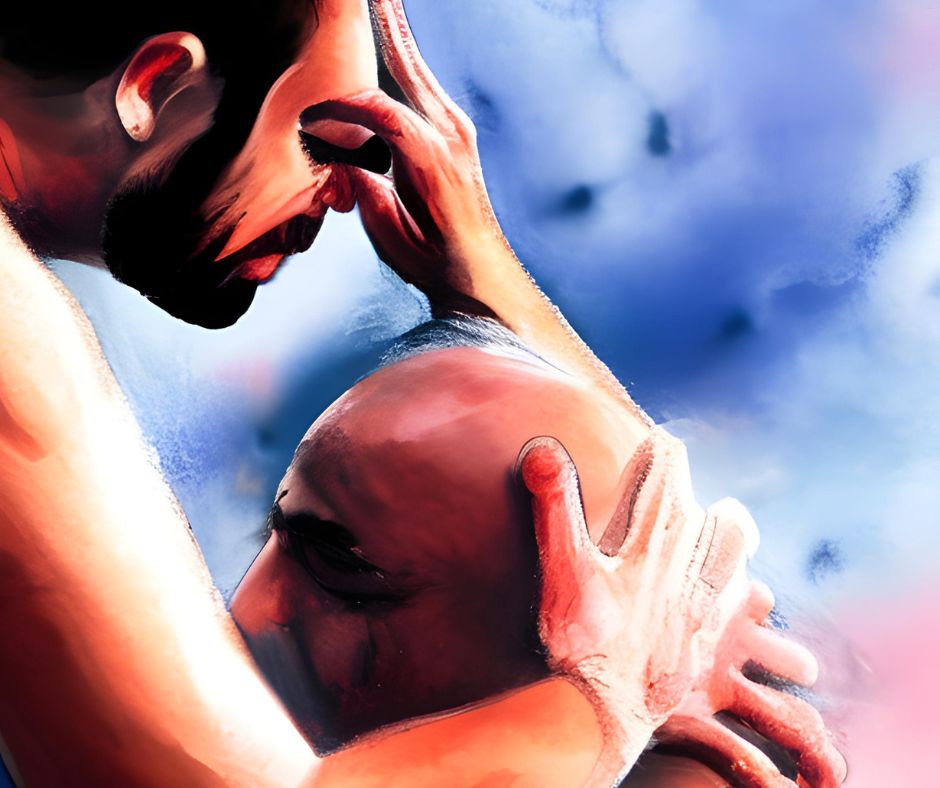
Canva generated AI art depicting “dad feeling self-compassion and trying to pull himself together so he can be there for others on father’s day trauma recovery reintegration” looks uncannily like myself embracing my wounded inner child
To all the men today who think they are a shit dad, I see you through me.
I see what constraints you are living with, between your childhood trauma and the toxic culture that has relegated us to the dustbin of the heartless-provider1. It’s very fucking hard to be compassionate and kind and patient with our kids today when generations behind us were not these things: we didn’t have the role models.
I understand, as you do, that not having the role models doesn’t excuse us from the responsibility to be the good-hearted men we know our kids need. We understand it’s not our fault that our parents didn’t love us the way we needed, but we also understand it’s our responsibility to find the love we need to give ourselves and our kids.
That though, is so fucking hard, especially in our culture, alone, divided, “the village” now a legend we hear about from traditional societies and pre-industrial Europe. It’s really really hard to act and live from our higher true self (where compassion and kindness are the default reactions) when our conditioning and ego and trauma is running the show most of the time because our nervous systems are fried and our default reactions are non-constructive, damaging, traumatising.
It’s very fucking hard to be aware enough, awake enough, and self-compasionate enough to not pass on the trauma we are carrying from generations past. It takes work to reconnect with our true self enough that our default reactions transform out of destructive habitual maladaptions into constructive and compassionate active responses.
On the journey of trauma recovery and conscious evolution, we are gradually ascending in a spiral that brings us inexorably closer to reacting with compassion as a default because that’s all our true self knows. But it’s a journey and a spiral, meaning we have to go through the same tests and lessons over and over again, learning something new each time, and evolving if we are aware of where we tripped up last time.
If you’re doing this, then you’re on the right track and you’re a much-better dad than you are probably giving yourself credit for.
Taking responsibility for your own love and healing and evolution is the absolute best fathering a man can do, because without that our kids are just getting some performance of what we think a father should be and that’s only ever going to be disingenuous, dishonest, not real.
Be your flaws and do the work of overcoming them, of recovering from and transforming trauma and becoming whole again, and know that you’re setting an example of a man who takes genuine happiness seriously and will not settle for some performance of happiness we copied from a fucking beer ad or something.
.
.
.
I made a video of this post because I know that some folk out there just can’t do reading sometimes and I wanted this compassion missive to reach as many as possible 👇🏼
What I mean by this is that we have been conditioned to provide materially for our families, at the expense of our own hearts and we are now expected to be loving and compassionate fathers despite having those parts of us conditioned out of us by culture. We were made into worker drones to serve the industrial economy and now we are trying to find our hearts again. ↩︎
I’m really proud of myself and very excited because I feel I can say I am in recovery from mental illness, which is no small deal.
Trigger warning though:
I have been debilitatingly depressed for months at a time in the last 10 years or so. I have experienced heart-breaking bouts of acute suicidal ideation and a deep sense of alienation from my self and my worth. (This is a trauma response I have learnt about and am able to see for what it is: no more and no less than fight-or-flight, my nervous system trying to protect me from acute and sometimes chronic emotional pain and suffering.) I have been through 2.5 episodes of spiritual emergenc(y) and about .5 episodes of full-blown acute episodic stress-induced psychosis. I have been dependent on drugs and alcohol and various behavioural addictions since my early teens. I am now 39! Apart from a bit of mild binge-eating or a dose of half-mindless entertainment, I am now nearly addiction free. (The final addiction to drop is our attachment to false ideas about reality.)
I no longer get floored by depression ~ I have learnt and am teaching myself how to respond to life in way that doesn’t result in debilitating overwhelm. I am able to see when my nervous system has been triggered and know that any thoughts (say, of worthlessness) are cognitive distortions. Most days I experience micro-mystical states of deep peace and contentedness that are dependent on no external source ~ due to the self-work I am doing, these moments of genuine happiness are the result of being in relationship with my true self and with reality as it is, compared with wishing reality were how I think it should be.
I am reporting this after an exchange with Zane tonight that previously would have totally derailled me. A minor (but vaguely problematic) exchange that remained minor because I saw what was happening: we were triggered = responding half-consciously from dysregulated nervous systems that believed we were in the past, not the now. I saw what was happening, and exited the situation instead of trying to make Zane see reason (read: instead of trying to make reality or Zane behave as I think they should). Earlier in the evening I had self-regulated after Zane had been pushy and rude. Then we had the exchange where we were triggered and I co-regulated with Nikki. And I have been at baseline ever since, whereas a year and a half ago I would have still been fuming.
In fact I now need to regulate joy because I am so excited about other positive things going on!
Previously I wouldn’t have been able to enjoy these positive things because once I was triggered it would sometimes take me days to come back to baseline. I would let triggering situations hijack my happiness and I would feel so trapped in suffering that suicide felt like the only option.
I didn’t know how to respond to or cope with life in a healthier way, but now I do and am learning more all the time.
So I’ve come a long way!
Nikki is doing really well too and we were able to report to our relationship counsellor today that we each feel we are genuinely healthy ~ at least, as healthy as we can expect. (I’ve since re-encountered Gabor Mate’s idea that a lot of our mental and physical symptoms today are the reasonable responses of our whole organism to the toxic culture we are growing in.) Sometimes we are distressed and suffering acutely, but this does not mean we are unwell. It means we are human. It seems really obvious now, but it’s been a huge paradigm shift to feel that.
The cool thing is … the really fucking cool thing: this sense of wellness among suffering has not resulted from some miracle or fluke; it is the result of some 15+ years of (self-) inquiry, application, research, therapy, meditation, a bit more inquiry, some giving up, a lot of starting again, despair, triumphs, bum steers and mistakes and lessons and gradually a very solid deepening of self- and other-love.
It’s been a fucken journey! It still is. I’m finding my way. Makes my heart swell inside to think of it and report this here.
And like all before me who travelled the Path, I carry a torch that lights not just my way but others’ as well, and apart from being excited about my own increasingly consistent wellbeing I am excited about beginning to support others more on the Path.
I’m starting to offer dana-based coaching, so if you’re curious about that, get in touch at that link. I am starting to offer this in in the most ad-hoc fashion, making it up as I go along ~ join me if you’re ready to explore the Path together.
My enrolment at TAFE Qld was finalised today so it’s now official. I am going to study Mental Health (Peer Work) and I feel ready ~ ready to use my lived experience of recovery to help others move toward recovery and health and wholeness as well.
Did you know the word “wealth” is derived from weal, meaning good health? I find that weally intewesting.
I bought Gabor Mate’s book The Myth of Normal to celebrate enrolment, because we got an advance payment from cLink and I bought myself a 5-subject lecture pad as well because hey, nerds like to live a little as well!
like all before me who travel the Path, I carry a torch that lights not just my way but others’ as well, and apart from being excited about my own increasingly consistent wellbeing I am excited about beginning to support others more on the Path.
I am starting to offer dana-based coaching so if you’re curious about that, get in touch at that link and we’ll arrange a time to catch up.
please excuse the inconsistent pronouns ~ this post is essentially a dear-diary braindump, which might have some insight for you if we can wade through I 🙂
How do we do psychological fitness when we’ve been woken up again at 5.30 am and:
you’re volunteering in the afternoon before an evening Zen class that finishes at 8.30 pm and these are both in the city, an hour roundtrip commute that you can’t afford ~ at least they happen to be happening in the same venue;
the last two days have been chewed up by errands and counselling (Centrelink one day, and a very difficult but enlightening Somatic Experiencing session), and today was the one day remaining for me to work on Heartwards before GP appointments tomorrow and a busy Saturday of housework;
you’ve recently deferred a 9-month business-training opportunity because the mental-health needs of you and your family are reaching crisis point ~ have been at crisis point for maybe 18 months;
you’re one month out of a six-month situation where you and your family were living with a long-term friend / tenant whose narcissistic abuse left your family ravaged by trauma symptoms;
and you found out at bedtime last night that your 14-year-old stoner son might be using needles now as well and his best mate is in hospital after attempting suicide.
I sat in meditation this morning, afraid I would not be able to contain this shit-storm in the puny teacup of my mindheart, and asked myself, “How do I do psychological fitness in these conditions?” What does psychological fitness look like during times of such ongoing crisis?
In the end I didn’t do anything ~ instead, I let go, but this didn’t feel like an active act of release, more like a spontaneous relinquishment, a kind of breaking, an allowing control to fall through the cracks.
I allowed reality to be as it is. I feel like a broken record around this letting go thing lately, but it’s becoming the only way I know how to respond when a stack of things are happening around me that are out of my control and seemingly unpleasant, destructive, unhealthy, whatever … [insert discriminating dichotomous adjective here].
I remembered Viktor Frankl’s quote:
When we can no longer change a situation, we are forced to change ourselves.
It’s not quite you that lets go, but something else that lets go of the you that was grasping, clinging, attaching itself to desires about the way reality should be.
You stop worrying that you won’t be able to concentrate on mu after the 24 hours you’ve had, and you stop resenting that you’re going out of your way to volunteer for a job that you volunteered for.
You remind yourself that you need to work with what you’ve got and that means navigating the welfare system while you re-orient yourself toward making an independent living through the provision of meaningful and creative holistic health services.
You remind yourself that providing such services begins with treating your own trauma and accomplishing the degre of psychological-fitness stability you need before you can help others.
You remember that you deferred the training opportunity precisely so you could be more available for family-health needs,
and you remember a journal entry you made last night:
Zane is a teenage drug addict and a dropout. Nikki’s CPTSD has been triggered. And I’ve got my own mental and emotional anguish coming up left right and centre even when there aren’t any triggers. It makes me anxious that there will never be time for anything else ~ even though my enlightened self understands that there is nothing else: this is life as nature made it, and our expectations that we get to do what we want (run a business, feel positive and hopeful) are what cause suffering … the expectations and the sense I am entitled to do something great instead of be there for my family, like being there for my family is not the greatest thing …
which reminds me I forgot to add to that entry something my Zen teacher says: “It doesn’t get better than this.”
We believe there is some state we will reach in the future that is better (more calm, relaxed, exciting, whatever) than our current state, but this is not true ~ the only thing you know is true is that your quality of life depends entirely (and forever) on how you interpret the present,
and that psychological fitness is (among other things) the ability to skilfully interpret the present with positivity and optimism as often as possible.
You remember and remind yourself that you learnt a lot about the neutralisation of negative karma by practising non-resistance/ahimsa when you realised you had no choice about you and your family having to live with a narcissistic abuser, and that now you live with two beautiful tenants because maybe that negative karma was burnt for good.
In remembering this, you start to remember that you can choose to feel gratitude for the good in your life, and that this cultivates a wholesome state of mind, instead of allowing the habitualised negativity bias to get the better of you … we are no longer on the savannah, but have become homo evolutis and can choose to pursue flourishing instead of remaining consumed by fear.
And you remember that your opinions about whether Zane should be sober and attending school at 14 mean nothing to karma or reality or whatever you want to call the animating force that causes spooky action. You remember that you are nothing and everything ~ that your desires for how the days should unfold mean nothing to reality … that you are but one individuated moving part within a whole much greater than your puny mind could ever perceive in its entirety so you should just let go and allow the universe to move through you, allow yourself to become a servant of the greater good by getting out of the way and learning to allow.
on accepting reality for long enough to learn adaptive coping mechanisms to replace maladaptive ones
because Possum inspires and motivates me to be a human animal capable of adapting to the urban environment that has displaced us from our natural habitat
I am disappointed with myself at the moment and doing my best to not berate myself over and over because I know that would be maladaptive.
I had a couple of drinks last night while making dinner and listening to Paul Kelly. So far so great, I was feeling good and not trying to drink my pain away as I learnt how to excel at for the last 30 years in our culture.
Actually I did have a persistent headache, but I wasn’t experiencing intense emotional pain. I felt I was coping pretty well with our stressors and was safe to have a wee tipple. I was treating the booze a bit like paracetamol, a kind of experiment. And I felt like getting a buzz on. It felt healthy, and it was, compared with how I’ve abused substances in the past, so I can say truthfully that overall I’m making progress with becoming less dependent on exogenous hedonic pleasure for that false and fleeting sense of well-being it brings.
This kind of thinking helps me to curb the self-flagellation.
Thing is, I’m supposed to be on a self-initiated three-month “sobriety binge”. I want to subject myself to coping with reality without external crutches like booze and weed and Minecraft and see what comes up, what I learn, how I manage. I’ve done these sobriety binges before and they’re great, like a detox, very illuminating.
What started as a few healthy drinks to get a buzz on and curb a headache turned into Nikki and I sharing a bottle of vodka. Still not such a great big deal in itself. We didn’t drink a bottle each, which is something. I feel confident we will not relapse so far that we are doing that again, once or twice a week.
We are making progress with becoming less dependent on exogenous hedonic pleasure for that false and fleeting sense of well-being it brings.
We didn’t get so intoxicated that our perceptions fucked out completely, causing us to do anything we deeply regretted, as we have done in the past. Of course I value the Buddhist precept recommending that we not intoxicate self or others, lest we become unskilful and cause harm. I also value the Middle Way, and am less likely these days to exploit the teaching of “moderation in moderation”, to justify excessive binges that result in immediate harm and then days and days of regret and shame.
So there is progress being made – I am becoming Possum, the great urban adaptor. I am proud of myself and of Nikki and I am immensely grateful that I share this journey with such a committed alchemist as my wife. We are learning that there are ways of transmuting suffering into joy and that idea is feeling less and less abstract and esoteric and inaccessible as we draw from the courage to actually implement the ideas and test them, apply them.
By turning toward suffering with the right coping skills, we are learning a lot about the nature of mind and reality and about the way these interact to form interpretations of either happiness or misery, and in that turning toward we are finding choice, the ability to choose our interpretation, to choose happiness in the midst of suffering. Just imagining that and feeling it’s possible brings a micro-moment of actual joy, an emotion that is rare for me at this stage but becoming slowly more frequent.
So far still good and actually this little story doesn’t have the plot twist that usually follows the “so far so good” trope.
What concerned me this morning was the underlying motives to drink that I was not quite aware of last night.
The motive was to get a buzz on and curb a headache, which really is not such a big deal. I’m not a crack addict or a criminal and I don’t fly into drunken rages and trash the place. I don’t beat my kid and then fuck off for days at a time to whack the pudding in the mistaken hope that this will make me feel better and then return home full of misplaced shame. I am a kind and gentle contemplative person who was raised in a materialistic culture and doing pretty well at getting off the hedonic treadmill by learning applied eudaemonics.
Sick! Kickin at goalposts I’ve set for myself and sometimes missing. But I was raised around AFL and as the joke runs, aussie-rules football is the only game where you get a point for missing!
Still, the motive was to make reality more pleasant than it was (by adding a ‘buzz’), and to avoid the pain of a headache instead of accepting that symptom as a message screaming, SLLLLOOOOOOOOOOW DOOOOOOOOOOWWWWWWWWN.
I’m still learning how to stop and do nothing and relax and enjoy just being alive on a beautiful planet.
The plan was to do our home-coming decompression meditation, have a couple of bevvies making dinner while Nikki did some gaming, then crash out early to practise good sleep hygiene as the first foundation of mental and emotional fitness.
That’s my trip these days – I’m that kind of “fitness freak”. That’s why I feel disappointed. I let myself down. But I can accept that, and start where I am with beginner’s mind.
The plan was to be responsible and do self-care. Our life has been a comet of stress lately, and yesterday was no different except I felt I was keeping abreast of it, not getting blown away by its sheer force. We pulled into the driveway yesterday feeling we had got to a place in our incessant metaphysical nattering that we could stop and just be without trying to solve the problems of the collective unconscious with the power of conscious thought alone.
Because life happens while we’re busy making plans, Nikki got a call from a friend whose daughter and our friend has been admitted to the psych ward. The family is not coping well and we’re trying to position ourselves as advocates for the daughter to help them navigate the punitive public mental-health-emergency system. So Nikki spent an hour and a half on the phone, advocating on the daughter’s behalf, which is good, this is what we want to be doing, just maybe not at 5.30pm on Friday, mere moments after we had decided to stop and just be without trying to solve the problems of the collective unconscious with the power of conscious thought alone.
The phone call was not the problem. It just kind of threw us out. The problem (for want of a better word) is not even that a few drinks became 3 and then 5 and 6 until we finished the bottle.
We had a nice dinner, Nikki did some gaming while I did some study and we went to bed watching Dead Poets Society, because I thought it would be a nice easy-going drama that wouldn’t be too stimulating and would distract me just enough to drift off to sleep. I’ve been afraid of sleeplessness since a heinous mid-week bout of insomnia.
Somehow it was 1.30am before I was able to wrench myself away from what I had somehow forgotten is a profoundly inspiring (read: stimulating) film for me. This was progress for me – normally I would eat the whole proverbial bag of chips.
I even managed to sleep instead of bouncing off the walls of my mind all night, which is sometimes what happens when I drink enough to edit the unpleasant out of reality but not enough to wipe myself out.
The ‘problem’ is I employed a maladaptive coping mechanism to deal with stress I’m almost not aware of because it has become so normalised. The problem is I don’t know how to do nothing and just be for long enough to relax on a Friday evening.
It’s not a problem exactly because these skills can be learnt.
It’s not even a problem exactly that I woke up wide-eyed and pinging at 6.30am, still with the headache.
It’s just I’m disappointed because I thwarted the opportunity to get the rest I needed and now I’m back to square-one. I was wanting to bounce back from that heinous mid-week insomnia, and instead I did maligned adaptation.
Like the possum that fell into one of Nikki’s succulents on our back deck the other night, which picked itself up and scampered away when I stepped out to see WTF that noise had been. Possum inspires and motivates me to be a human animal capable of adapting to the urban environment that has displaced us from our natural habitat. Through healthy adaptation we are able to flourish – that is what eudaemonia is all about, human flourishing. It’s about getting off the pleasure train (the hedonic treadmill) so we can stop long enough to see where we are with clear and healthy eyes, without resistance, without trying to change reality to suit our desires.
I said to Nikki when I woke up that I find it vaguely distressing or depressing that in our culture we don’t know how to do nothing, how to just relax and stop and be still. We are either being productive or entertaining ourselves or distracting ourselves or running around doing errands. And then we need to use things outside ourselves to bring the nervous system back to relax mode. Things like booze, which don’t even actually do that anyway – hence the term maladaptive coping mechanism.
Nikki and I are not employed in the traditional sense and we still manage to pull 16-hour days 6 days a week because being alive and healthy is a full-time business.
And we’re needing to teach ourselves how to de-stress from that in ways that are healthy. But we are at least teaching ourselves these skills, and it is precisely these skills that I am hoping to share with others through the business I’m setting up around Kokoro 心 Heart:
coping skills
mental, emotional and nervous-system regulation
through meditation and the art of skilfully doing nothing in motion
Today hopefully there will be nothing but a long swim and some cross-stitching. [We ended up visiting our friend in the psych ward, but today today – the day of posting, two days later – we are going for a long swim. I went to a day-long silent-meditation retreat yesterday and have managed to get 9 hours sleep last night!]
[Meanwhile yesterday:] I at least am successfully not berating myself, and remembering:
S = R x r
H = R x a
where
S = suffering
R = Reality
r = resistance
H = happiness
a = acceptance
So that:
Suffering = Reality x resistance
Happiness = Reality x acceptance
I am accepting that this self-inflicted tiredness is where I am at, and remembering that the world as it is (with me not sleeping well in it and everything) is perfectly imperfect.
A unique and deeply personal modality is forming around me through Zen training, Cultivating Emotional Balance and Somatic Experiencing.
I am learning to have an embodied mindful awareness throughout the day and it is helping me to notice those once-hidden underlying motives to avoid reality in one way or another.
Through making this unconscious conscious without freaking out, we gradually become awakened enough to accept reality and all its warts with equanimity and joy.
That’s what I believe anyway and I’m doing the experiment to see if it’s true.
During my “sobriety binge” I got tipsy and messed with my sleep – now I’m trying to respond to that with kindness so I don’t continue repeating this cycle of maladaptive coping mechanisms.
I am enough; I come back to the present through my senses whenever I remember, and by doing so I gradually become more and more aware of reality, more grounded in the present, less fixated on the past or the future.
There is an internal narrative telling me that I need to be doing more of one certain thing or another – more productive, more efficient, more materially secure, etc,
but this is not all there is, not the whole story. Mental training, emotional resilience, psychological integrity … these are things I need to prioritise as the foundational prerequisites of holistic wellness.
My affirmation today is that I remember non-attachment: by not grasping at my preferences in the illusion of reality, I liberate myself from the suffering of samsara and cyclical rebirth






 Kokoro 心 Heart