vision and insight ~ in service of awakening and wholeness

bit of an update for anyone who’s curious because they know
things have been a bit misshapen for me recently

I held something very heavy for a visitor at work the other day, and it was only later when I was writing the case note at home (we had gone overtime on that shift before I realised I had completely spaced on writing the note at work) that I realised how heavy it had been, but also I realised that maybe it hadn’t seemed heavy at the time because, I realised, I must have a natural ability to hold this space for others without much in the way of formal training. 

I’ve said ‘realised’ a lot because that night after work was rich with insight.

I realised I am naturally good at this work, and that was pleasing to say the least ~ to know that I have a natural talent for helping people and for supporting them in distress just lights up my heart. Which leads to and supports the next thing 👇🏻

I had been reflecting that night after work, on a new opportunity I am exploring to live, volunteer and potentially ordain as a Zen monk at a Buddhist meditation centre in Springwood in the next few months years, and remembering that I have this vision to become a Buddhist Psychotherapist, coach, dharma teacher and author of new psychology. This has been a vision for a few years now, but I lose sight of it now and then, when life is especially stressful and demanding that my attention go more toward spot fires and admin than to long-term plans of the future and potential.

Which brings me to the other point of reflection that night – one I haven’t shared on the socials yet – which is that Nikki and I are separating. I haven’t been able to sense hope or even have sight of a future in the last two months because I have been couch-surfing and house-sitting through the separation. I have also not been able to maintain the practices and routines that keep my present in shape for the future I desire and deserve, one of genuine happiness in service to humanity and the planet. That’s why I say in the precise that things have been a bit misshapen lately. However, house-sitting for a month at my mum’s place, I have had the time and space to reflect and get back in touch with what feels like my sacred purpose here on this beautiful planet.

The curious mixture of emotions resulting from these reflections was a cocktail of high elation and deep sadness ( … interesting that these should be so dichotomised … 🤔 ) which reminded me that sometimes I have trouble regulating joy. The tinge of regret among the sadness and the hurt of recalling the moment when the separation was initiated … these were nuances that made this rich experience all the more stimulating. 

I was going to draft this post then, but needed to be up for something in the morning and am proud of myself for being able to regulate enough to rest because I am understanding more and more these days that the realisation of the above-mentioned vision depends, of course, on my own wellbeing and self-care. 

I say ‘of course’ because of course it’s obvious once you’ve realised this, but it’s only recently that I’ve begun to understand this, which seems weird now that I know it 🤔 😂 I wanted to post about that here soon, but the gist of it is the recent insight for me that my recovery of wellness from dependence on substances and other addictions depends on building a wholesome and self-compassionate lifestyle that naturally erodes that dependence and becomes the foundation for genuine wellbeing.

I always thought I needed to drop my addictions at once and then I would be able to build a wholesome lifestyle, but my whole approach around this has shifted. I now see that a lifestyle characterised by wholesome roundedness includes and naturally leads to the sort of healthy coping skills we need to manage stress without dependence on substances and behaviours that trigger substances in the brain.

This approach inspires a lot of hope in me, because it feels like the right way to go about this – compared to my former approach of dropping all my dependencies at once to ‘go clean’, hoping that I will magically develop the coping and stress-management skills I need to be okay with life’s demands without the support of drugs and maladaptive behaviours, like the ol’ coffee to wake up and weed to get sleep routine or the need to be drunk at a party to socialise. Which hasn’t actually been a problem for me since my early 30s. 

None of my dependencies have been a real problem for a while, actually. I’ve been saying and feeling like I’ve been in genuine recovery for a few years now, including the periods of setback that even now I can see (while I’m in them) are just a part of the journey. This confidence comes from having gradually improved my lifestyle to support not just sobriety but a thriving growth and an ever-deepening connection to my spiritual (or true) self. 

That improvement has been greatly supported by Nikki over the years, and part of the sadness I feel about our separation is that we won’t be supporting each other as closely in that as before. I am also happy and grateful though, that we are still supporting each other during this time of transition, because it means the love was real even if we are no longer compatible for the romantic and intimate closeness we had for the last seven years or so.  

Like I said, the emotions around this are mixed because that sadness co-exists with joy from knowing I am getting myself into a position where I can deepen my connection with and understanding of these Buddhist practices and ideas and become better able to support others in the journey from distress and suffering to ease and genuine happiness, thereby helping to bring about a more-harmonious and sustainable world for all. Note the subtitle of this blog: a health world arises out of healthy minds. I deeply believe this and can even say I know it on an intuitive level, and not just because Buddha said “mind is the forerunner of all states”.

Of course there is a unity between body and mind, and I have been feeling enthusiastic lately about learning primal and animal movement as part of my holistic health regime, but that’s for another post and another time.

I have spoken to my current Zen teacher Arno about this plan to ordain, and he supports it. If the plan comes through, I will be taking ordination with a different teacher – the abbot at Bodhi Chan Meditation Centre where Pathway Zen sit for our sesshins twice a year, in Springwood. The Sanbo Zen lineage I have been sitting with does not have a monastic tradition or pathway, believing the valid point that awakening must be pursued in the “marketplace” as a “householder”, compared to a monastic, who has taken “the path of homelessness”.

I value this idea alongside such ideas from Zen that “a day without work is a day without food”, inspiring the work-practice of samu. I am under no illusion that ordaining in the West will necessarily mean I don’t work at all and depend entirely on the lay community for my sustenance and accommodation. I do not expect this kind of support, though it may be the case that such lay–monastic community relationships exist even in humble Brisvedas. I expect that I will continue working part-time in the mental-health space, and of course I will always have general life affairs to manage.

I am not going away to the Himalayas to sit in a cave facing the wall for nine years. I will very much still be living in the “marketplace”, the only difference being that I will have taken some vows, be observing a set of monastic precepts, and training as a monk among those “worldly” obligations.

All that said, there is a possibility I will not be able or expected to work (in some traditions the monks are not even allowed to handle money).

I met Arno for coffee the other day after one of his talks at QUT, and got onto the question of whether I will be able to work if I ordain. I said I thought I could because I knew a Zen monk down south who worked part-time in disability support. Arno said no, if you ordain you will be dedicating yourself solely to the task of liberation.

And I find it interesting that I don’t baulk when I hear this ~ it doesn’t seem like some outlandish thing, to think I could do that. On the contrary, when I hear this I hear a call to ordain that I have been hearing for 10+ years and think it’s time to answer the phone!

Every individual has the potential to realise enlightenment in this lifetime (in this very moment!) and I am dedicating myself to realising that potential because I genuinely believe it’s the best way I can empower myself to genuinely help others and contribute to the wise, compassionate, sustainable and harmonious future we deserve.

So yeah, that’s a lot, and my first real post on the socials for a while. There’s been a lot to deal with lately that has kept me focused on IRL stuff, but I’m hoping that during the house sit and into the future I’ll have more time and consistency to write and share more.

Bodhi Goes Walkabout

I am adrift again after 7-odd years, remembering Robert Pirsig’s idea of drifting ~ I have choices in this river of change and I choose to go with the flow as I bump from shore to shore. I choose to go full-vagrant, wandering-sannyasin style … neither grasping for comfort nor shunning despair and fear. There’s a freedom in that, I trust. I’ve got this. I was a part-time-reluctant vagrant for 10 years in my 20s and 30s. I gained a lot of skills in those years and I am resourcing from those now. I choose to accept because resisting change is a guaranteed way to suffer and I choose non-suffering. Aho 🙏🏻🦋💚

~

I am staying with a friend on the southside of Brisbane, a new place for me, and stepping onto the path of homelessness again. I am hosting a cleansing ceremony with some of the men from the circles around here, and organising ways to strengthen and deepen my commitment to the path. The Zen group I sit with are taking refuge this year (we will get a little vest 😍) and I am seeking the counsel of a teacher at another group in Brisbane that ordains. I said to the men:

Brethren, I am ritualising a cleanse I have imagined many times while my marriage was getting wobblier and wobblier: I am going to shave my dreads and beard, and I’d love for you to hold my hand while I do so because who knows what sort of catastrophic emotional release it might catalyse 😅

Two of my marriage vows were to never cut my dreads or beard. Now that the marriage is over, the hair needs to go.

Will you join me to celebrate? The marriage was magic and transformative in many beautiful ways. The sadness needs to be honoured as well.

Think of it like a birthday, a celebration of life, death, decay and growth. Maybe we’ll get on the turps and blow some herb if you’re partial to that. Bring a share plate and a chin-beanie cos it’s going to be fucken weird having no insulation!

Oh, the ordination part! In the last 15 years or so I have sporadically indulged the fantasy of running away to the Himalayas. I tried this in Thailand but ended up getting drunk for 18 months and writing before I finally got my arse to a monastery for 5 gruelling days. Since then I have deferred the urge to ordain for no less than 2 women, joined a sex cult on the Isle of Lesbians for 3 months and walked three quarters of the Lycian Way as pilgrimage.

My commitment to the spiritual path is real and alive and valid and urgent. I want to celebrate that and step into it, no more shirking!

A dharma sister has referred me to a Zen group that ordains monks here in Brisbane. I’m pursuing that, starting with going to sit with them. They were the first Zen group I sat with before the covid struck, so there’s a return of a circle there.

It’s honestly not as radical as it sounds!

At the shaving ceremony I’ll give a short talk about Buddhism and some of my motivations to ordain, then we shall break the fifth precept and get moderately intoxicated. Should be a laugh 😃

satisfaction + career = sustainability


career = satisfaction ≠ sustainability

Tuesday 7 November 2023

I am starting with Neami at Safe Space tomorrow and have some time today to relax a bit, make some space for it. I’ll be working as a Peer Support Worker, responding to people presenting at the service in varying degrees of psychological distress. It’s not counselling or even directly therapeutic ~ peer support roles are explicitly non-clinical. I will be sitting with people as a person with lived experience of recovery from acute and chronic mental-health challenges, to give them hope for recovery and support them as they see fit. 

Thankfully, I am ahead with TAFE assignments and would like to get ahead with some course reading but that doesn’t feel like a priority compared to preparing for tomorrow, which includes looking at some of the documents and research I have found and would like to study. 

I’m starting a folder for these documents because: 1.) I am interested and curious and taking this seriously and I consider it an investment because I’d like to work in this area as a lifelong career; and 2.) it is a peer worker’s role to be aware of these documents and current research, to support the purpose of advocating for systemic change in the mental-health system. No small bikkies round here eh! 

The gist of the following reflection if it’s a bit TL;DR is that I have a deeply satisfying spiritual practice now, which I didn’t have during my first career, in publishing. The Zen practice I have now is the central and only source of true satisfaction, and on this foundation of extant satisfaction I can build a successful career in a helping profession and not be dependent upon that success for satisfaction. I will not be dependent upon thanks and accolades to feel satisfaction or success, and therefore will be less susceptible to burnout when sufficient thanks are inevitably not forthcoming. It will be inherently unsustainable to work in this profession being dependent on thanks to keep going, so I feel very grateful that I have found the Zen practice because it makes it more likely I can ‘stay the distance’ in what is bound to be a career that is as exponentially rewarding as it is challenging.

1. careerism + contentment

Josh Korda from Dharma Punx says in his book Unsubscribe that the dharma can liberate us from addictions like consumerism and what he calls ‘careerism’, and I’ve been thinking about this today. 

I understand that addictions tend to be the result of habitual tendencies to escape from reality or modify our consciousness so that reality seems more bearable. And since I came back from retreat recently I have been considerably more aware of the contents of the monkey mind and I’m grateful for that because the sooner I notice I have wandered away from the present (imagining the future or recalling the past), which is a habitual escapist tendency we all share, the sooner I can come back to reality. The more time I spend in reality (in touch with the present moment), the better I am able to learn how to cope with reality. 

Without frequent contact with reality, how can we learn to cope with and adapt to it?

And I noticed during the retreat that unless something immediately stressful was going on that needs attention (which there wasn’t, for seven days, it being a retreat), the present is the best place to be. I noticed that I would feel anxiety or discomfort or dissatisfaction immediately upon wandering into monkey mind and then when I caught myself and came back to MU in the present (in the tradition I practise in, the mantra MU is our object of meditation ~ similar to the breath in other traditions), the anxiety would dissipate because I had gone back to the reality of the moment, from where I could do nothing and didn’t need to do anything about the situation I had remembered or imagined. The situation was both geographically and temporarily distant and therefore beyond the range of my influence and therefore not worth my time and energy, compared with what was happening right there in that moment.

It doesn’t mean I don’t plan for the future or learn from the past. It just means I can do these things more consciously and intentionally, rather than habitually and compulsively as a maladaptive tendency that formed as a way of escaping the boring/painful present. 

Another way to say it is that MU is a refuge from anxiety or worry and regret or nostalgia. This is a ‘negative image’ of the same idea that I would feel anxiety or discomfort or dissatisfaction immediately upon wandering into monkey mind. In MU there is no anxiety ~ it is a totally neutral object of meditation.

Since the retreat I notice more frequently that I have drifted from the present into story and can bring myself back sooner. The result is a deeper and more-frequent sense of contentment because I am just present without adding commentary to a reality that doesn’t need anything added or subtracted. 

Folks have asked me what I got from the retreat and I haven’t been able to answer easily because the benefits are subtle and metaphysical or psychological, hard to describe. Our landlord asked me today and it came to mind that the benefit is a deeper and more-consistent sense of contentment (not to be confused with complacency) and even a sense of acceptant satisfaction in the sense of dukkha, the OG of Buddhism translated as either ‘suffering’ or ‘dissatisfaction’. Not quite liberation from samsara, but a growing sense of equanimity about being here whether I like it or not. 

***

I say all this 👆🏼 because it was appreciated timing to go on the retreat almost immediately before starting this new job. I feel renewed and refreshed in a mundane sense. At a deeper more-spiritual level, I have realised or remembered this morning that the contentment resulting from dedicated practice is worth more than any job satisfaction or career kudos I might get from working in the mental-health space.

I didn’t have contact with the source of this satisfaction when I was working on my former career in publishing, and as a result I sought abiding satisfaction in work, where abiding satisfaction does not reside (outside the self). 

I’m glad to have this practice now because it is the central and only source of true satisfaction, and on this foundation of extant satisfaction I can build a successful career in a helping profession and not be dependent upon that success for satisfaction, without falling into the trap of seeking satisfaction where it does not exist (in external things and activities like work or even relationships)

***

I didn’t know I would end up journalling about this today, but I’m glad I did. To say my practice and study of Zen meditation is a resource that will keep me grounded and resourced as I embark on the journey of professionally helping those in psychological distress is a bit too glib (consider Zen is a genuine transpersonal practice and not just a means for reducing stress), but it’s also true: getting my satisfaction from the self (through meditation) will mean I don’t expect satisfaction (or thanks or accolades) from my work, clients or colleagues, and will mean my work as a peer practitioner will be more sustainable. I will be more likely to ‘stay the distance’, making an impact through meaningful work without a high risk of burnout and dissatisfaction.

So that’s what I came to write about today. 

I am starting in peer work tomorrow because for many years I have been wanting to learn about and help others learn about how to be happy and healthy in our challenging modern world. Truth is I have been doing peer work for most of my life and tomorrow is just a start on the journey to ‘professionalise a lifestyle’, as I put it to a colleague recently. 

There are few things truly worth doing with our time here, and cultivating genuine happiness (sukkha in the Buddhist parlance) is certainly among those few things, if not the only thing. We need to do other things while we are here, such as accommodate the inescapable reality of our current conditions (read: pay the bills, etc.) and I am grateful I might be able to ‘pay the bills’ doing something as meaningful as supporting others’ genuine subjective wellbeing.

2. research + advocacy

One of the documents I mentioned above is the Charter of Peer Support published by The Centre of Excellence in Peer Support (CEPS) in Victoria, Australia. It describes in detail what peer work actually is, and an understanding of this document (combined with work experience) will help me refine an elevator pitch I can use on the typical look confusion I encounter in others when I say I’m a peer worker. Even in some areas of the mental-health space it is still not quite understood what a peer worker brings to the table, but that’s a post for another time.

Some research I want to look at is about “dual diagnosis” of mental illness with addiction. This is interesting to me, because a first report from ​​the Senate Select Committee on Mental Health has shown that dual diagnoses are “The expectation not the exception”, which seems like a no-brainer for me (with lived experience) but may not be for others (perhaps those without lived experience of either, which surely is the exception not the rule, these days). It’s going to be interesting, as I start working in this sector, to see what sort of no-brainers from the lived experience perspective need to be explicitly supported by research for the service commissioners to take them seriously.

September dharma circle

Photo by Sagui Andrea on Pexels.com

We enjoyed another beautiful dharma circle on Saturday, our second. I am so grateful for Mónica and Natalie who arranged the whole thing using the running order / model we are beginning to co-create for a decentralised, non-hierarchical spiritual-practice group that operates in community. So exciting!

I’ve been so stretched this month and could not have pulled this together on my own. Mónica’s guided journey was deeply restorative for me and it was great to see some circlers from last month, plus a new circler Lo, welcome. And thank you Nat for holding the circle.

I feel very inspired about October and would like to cohost with someone at Brisbane Theosophical Society in Spring Hill (if we can arrange access in time). Does anyone want to share some thoughts and/or guide a journey with me for us? I can hold the container while someone takes the whole session, or share a mixture of short practices together.

There is a beautiful collaborative vibe around the place and I’m very happy to be a part of this.

If you are interested and happen to be in Brisbane, get in touch to chat about the circle and see if you’d like to get involved.

Brisvedas Dharma Circle

A disparate and spiritually secular sangha meeting locally around Brisbane to discuss the dharma and practice meditation together.

Not just a Buddhist group, but a group of anyone who seeks the truth through experiential means and is interested in being guided by an understanding of the ancient spiritual literatures.

We are hoping that anyone from any spiritual tradition will feel welcome to participate, events are co-facilitated by anyone who feels comfortable doing so.

EP re-connecting with Self to avoid being an existential suckhole

This is the EP version of this idea that if we don’t have connection with self (which is the definition and consequence of trauma), there is a tendency to seek that connection with other, either other people or other stuff, things external to the self, and wind up sucking the other dry.

Insights are emerging out of some tension that has been plaguing the family for the last week or so1, and a very valuable lesson:

when we don’t have connection with self (which is the definition and consequence of trauma) there is a tendency to seek that connection with other, either other people or other stuff, things external to the self;

knowing our needs is a function of connection with self, meaning that we meet our psychological needs by connecting with self and to connect with self we need to be meeting our needs; 

when we give to, serve, or try to help others (without connection with self), we often end up doing the opposite of giving, which is sucking, taking, draining …

We end up sucking from others when we are trying to give, or when we think we love them, because instead of giving we are taking, sucking, a natural metaphysical consequence of there being a void or vacuum where our connection with self once was ~ we become a psychological blackhole, syphoning from others what we can only truly get from connection with self.

The formal term for this is “being an existential suckhole”.

I don’t mean to sound so obtuse ~ I’m just trying to work this out. 

We reconnect with self by recovering from or releasing trauma, and through contemplative transpersonal practices (because by ‘self’ I actually mean ‘the part of us that transcends personal identification’).

How do we release trauma and integrate the parts of ourselves that we exiled during events we found traumatising? I cannot articulate that right now but it’s a central aspect of the Heartwards modularity

I’m sure there’s literature around this and it sounds very much like something Buddha would say (I’m thinking of the “wrong objects” here) and I am interested in seeing that documentation but for right now the insight feels real enough to not need validation. 

I drafted a lot more for this post and have hacked it back to the above so I can get something up here for the day. More to come.

Photo by Andrea Piacquadio on Pexels.com
  1.  truth is it’s been plaguing us for years, generations, but this week it has come to a head again, as it does, crying to be seen ↩︎

concentration depends on a healthy ego

Ah, clarity!
Photo by Francesco Ungaro on Pexels.com

After a meditation this morning where I was very easily distracted, unable to concentrate for long, I am wondering about the defilements and/or the Five Hindrances, and ethics (vinaya or virtue, in Buddhism). And the importance of a healthy ego in our practice.

We practise virtue to protect and support our concentration (the old example being that it’s hard to have a clear mind in the afternoon when we’ve committed murder in the morning), and we practise concentration to allow insight to penetrate illusion …

👆🏽 in this sense, concentration meditation is a transpersonal practice, and therefore everything that supports concentration is a therapeutic practice ~ this might seem like an arbitrary distinction (and isn’t duality precisely what we are trying to escape!?) but it’s a helpful dichotomy for me at the moment

… I thought, The mental content doesn’t seem to be about any obvious breach of ethics, so why is it that I am especially disturbed today?

Maybe it’s just that I wasn’t aware of how my conduct compromises one of the less-obvious precepts, such as ‘do not extol self over others’ or the one about not harbouring ill-will ~ one of the reasons I don’t meet Zane’s needs as a father is that I am still working on how to relinquish resentment. 

Maybe a distracted mind is just something a student needs to accept ~ radical acceptance.

It certainly seems that access to consistently strong concentration is dependent on factors outside my control, but also I’m not sure about that. 

There must be things we can do that support concentration.

I don’t know ~ I’m trying to find my way around understanding what to do with distraction in meditation, with what has been called kapicitta since Buddha’s time. Monkey mind! It’s old school.

Maybe the content was among the Hindrances (I desire to be more loving or a better dad). 

I had to look up ‘defilements’ again, and read about the kleshas ~ rooted in the Three Poisons of ignorance, attachment and aversion, the defilements or afflictions are the 108 mental states that disturb the mind and result in unwholesome actions.

So yeah, I was right in my wondering, even if I was supposed to be concentrating at the time and allowing thoughts to come, dwell and fall away. That is the practice, the whole practice and nothing but the practice. 

And yet, I was compelled to scrounge around for a pen and scribble on the nearest piece of paper (my precepts sheet), “I am enough”, because I felt I had arrived at some insight that was bugging me and would continue to bug me until I made a note and allowed myself to let go of the idea while I continued trying to concentrate.

As I currently understand it, the whole practice in Zen is to concentrate on an anchor that keeps us from indulging the monkey mind, and we concentrate some more until some kind of non-cognitive insight penetrates illusion. 

Yes but there are other things, such as ethics, which support the practice of concentration. Concentration is but one aspect of the Eightfold Path ~ surely the other aspects of the Path are complementary to concentration (samadhi). 

Let’s see if I can remember the others, and see if what I’m thinking about here fits among any of those: 

  1. right concentration 
  2. right mindfulness
  3. right effort
  4. right speech
  5. right action
  6. right livelihood
  7. right view
  8. right resolve

Maybe it falls within right view (samya dristi), but I’m guessing here ~ wondering whether our perception of self is an aspect of right view. If I have an unhealthy view of self, will that compromise concentration? I think so, yes.

Because it seemed a lot of the mental content (kleshas or afflictions) were about how I could be better: more loving, more organised, more efficient, more available, less distracted all the time, more able to concentrate, and I thought, We may need to complement our (transpersonal) concentration practice with the (therapeutic) practice of treating the health of our ego. 

If we cultivate healthy ego, our ego is not always going to be popping up and saying, “Do this!” or “Do that!” when we’re already damn-well trying to do exactly what we’re supposed to be doing, which is concentrating!

This is not a new insight for me ~ it’s been percolating for a while and keeps coming up in my reflections. Reflecting on it here has been helpful if only because it colours in the textures of my own practice. And these reflections may also illuminate beyond the lines of what I feel like calling “the original Buddhism” ~ I mean, we might need to elucidate other Hindrances or nuances of the kleshas to accommodate the mental state of humans in the 21st century compared with the mental state of humans when the Buddha was alive and teaching. 

As I draft this today I have been tinkering with the various documents where I am trying to track the development and expression of these ideas in a more coherent way that I can share with others, but for now this meandering post will have to do.

I love a good meandering post. 

I am distractedly curious and passionate about understanding and applying these ideas, and helping others to do so. As I move into the mental-health sector as a peer-support worker I hope to find opportunities to do so. 

Meanwhile, I have updated the Heartwards website where I am offering coaching services from a transpersonal perspective to help others recover from trauma and addiction. And I have opened but not worked on a hypertext project I think of more often again lately, called Whatness. I would like to add something about the Hindrances there, because processing such ideas enough to be able to express them, without reference to some other source, means I have integrated them enough to apply them on the fly. 

Meanwhile, if you’re reflecting on things that support concentration in meditation, I’d love to hear about in the comments. 

Legend 🤙🏼

ego … it’s just like, your opinion, man

During a compassion meditation just now, something came up that I’m really proud of ~ and perhaps an insight I think will be helpful for anyone who has become aware they are acting out a conditioned response and weren’t able to stop. It hurts to let go of our conditioning while we are in the middle of such an emotional reaction, because when we try to let go, our ego thinks it is dying.

But it’s okay ~ compassion to the rescue!

It can hurt to renounce our egoic position because we conflate the ego with ourself and we feel like we’re letting ourselves down, but we’re not ~ we’re letting our ego get out of the way so our higher self can come through.

So I share this story for anyone who has experienced the exquisite pain of relinquishing egoic conditioning to allow a heartfulness to come through instead of the controll-y fear that a lot of us put up with inside us because of maladaptive coping mechanisms. I’ll see if I can be concise.

Today a decision was made in our family that I didn’t agree with*;

it was a decision that really, ultimately, has nothing to do with me, and getting in the way of it would have caused more conflict and tension than it was worth;

my ego/conditioning thought otherwise ~ that I should step in and dictate values, make ultimatums, control the situation and ‘fix’ the ‘problem’;

but I saw the egoic conditioning for what it was, sat myself down, selected a guided meditation that seemed appropriate (this one here) and submitted myself to a bit of ‘cultural re-education’.

I’m deeply grateful for that guided meditation, because it helped me find the space to remember I can let go of how I think reality should be, and allow reality to unfold as it sees fit, and wow, what a relief it was!

The suffering of resistance fell away, and something like a higher (compassionate) self kicked in.

I can be honest and say I wasn’t all that happy about it: there is something exquisitely uncomfortable and painful about the micro-ego-death it felt like I went through.

In my experience there is something really painful about relinquishing egoic control and recognising that my opinions about reality don’t mean shit to reality … in recognising that my conditioned ideas about how we should be raising our son are probably a bit shit.

But the pain is just my ego taking a hit, and that’s okay, necessary, especially as there is a compassion practice in my life to support that death and rebirth.

After some compassionate reflection, I feel lighter and liberated and refreshed and grateful because now there is more room in me for compassion to move in where egoic conditioning had once been “man-spreading”.

By renouncing my conditioned attachment to expectations and to values I borrowed from my parents and upbringing, I am able to move into alignment with compassionate values that tell me Zane’s mental health is more important than whether he’s going to school.

~ ~ ~

* The details are not super relevant, but sometimes they can help a person to relate to a story, so, what happened is: Zane was allowed to go out and see his mates after he bullshitted his way out of school for the second day in a row ~ after being out of school for six months. Whether this was a good or bad decision is not the point ~ he’s having a hard time lately, and forcing him to go to school would only make that worse, but I was worried that rewarding him for wagging would establish a problematic precedent. Any argument made on compassionate grounds is bound to trump what my ego thinks is best.

becoming Possum – applied eudaemonics

re-adaptation
regarding adaptation
redoing adaptation

on accepting reality for long enough to learn adaptive coping mechanisms to replace maladaptive ones

because Possum inspires and motivates me to be a human animal capable of adapting to the urban environment that has displaced us from our natural habitat

I am disappointed with myself at the moment and doing my best to not berate myself over and over because I know that would be maladaptive.

I had a couple of drinks last night while making dinner and listening to Paul Kelly. So far so great, I was feeling good and not trying to drink my pain away as I learnt how to excel at for the last 30 years in our culture.

Actually I did have a persistent headache, but I wasn’t experiencing intense emotional pain. I felt I was coping pretty well with our stressors and was safe to have a wee tipple. I was treating the booze a bit like paracetamol, a kind of experiment. And I felt like getting a buzz on. It felt healthy, and it was, compared with how I’ve abused substances in the past, so I can say truthfully that overall I’m making progress with becoming less dependent on exogenous hedonic pleasure for that false and fleeting sense of well-being it brings.

This kind of thinking helps me to curb the self-flagellation.

Thing is, I’m supposed to be on a self-initiated three-month “sobriety binge”. I want to subject myself to coping with reality without external crutches like booze and weed and Minecraft and see what comes up, what I learn, how I manage. I’ve done these sobriety binges before and they’re great, like a detox, very illuminating.

What started as a few healthy drinks to get a buzz on and curb a headache turned into Nikki and I sharing a bottle of vodka. Still not such a great big deal in itself. We didn’t drink a bottle each, which is something. I feel confident we will not relapse so far that we are doing that again, once or twice a week.

We are making progress with becoming less dependent on exogenous hedonic pleasure for that false and fleeting sense of well-being it brings.

We didn’t get so intoxicated that our perceptions fucked out completely, causing us to do anything we deeply regretted, as we have done in the past. Of course I value the Buddhist precept recommending that we not intoxicate self or others, lest we become unskilful and cause harm. I also value the Middle Way, and am less likely these days to exploit the teaching of “moderation in moderation”, to justify excessive binges that result in immediate harm and then days and days of regret and shame.

So there is progress being made – I am becoming Possum, the great urban adaptor. I am proud of myself and of Nikki and I am immensely grateful that I share this journey with such a committed alchemist as my wife. We are learning that there are ways of transmuting suffering into joy and that idea is feeling less and less abstract and esoteric and inaccessible as we draw from the courage to actually implement the ideas and test them, apply them.

By turning toward suffering with the right coping skills, we are learning a lot about the nature of mind and reality and about the way these interact to form interpretations of either happiness or misery, and in that turning toward we are finding choice, the ability to choose our interpretation, to choose happiness in the midst of suffering. Just imagining that and feeling it’s possible brings a micro-moment of actual joy, an emotion that is rare for me at this stage but becoming slowly more frequent.

So far still good and actually this little story doesn’t have the plot twist that usually follows the “so far so good” trope.

What concerned me this morning was the underlying motives to drink that I was not quite aware of last night.

The motive was to get a buzz on and curb a headache, which really is not such a big deal. I’m not a crack addict or a criminal and I don’t fly into drunken rages and trash the place. I don’t beat my kid and then fuck off for days at a time to whack the pudding in the mistaken hope that this will make me feel better and then return home full of misplaced shame. I am a kind and gentle contemplative person who was raised in a materialistic culture and doing pretty well at getting off the hedonic treadmill by learning applied eudaemonics.

Sick! Kickin at goalposts I’ve set for myself and sometimes missing. But I was raised around AFL and as the joke runs, aussie-rules football is the only game where you get a point for missing!

Still, the motive was to make reality more pleasant than it was (by adding a ‘buzz’), and to avoid the pain of a headache instead of accepting that symptom as a message screaming, SLLLLOOOOOOOOOOW DOOOOOOOOOOWWWWWWWWN.

I’m still learning how to stop and do nothing and relax and enjoy just being alive on a beautiful planet.

The plan was to do our home-coming decompression meditation, have a couple of bevvies making dinner while Nikki did some gaming, then crash out early to practise good sleep hygiene as the first foundation of mental and emotional fitness.

That’s my trip these days – I’m that kind of “fitness freak”. That’s why I feel disappointed. I let myself down. But I can accept that, and start where I am with beginner’s mind.

The plan was to be responsible and do self-care. Our life has been a comet of stress lately, and yesterday was no different except I felt I was keeping abreast of it, not getting blown away by its sheer force. We pulled into the driveway yesterday feeling we had got to a place in our incessant metaphysical nattering that we could stop and just be without trying to solve the problems of the collective unconscious with the power of conscious thought alone.

Because life happens while we’re busy making plans, Nikki got a call from a friend whose daughter and our friend has been admitted to the psych ward. The family is not coping well and we’re trying to position ourselves as advocates for the daughter to help them navigate the punitive public mental-health-emergency system. So Nikki spent an hour and a half on the phone, advocating on the daughter’s behalf, which is good, this is what we want to be doing, just maybe not at 5.30pm on Friday, mere moments after we had decided to stop and just be without trying to solve the problems of the collective unconscious with the power of conscious thought alone.

The phone call was not the problem. It just kind of threw us out. The problem (for want of a better word) is not even that a few drinks became 3 and then 5 and 6 until we finished the bottle.

We had a nice dinner, Nikki did some gaming while I did some study and we went to bed watching Dead Poets Society, because I thought it would be a nice easy-going drama that wouldn’t be too stimulating and would distract me just enough to drift off to sleep. I’ve been afraid of sleeplessness since a heinous mid-week bout of insomnia.

Somehow it was 1.30am before I was able to wrench myself away from what I had somehow forgotten is a profoundly inspiring (read: stimulating) film for me. This was progress for me – normally I would eat the whole proverbial bag of chips.

I even managed to sleep instead of bouncing off the walls of my mind all night, which is sometimes what happens when I drink enough to edit the unpleasant out of reality but not enough to wipe myself out.

The ‘problem’ is I employed a maladaptive coping mechanism to deal with stress I’m almost not aware of because it has become so normalised. The problem is I don’t know how to do nothing and just be for long enough to relax on a Friday evening.

It’s not a problem exactly because these skills can be learnt.

It’s not even a problem exactly that I woke up wide-eyed and pinging at 6.30am, still with the headache.

It’s just I’m disappointed because I thwarted the opportunity to get the rest I needed and now I’m back to square-one. I was wanting to bounce back from that heinous mid-week insomnia, and instead I did maligned adaptation.

Like the possum that fell into one of Nikki’s succulents on our back deck the other night, which picked itself up and scampered away when I stepped out to see WTF that noise had been. Possum inspires and motivates me to be a human animal capable of adapting to the urban environment that has displaced us from our natural habitat. Through healthy adaptation we are able to flourish – that is what eudaemonia is all about, human flourishing. It’s about getting off the pleasure train (the hedonic treadmill) so we can stop long enough to see where we are with clear and healthy eyes, without resistance, without trying to change reality to suit our desires.

I said to Nikki when I woke up that I find it vaguely distressing or depressing that in our culture we don’t know how to do nothing, how to just relax and stop and be still. We are either being productive or entertaining ourselves or distracting ourselves or running around doing errands. And then we need to use things outside ourselves to bring the nervous system back to relax mode. Things like booze, which don’t even actually do that anyway – hence the term maladaptive coping mechanism.

Nikki and I are not employed in the traditional sense and we still manage to pull 16-hour days 6 days a week because being alive and healthy is a full-time business.

And we’re needing to teach ourselves how to de-stress from that in ways that are healthy. But we are at least teaching ourselves these skills, and it is precisely these skills that I am hoping to share with others through the business I’m setting up around Kokoro 心 Heart:

  • coping skills
  • mental, emotional and nervous-system regulation
    • through meditation and the art of skilfully doing nothing in motion

Today hopefully there will be nothing but a long swim and some cross-stitching. [We ended up visiting our friend in the psych ward, but today today – the day of posting, two days later – we are going for a long swim. I went to a day-long silent-meditation retreat yesterday and have managed to get 9 hours sleep last night!]

[Meanwhile yesterday:] I at least am successfully not berating myself, and remembering:

S = R x r

H = R x a

where

S = suffering

R = Reality

r = resistance

H = happiness

a = acceptance

So that:

Suffering = Reality x resistance

Happiness = Reality x acceptance

I am accepting that this self-inflicted tiredness is where I am at, and remembering that the world as it is (with me not sleeping well in it and everything) is perfectly imperfect.

A unique and deeply personal modality is forming around me through Zen training, Cultivating Emotional Balance and Somatic Experiencing.

I am learning to have an embodied mindful awareness throughout the day and it is helping me to notice those once-hidden underlying motives to avoid reality in one way or another.

Through making this unconscious conscious without freaking out, we gradually become awakened enough to accept reality and all its warts with equanimity and joy.

That’s what I believe anyway and I’m doing the experiment to see if it’s true.

During my “sobriety binge” I got tipsy and messed with my sleep – now I’m trying to respond to that with kindness so I don’t continue repeating this cycle of maladaptive coping mechanisms.

working with reactivity to reduce suffering

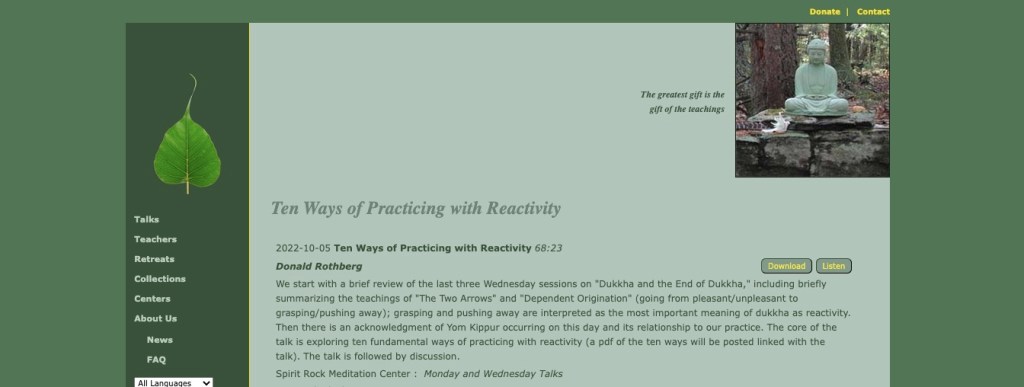
Here is a talk by Donald Rothberg called “Ten Ways of Practicing with Reactivity”, which helped me with something like an insight about a false belief I suffer from. He says that if a child’s parents get divorced, that child may believe it was their fault and because they don’t have the capacity to reframe this false belief, they may experience the cognitive distortion that any future relationship trouble is their fault. I can certainly vouch for this, and I hope I can remember this in future to prevent myself from berating myself endlessly when even the most minor disturbance occurs in my family of choice.

At that link you’ll be able to download a resource listing the ten ways of practising with reactivity, the first of which is to cultivate wisdom. Easier said than done, but Donald provides the teaching of the Two Arrows to help us get started. If someone hurts us, or if we hurt another, that is the First Arrow – if we then begin berating ourselves or ruminating on the hurt, that is the Second Arrow. If we lash out, that’s another Second Arrow, et cetera et cetera, ad nauseum. We may not be able to prevent another from hurting us, and we often are not able to refrain from acting with reactivity, but we can be skillful about how we respond after the fact.

Something we can do after the fact is cultivate the heart practices. I have been starting to do this more recently, and it really helps – if we flood our minds with compassion or forgiveness, there is less room for resentment and anger. I also use this emotional first-aid resource that I developed for myself and have shared here before.

Donald also encourages us to use relatively mundane instances of unpleasantness to practise becoming aware of reactivity. When something vaguely unpleasant happens, something manageable and not too triggering, stay with it. This way we’ll be able to start noticing when reactivity is happening and how it feels – it’s an easy-to-remember way of practising mindfulness throughout the day.

I found it interesting that he talks about reactivity in the context of dukkha, that classically unpleasant experience of suffering or dissatisfaction in the Buddhist conception of our deluded interface with reality – that first one in the Four Noble truths, that suffering exists. He says that reactivity generally manifests as either grasping or aversion, and it seems to hold water for me.

Reactivity is a thing I’ve been trying to understand and move away from, so having it placed in the context of the Four Noble truths helps me feel like the experience is held in a container I trust and have faith in. I understand that grasping and aversion cause suffering because they fuel the wish for reality to be other than it is, and now reactivity is just another way of describing an experience that falls in the attachment basket.

The above are just the bits of Donald’s talk that landed with me – check out the rest of the talk and the accompanying document if you’re interested in learning how to be less reactive and more responsive in life.

updated emotional first-aid worksheet [PDF]

Photo by Roger Brown on Pexels.com

I have updated the PDF worksheet for emotional first-aid that I first posted about here, which I have designed mostly for my own use but am sharing here because it might be helpful for others. You can download the worksheet directly here, and see the Resources page for other tools that can be used for emotional self-care and balance. I have added there some resources for cultivating emotional balance:

we can start developing our emotional vocabulary with reference to the Ekmans’ Atlas of Emotions, which is associated with the Cultivating Emotional Balance training that was commissioned by the Dalai Lama. Using the Atlas can help us to “map” an emotional episode so that when it happens again we are better able to navigate it.

I use the emotional first-aid worksheet to process emotional episodes in a healthy, supported and self-guided way, as a practice of self-soothing and -regulation. Here are the .odt and .docx files if you want to modify the worksheet for your personal use. It is an ever-evolving worksheet – I have never used it the same way twice, and as I learn more about emotional balance I am adding new ideas to the document.

In this version I have added a section for reflecting on whether the emotional experience was balanced or imbalanced, using a model I have learnt through the Cultivating Emotional Balance training program, according to which, emotional balance is:

  • the appropriate emotion,
  • felt with appropriate intensity
  • and appropriate expression,
  • at the appropriate moment.

To make an obvious example, it would not be emotionally balanced to laugh manically and start peeling potatoes at the scene of a horrendous car accident.

I have also elaborated on the RAIN meditation in the Self-care section of the worksheet. This meditation helps us to:

Recognise
the emotions we have experienced

Accept or Allow
that we have experienced them, rather than suppressing them

Investigate
the experience of these emotions, to see for example whether they have triggered cognitive distortions or whether they were balanced

Nurture
ourselves, because probably we are coming to RAIN because we have experienced some affliction and if so it’s time for some compassion and forgiveness

Tara Brach has a very good guided RAIN meditation that you can find on Insight Timer here. If you don’t have Insight Timer, here is a link to where you can download an mp3.

The worksheet guides you through asking, What sort of things did you think, feel and do before, during and after the emotional episode?

Then there are some prompts for self-care and emotional first-aid you can try, and some reflection questions about things like, What are you grateful to have learnt from this experience?

I’m proud of this resource because it has helped me a number of times already when I needed to change the narrative around some event that was emotionally distressing. The worksheet is inspired by the work of Guy Winch, which was my introduction to this practice.

.