I noticed upon waking this morning that I almost immediately began worrying, and I was able to bring myself back into the present of the body, which was a relief. It’s frustrating that my habitual tendency is to worry, because I know it just causes suffering, but I feel like it was a small win today to recognise that and make an effort to respond skilfully using some of the practices I have been taught.
Afterward I reflected on how the mind really does create (our interpretation of) reality and if we can become more aware of our habitual thought patterns and do the work of editing them, we can change (the way we perceive) reality, and by changing that perception we may as well have changed reality because the state of our perceptions determines our happiness and wellbeing more than the state of reality actually does.
This is my current understanding of what people mean when they say our thoughts create (our) reality: our perceptions are more real than reality itself. I understand this is something taught in Buddhism … “mind is the forerunner of all states” and “perceive all dharmas as dreams” … but I’m curious to know what the modern psychology and neuroscience says about this.
It could be the difference between happiness and suffering, because whether we are happy or suffering depends on our relationship with / interpretation of events, does it not?
So my affirmation today: remain mindful as much as possible, and know that awareness of thought patterns empowers me to choose how I feel; negative thought patterns do not have to be allowed their habitual free reign.
I am enough; I come back to the present through my senses whenever I remember, and by doing so I gradually become more and more aware of reality, more grounded in the present, less fixated on the past or the future.
There is an internal narrative telling me that I need to be doing more of one certain thing or another – more productive, more efficient, more materially secure, etc,
but this is not all there is, not the whole story. Mental training, emotional resilience, psychological integrity … these are things I need to prioritise as the foundational prerequisites of holistic wellness.
My affirmation today is that I remember non-attachment: by not grasping at my preferences in the illusion of reality, I liberate myself from the suffering of samsara and cyclical rebirth
My affirmation today is, again, I am enough. I am enjoying this theme and I think it’s worth reflecting on regularly. It can be expanded to include this is enough, and it makes me think now about gratitude. A quote we had on the wall for a while:
Gratitude turns what we have into enough.
That which is, is enough.
I got up early enough. There is enough time to do whatever needs to be done. I do enough of what I want. The weather is warm enough (this is easy today because the weather is perfect). I have enough energy to be productive enough today. I am enough without being productive.
The last few days have been “hijacked” by life, resulting in me not being able to do what I wanted to do, which was work on kHeart projects. Life has been this way a lot lately – enough to show me that there is something for me to be seeing.
What does that mean? What am I supposed to be seeing?
I am supposed to be seeing and looking at the reality that life doesn’t always go as we planned – in fact, it never does. We know the saying, “Life is what happens while you were busy making plans.” The future is never as we imagined it would be.
In the space between the present and the future, there is a line between getting our way and getting out of the way, between getting what we want and going with the flow.
I am beginning to see that the idea of attachment and non-attachment applies to time and events as much as it applies to material possessions.
I understand non-attachment in the material realm and am generally okay with not getting or having possessions. I am learning now that I have something to learn about accepting and adapting to situations where I don’t get what I want in terms of controlling the way I spend my time.
For most of my life I have been a loner, and I don’t mean that in a self-disparaging way: my upbringing lead to me being comfortable with being alone, and I was mostly happy with that. Sometimes I was lonely, but I adapted and came to enjoy having lots of time alone. I am mostly an introvert as well, so I need time alone to recharge. The “lone wolf” is a descriptor that applies better than “loner”: I have friends that I see now and then, but mostly I’m pretty self-contained.
I am seeing a narrative emerge here – a story I tell myself about myself – and I’m seeing that a guided journaling practice might help others to see where narratives are running the way they think about themselves.
I see it as a narrative because I see how I am telling you how I was or am. If it can be told, it is a narrative, and if it can be told one way it can be told another. It makes me think of the Taoist idea: if it can be named, it is not the Tao.
Meaning that if I can tell you about it, it is not the truth – if I can tell you about myself, I am not telling you about my true nature. Everything we tell about ourselves – every narrative we create to explain ourselves – is a fiction, a construct. It is not the truth, but a choice between various and myriad lies or fictions, illusions.
I’m getting obscure again, but this is ephemeral territory, the metaphysical and the esoteric. The exoteric is an example.
My son Zane has told me things about himself, like “I’m not the sort of person who … [insert character trait here] … likes to talk about his feelings … likes learning … likes slow movies.” When Zane has done this I have recognised that these are very much choices he is making about identity, not expressions of his true nature. These claims have been made over the last five years, between the ages of 9 and 14, a time of development when children begin realising they have an identity they need to understand. They are seeing that they are not just expressions of their parents, but individual entities and there seems to be an urgency to claim their own identity. When he has made these claims I have tried to say variations of “maybe that will change one day”, because I want for him to not become locked-in to one identity-choice or another. Imagine a person believing their whole life that they are not the sort of person who likes to talk about their feelings. (Like human beings can be sorted into this or that category like so many biscuits behind a barcode!) That would be a prison on the island of the illusion of independence – no man being an island and all that.
Something I don’t have to imagine is a person believing their whole life that they are happier when they are alone. I don’t have to imagine this because it is a belief I have been narrating to myself my whole life – because a bunch of people let me down early in life, and I decided I would be better of without them and they would be better off without me. Trouble is, “they” was a specific group of people back then, whereas now “they” applies to the whole amorphous group of people known as everyone other than me.
As an adult I choose to share my aloneness with a few select others who show that they care about me and are able to let me care about them, but because I was mistreated by a select few as a child – my brother, father and some kids at school – I must have told myself at some point that I am the sort of person who doesn’t need friends to be happy, that I am the sort of person who is happy to be alone.
After a slew of toxic relationships in my young adulthood (before I met Nikki) I had resigned myself to believing that I would be happier to be single my whole life than to continue from one toxic relationship to another. I had resigned myself to dying alone, using justifications such as “we are each alone at death anyway”.
I’m rambling a bit, but that’s okay because this has become an exercise in questioning the narratives that dictate my beliefs about my nature, true or otherwise.
I have been thinking, these last few days when I haven’t been able to get what I want, that I need to figure out how to get more solitude in my life(style).
That word “more” is a clue and a key. If we are saying we need more of this or that (more money, a job that is more fulfilling, more time, more time alone, more time alone doing this or that … it’s an endless list of more and more qualifications of what we want from what is) then we are not living from the awareness of enoughness.
Understanding this in relation to time is the challenge I am currently facing, which I choose to accept.
When I am frustrated that I am not getting the time I want, I see that attachment is at work and I remember that this is enough. That which is, is enough.
That is my affirmation today, should I choose to accept it.
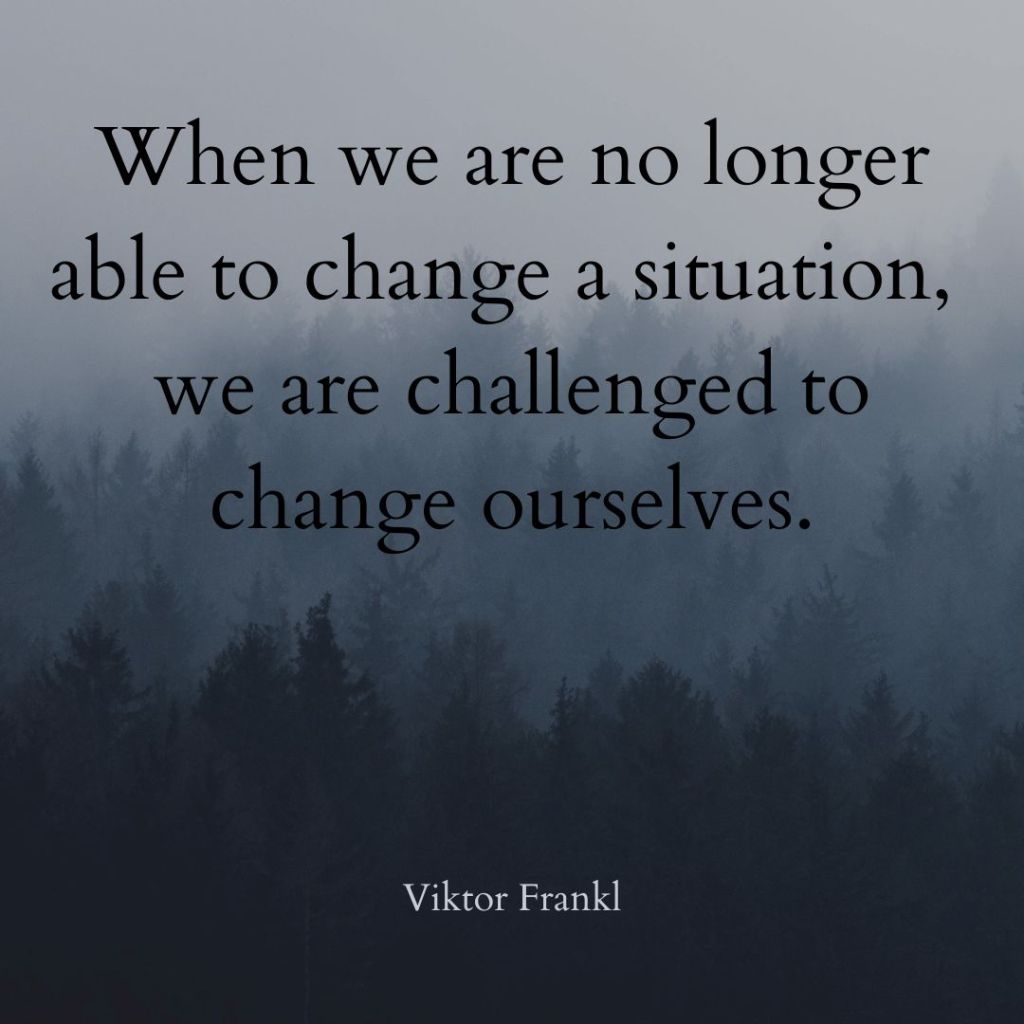
Frustration is a red flag that attachment is operating. I can try to make that which is different, or I can choose to adapt and feel grateful and allow whatever is to be. I can choose to get out of the way and allow my resistance to that which is to dissipate. And in this way I can allow a new narrative to write itself: I am equally happy when my time is spent alone or with people; if I cannot change the external conditions/situation dictating that I must spend more time with others than I am used to or would like, then I must accept only that which I can change, which is how I feel about the situation/condition. Remember Frankl:
When we are no longer able to change a situation, we are challenged to change ourselves.
That should be enough said, but we all know I like to get a bit long-winded.
It is enough to just be a kind and present observer in and of the world, a being that brings laughter and lightness and other authentic qualities to their experience and to that of those around them. Or to be a kind and present observer who is grouchy. We don’t need to add or subtract anything from ourselves to be worthy of joy, happiness and love.
This doesn’t mean that we don’t do. Just being is not enough.
Is that a paradox? I don’t think so.
It just means that from our place of being enough, everything else we do comes with ease, is additional, expectation free.
It means that whatever I do today it’s because I choose to add this to my already-enoughness. It also means that if something gets in the way of what I want it doesn’t matter because I am already enough without getting to the thing I wanted.
I allow myself to go gently back into the practice of discipline, structure, ritual. My self-expectations are realistic. I enjoy coming back to the world after an extended period of avoidance. I accept that I haven’t been coping, and I step back into responsiveness and responsibility, moving again toward thrival.
I move through my tasks and actions with awareness, relishing each moment I come back to the reality of now through my senses. I come back to my senses.
The world is benevolent, and we are put through trials by a loving energy that knows we are able to learn what we need for life to be more and more like a flow.
I relinquish attachment to what I like, and I allow aversion to move through me without causing stuckness.


 Kokoro 心 Heart